

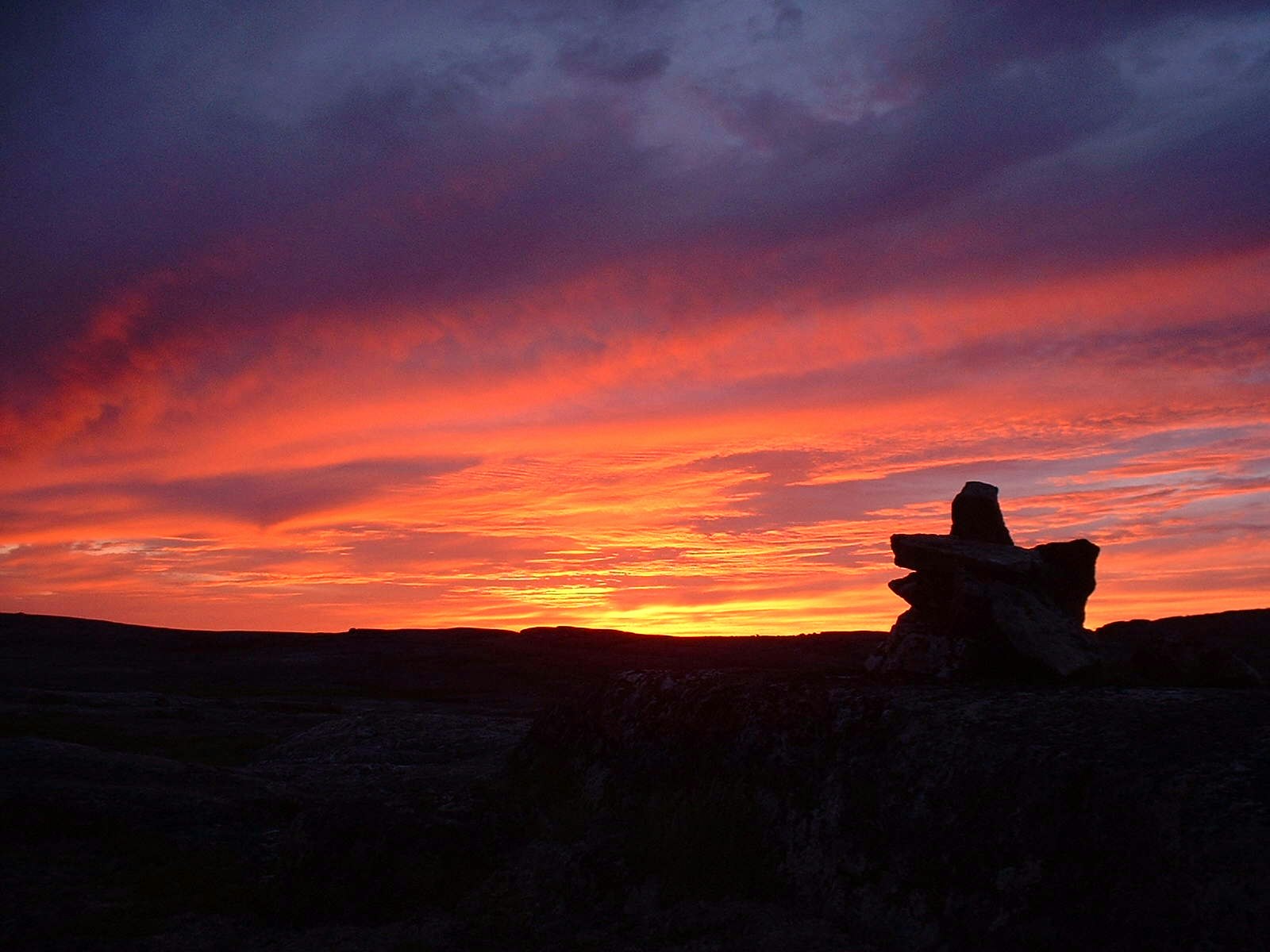
A low, weathered outcrop beside Hudson Bay holds a record that almost all the rest of Earth has erased. Rocks in the Nuvvuagittuq Greenstone Belt near Inukjuak, in northern Quebec’s Nunavik region, are at least 4.16 billion years old, according to two isotope clocks that independently placed them in the Hadean eon.
The finding does not mean every stone at the site formed on one date. The researchers dated younger rock that intruded into the belt, then used the visible crosscutting relationship to show that the surrounding host rock must be older. That geological logic turns 4.16 billion years into a minimum age and makes Nuvvuagittuq the only known surviving coherent rock record from Earth’s first eon.
The oldest intact rock is not the oldest piece of Earth
Geologists have found older terrestrial material, but not older intact rock. Zircon crystals from the Jack Hills of Western Australia formed about 4.4 billion years ago. These resilient minerals survived after their original parent rocks were destroyed, eroded and recycled into younger sediment. One such crystal, barely wider than a human hair, remains the oldest known piece of Earth.
Nuvvuagittuq offers a different kind of archive. Its ancient material remains a coherent, mappable rock body, so scientists can examine which units touch, cut or overlie one another. Before the new work, Canada’s Acasta Gneiss, about 4.03 billion years old, was generally regarded as the oldest undisputed intact rock. The Nuvvuagittuq result extends the preserved rock record more than 100 million years deeper into Earth’s childhood.
Here, “intact” does not mean pristine. The rocks have endured more than four billion years of heating, pressure, deformation and chemical change. It means their field relationships survive well enough to read as geology, rather than existing only as isolated mineral grains whose original rock has vanished.
Why Nuvvuagittuq’s age was disputed for years
The claim has a long history. In 2008, a team reported in Science that part of the belt could be about 4.28 billion years old. That estimate came from variations in neodymium-142, the daughter product of radioactive samarium-146, which existed when the solar system was young but has long since decayed away.
Other measurements pointed closer to 3.75 or 3.8 billion years. A study of zircon-bearing rocks and crosscutting relationships, for example, supported an Eoarchean rather than Hadean history for at least some events in the belt. Critics asked whether the oldest neodymium signal dated the rocks themselves or was chemical inheritance from an older mantle source.
That is a serious problem in deep-time geology. An isotope signature can survive melting or metamorphism and record the age of a source reservoir rather than the crystallization of the sample in hand. Nuvvuagittuq’s magnesium- and iron-rich rocks also contain few zircons, removing the mineral geochronologists most often use for precise uranium-lead dates. One old number could not close the case.
The breakthrough was dating a younger intrusion
In 2017, the researchers returned with a strategically different target. They collected metagabbroic intrusions that cut through the belt’s dominant Ujaraaluk unit. Magma had forced its way into pre-existing rock and solidified there, leaving a relationship that can be observed in the field.
The logic is simple and powerful: an intrusion is younger than the rock it penetrates. If the metagabbro is Hadean, the Ujaraaluk host must be older. Carleton University geochemist Hanika Rizo, a co-author of the work, gives a field-based account of that sampling strategy, while the University of Ottawa’s summary describes the site as roughly 30 kilometres from Inukjuak.
This distinction prevents an easy misreading of the headline. The team did not obtain one exact 4.16-billion-year crystallization age for the entire outcrop. It established that an intrusive event occurred in the Hadean. Because the enclosing sequence was already present when that happened, 4.16 billion years is a defensible lower bound for the older host rocks.
Two independent clocks converged in the Hadean
The decisive evidence came from two versions of the samarium-neodymium clock. The long-lived samarium-147 to neodymium-143 system yielded an age of 4.157 billion years, with an uncertainty of 174 million years. The extinct samarium-146 to neodymium-142 system yielded 4.196 billion years, with an uncertainty extending 53 million years older and 81 million years younger.
Those uncertainties are large by the standards of younger geology, but the two ranges overlap. More importantly, the clocks rely on isotopes with radically different half-lives. It is much harder to explain their convergence as the same inherited signal or the same later disturbance. The authors of the 2025 Science study called that agreement compelling evidence that the intrusions themselves are Hadean.
“At least 4.16 billion years” is therefore a concise statement of a layered argument. One clock centres on 4.157 billion years, a second centres on 4.196 billion, both indicate Hadean crystallization, and the dated rock is younger than the host it cuts. It is a minimum age grounded in both isotope chemistry and the physical order of events.
A surviving record, though not a pristine time capsule
Earth formed about 4.54 billion years ago. The Hadean spans the interval before roughly 4.0 billion years ago, when the planet’s first crust was repeatedly melted and reworked, impacts were common, and liquid water was beginning to shape surface environments. Plate tectonics and erosion have since destroyed or transformed nearly every rock from that time.
Nuvvuagittuq matters because a complete rock body preserves more context than a detached crystal. Its metamorphosed volcanic rocks and associated units may help researchers test how the first mafic crust formed, how quickly reservoirs inside Earth separated, and how early water interacted with crustal material. These are clues to the world in which the first oceans and potentially habitable environments emerged.
Context is what makes an outcrop more informative than a collection of old grains. The chemistry of several neighbouring units can reveal whether material erupted at the surface, cooled underground or was later exposed to seawater. Researchers can then compare those signals with the order preserved by contacts between rocks. Even after metamorphism has blurred the original scene, multiple lines of evidence can constrain a history that a single crystal cannot supply.
The outcrop should not be imagined as an unchanged patch of a Hadean shoreline. The rocks have been metamorphosed and deformed, and scientists must disentangle original chemistry from later overprinting. Nor does the new date by itself demonstrate that life existed there. Its value is more fundamental: it preserves geological relationships from a period otherwise represented mainly by durable zircons and indirect chemical traces.
The oldest archive also needs protection
The belt is not merely an abstract scientific site. It lies on Inuit-owned land near Inukjuak, and its growing fame has created a conservation problem. Local landholders have restricted sampling after rocks were removed without adequate control and parts of the outcrop were damaged. Reporting by the Associated Press described efforts to protect the finite formation while still allowing carefully managed research.
That stewardship is inseparable from the science. Every sample taken removes part of an archive that cannot regenerate, and modern isotope work can require surprisingly little material when collection is targeted. Future studies will need community permission, precise field documentation and methods that extract the most information from the smallest intervention.
The age debate may continue to sharpen as new samples and techniques arrive. But two clocks now agree on the crucial point, and the crosscutting rocks provide the ordering that earlier arguments lacked. On the Hudson Bay shore, a battered but coherent fragment of the Hadean has survived the tectonic recycling that erased almost everything around it.