

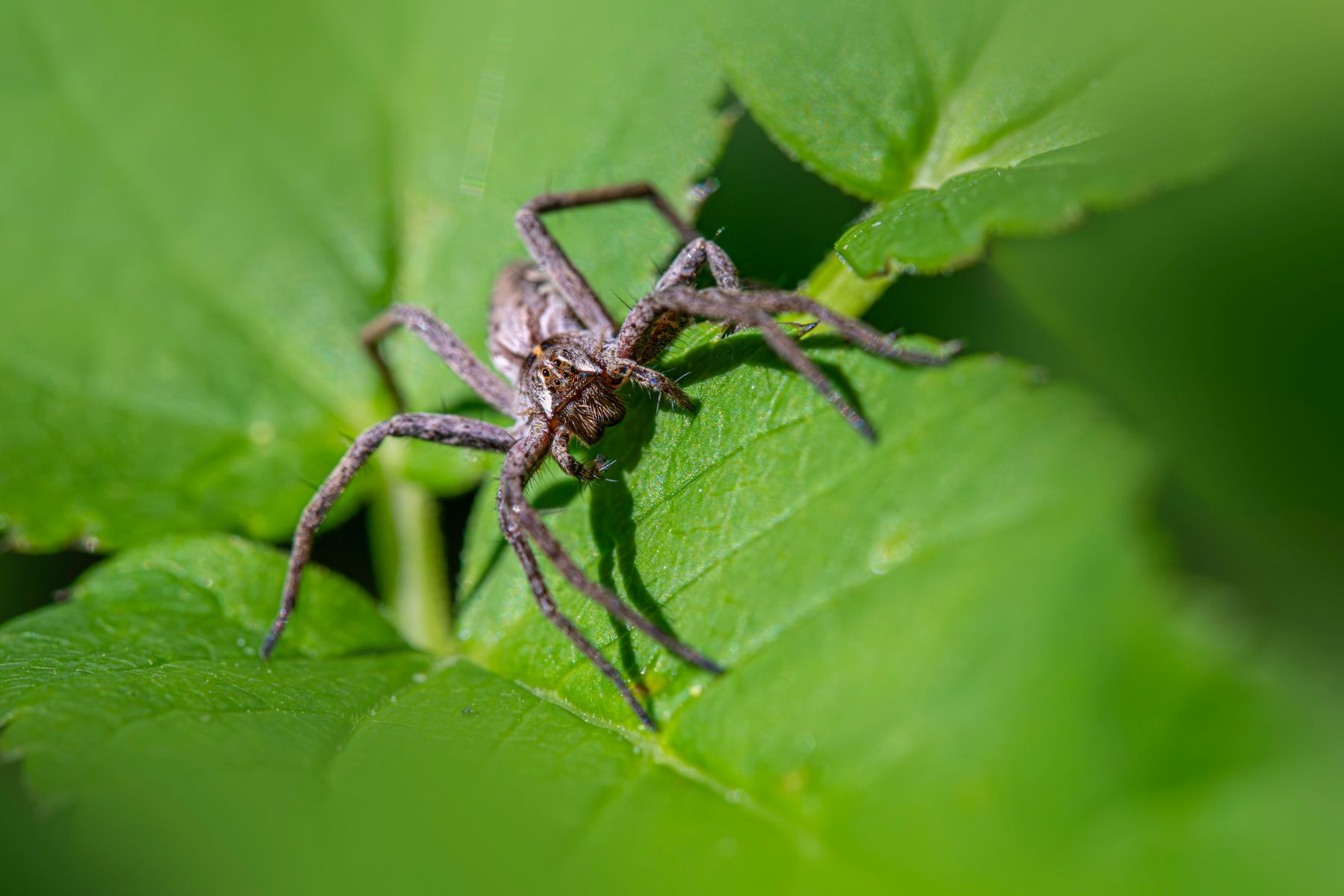
The air above a quiet field is electrically different from the ground beneath it. In fair weather, the electric potential typically rises by about 120 volts for every meter of height near a flat surface. That sounds dangerous only because voltage is easy to confuse with current. The fair-weather atmospheric current is extraordinarily small.
For a small spider standing on vegetation, however, the field can be useful information. A 2018 Current Biology experiment found that strong, naturally plausible electric fields increased behaviors that precede ballooning, when spiders release silk and let moving air carry them away. Fine hairs on their legs also moved in response to the field.
This is one study, not settled consensus. Its spiders were exposed to fields of 1.25 and 6.25 kilovolts per meter, much stronger than the roughly 120 V/m fair-weather field over flat ground but realistic near plants or in disturbed weather. Later work found that electricity assists takeoff while wind remains the stronger influence.
I think the headline is true with a boundary around it. Spiders can detect atmospheric-strength electric fields, and those fields can prompt the sequence that leads to flight. The evidence does not show that fair-weather electricity alone launches every ballooning spider.
The atmosphere is an electrical circuit
Earth’s surface is normally negative relative to the electrically conducting upper atmosphere. Thunderstorms and electrified clouds help maintain that global difference. Away from storms, ions in the air carry a minute current toward the ground.
Near a flat surface on a clear day, the atmospheric potential gradient is commonly around 120 volts per meter. Electric potential increases with height, producing a field directed downward. A person standing up spans a voltage difference, but the available current is too weak to resemble contact with an electrical outlet.
The field is persistent rather than fixed. Charged clouds, rain, fog, airborne particles, humidity and the time of day can change its strength. In unsettled weather, local fields can reach several kilovolts per meter and can sometimes reverse polarity.
That variation turns atmospheric electricity into potential weather information. An animal sensitive to the field does not need to understand voltage. It only needs a receptor that moves or changes activity when the local force changes.
Plants turn a background field into a stronger local signal
A fair-weather reading over level ground is not necessarily the field a spider experiences at the tip of a plant. Vegetation contains water and dissolved ions and is electrically connected to the ground. Narrow stems, leaf edges and branch tips distort the surrounding field, concentrating it around sharp projections.
The same geometric principle makes electric fields strongest around the pointed end of a conductor. A plant is not a metal lightning rod, but its shape and conductivity can still create substantial local enhancement.
The 2018 paper used finite-element models to estimate the effect. Under a background atmospheric gradient of one kilovolt per meter, the field about ten meters above the canopy of a 35-meter tree could exceed two kilovolts per meter. Near sharp leaves, needles and branches, the modeled values could reach tens of kilovolts per meter.
This matters because spiders often prepare to balloon from elevated points such as stems, leaves, fences and branches. The launch site provides clearance for silk and also places the animal in a locally intensified field.
Thirty-six spiders in an electrically isolated room
Erica Morley and Daniel Robert at the University of Bristol studied 36 adult sheet-web spiders in the genus Erigone, including 20 males and 16 females. The animals had been collected with balloon traps near the university’s veterinary school in 2016.
Each spider stood on a narrow vertical cardboard strip inside a transparent box measuring 0.9 meters on each side. Aluminum plates above and below the arena turned the box into a parallel-plate capacitor. The complete setup sat on an anti-vibration table inside an acoustically isolated Faraday-cage room.
The plates created fields of zero, 1.25 or 6.25 kilovolts per meter. Those two active treatments were chosen to represent values found in overcast, misty or stormy weather and around grounded vegetation. They were not meant to reproduce an ordinary 120 V/m flat-field day.
Every spider experienced all three treatments in randomized order, with one condition tested per day. After a five-minute settling period, the field was applied for two minutes. The researchers cleaned and electrically neutralized the launch strip between trials, then scored the videos without knowing which treatment was shown.
They counted two established signs of imminent aerial dispersal. In a tiptoe, a spider raises its abdomen and extrudes silk. A spider can also drop on a dragline and then release ballooning silk. Both behaviors became significantly more frequent when an electric field was present.
The clearest visual result came after takeoff. In the still chamber, turning the field on made an airborne spider rise; switching it off let the spider descend. That observation showed that electrostatic force could support motion under the experimental conditions.
The hairs moved differently for air and electricity
The behavioral trials showed that spiders responded to the field, but not how they detected it. Morley and Robert focused on trichobothria, long, fine mechanosensory hairs on spider legs. These hairs are already known to respond to tiny movements of air and to sound.
Using laser Doppler vibrometry, the team measured a trichobothrium on a front leg while exposing it to airflow and changing electric fields. Air moving at 0.5 meters per second pushed the hair aside for the duration of the flow.
The electrical response had a different shape. A sudden change in field produced the largest displacement at the transition. The hair then relaxed toward baseline over roughly 30 seconds even while the stimulus continued. Slowly oscillating fields also moved the hair.
Because positive-to-negative and negative-to-positive changes bent the hair in the same direction, the authors interpreted the motion as electrostatic induction. A control spine did not move above the instrument’s noise level, making whole-animal motion or stray airflow less likely explanations.
The distinction between the airflow and electrical responses is important. It suggests the same hair could carry separable information about wind and field changes rather than reporting both as one undifferentiated push.
There is still a gap between mechanical movement and sensory experience. The study did not record the neurons attached to the hairs, disable the hairs and show that detection vanished, or reconstruct the full pathway to behavior. Calling trichobothria electroreceptors is a well-supported proposal, not a finished map of the spider nervous system.
Silk can feel the force as well
Detecting the field is only half of the physics. Ballooning silk can acquire negative electrical charge. In Earth’s downward fair-weather field, a negative charge experiences an upward force. Like charges on neighboring strands also repel, helping explain why multiple fine threads can spread into a fan instead of tangling together.
A 2020 Physical Review E study measured nanocoulomb-scale charges associated with ballooning silk and recorded three launches inside a chamber designed to suppress air movement. The observed motion was consistent with electrostatic lift acting on charged strands.
That work did not establish one standard charge carried by every spider. Charge can vary with silk length, surface contact, humidity and other conditions. At the weaker fair-weather field, more charge or more silk is needed to supply the same lift than under the stronger fields used in a chamber.
Electricity can therefore play two distinct roles. Before launch, the field provides information through hairs on the spider’s legs. After silk is released, the same field can exert force on the charged threads.
Wind still matters most
It is tempting to retell the story as electricity replacing wind in the explanation of spider flight. I do not think the evidence justifies that switch. Ballooning is an interaction among animal behavior, silk, air movement and electrostatics.
A 2021 Journal of Arachnology experiment tested three linyphiid species with wind and electric fields. Strong fields elicited pre-dispersal behavior and, when combined with light wind, facilitated takeoff. Yet wind remained the most influential factor, and the authors described electricity’s role as supplementary.
A 2021 review of ballooning physics likewise treated aerodynamics and the atmospheric field as interacting explanations. Airflow can pull silk from the spinnerets, create drag and carry a spider horizontally. Electrostatic force can assist the initial lift, spread the threads and perhaps help a spider judge when conditions are favorable.
The relative contribution will not be constant. A tiny spider releasing many charged threads near a pointed plant in unsettled weather occupies a different physical situation from a larger spider launching over level ground in a weak field.
What it means for a spider to “decide”
A spider does not read a numerical weather gauge. Its sensory system receives airflow, vibration, humidity, temperature and electrical cues. Climbing to an exposed point, raising the abdomen, testing conditions and releasing silk together form a behavioral sequence.
In that context, “decide” is useful shorthand. The field can change the probability that the animal enters its pre-flight posture and commits silk to the air. It should not be mistaken for evidence that a spider consciously calculates voltage or predicts a storm.
The distinction also resolves an apparent contradiction in the numbers. The background field can be about 120 V/m on a calm, clear day, while the experiment used fields ten to fifty times stronger. A spider on vegetation does not necessarily experience the background value, and ballooning is not restricted to fair weather.
Even so, the experiment demonstrates sensitivity only across the range it tested. It does not by itself establish the minimum field an Erigone spider can perceive, or show that 120 V/m over an unobstructed flat surface is sufficient to trigger release.
An invisible part of the habitat
Ecology has traditionally foregrounded light, sound, chemicals, temperature and airflow. The atmospheric electric field is less obvious to human senses, but it is no less present. Terrestrial organisms have always lived inside it.
Other work has found that bees can detect flower-associated electric fields and that caterpillar sensory hairs respond to electrostatic cues from approaching predators. Those cases do not prove every arthropod has an electrical sense, but they make the spider result less isolated.
For a ballooning spider, a plant tip is simultaneously a physical launch tower and an electrical field concentrator. The hairs on its legs can sample both wind and voltage, while its silk becomes part sail and part charged lifting surface.
The familiar image of a spider waiting for a breeze is therefore incomplete. It may also be standing inside an electrical weather map, feeling the atmosphere move before its silk ever leaves the plant.