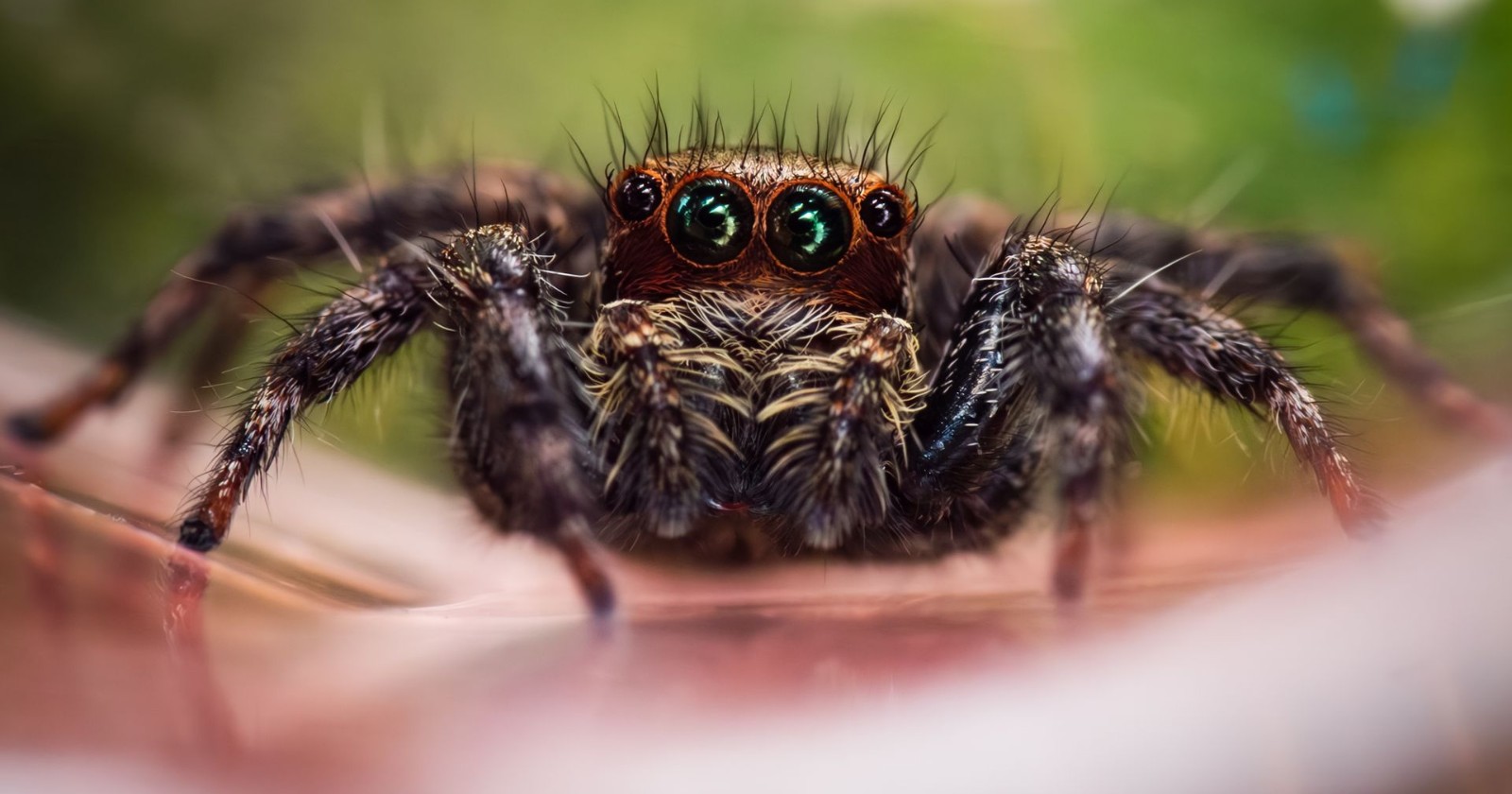
In 2020, ecologist Daniela Rößler was stuck at home during the COVID-19 pandemic and wanted some company. So she collected a few jumping spiders, put them in clear boxes, and lined them up on her windowsill.
One evening she looked over, and every spider was hanging upside down from a single thread of silk. Completely still.
“I had never seen this,” she told Science.
That evening started a six-year hunt for the answer to a simple question: do spiders sleep?
The twitching eyes
Her first clue came in 2022. Her team filmed newly hatched jumping spiderlings, which are so small and see-through that you can watch the inside of their heads. About every 17 minutes, the tubes behind their big eyes darted around for roughly 77 seconds. Their legs curled and their bodies twitched. It looked a lot like REM sleep.
But a twitchy eye is not proof of sleep. A commentary on that paper pointed out that nobody had run the usual tests. A sleeping animal lies still in a typical pose, is harder to wake, and makes up for sleep it loses.
Ten spiders, 80 eyes
The new study, published in PNAS, ran those tests on a different species, the Australian jumping spider Portia fimbriata. It grows to about 10 millimetres and hunts other spiders. Co-author Nadja Geiger calls her “famously clever” and says she sleeps upside down in a little web.
Science describes Geiger switching off the lab lights, ten spiders in front of her, each one with eight eyes staring back, before leaving the cameras to watch the night. Then came the slow part. The team had no brain recordings, only video, so it needed long recordings and huge amounts of footage to read the spiders’ behaviour.
Here is what the spiders did:
- They keep a clock. Activity dropped at nightfall, and the rhythm held without the usual light cues.
- They have two stages. A long quiet stage was broken by REM-like bouts, each about 83 seconds, with eye movements, twitching and leg curls. A spider had about 11 a night.
- They are harder to wake. After a loud sound, awake spiders reacted in about 1.7 seconds. Resting spiders took 2.7. Spiders in a REM-like bout took 4.3, and in four of the 10 tests in the open data, they did not react at all.
The night of the flies
To see if they would make up for lost sleep, the team put 25 live fruit flies into each spider’s enclosure for one night. The flies buzzed around, and the spiders sometimes tried to shake them off.
The spiders then slept about 70 minutes longer over the next 24 hours, from 13.6 to 14.8 hours. Their REM-like time rose from about 9.4 to 16.9 minutes, almost 80% more. They did it through more REM-like bouts, not longer ones. In total, 11 of the 13 spiders spent more time in the REM-like state.
The data the team posted online shows how that extra time split between day and night. Most of the extra sleep came by day, about 43 minutes, as if the spiders had a lie-in. Most of the extra REM-like time came the next night, about six of the 7.5 extra minutes.
Not the first to catch up
Lots of animals catch up on lost sleep, including fruit flies, jellyfish with no brain, and octopuses. Now we can add a jumping spider. After one bad night, it spent 80% more time in its REM-like sleep.
That makes it harder to argue that REM-like sleep needs a big brain. Nobody has counted a Portia brain, but estimates are below a million neurons. A human brain has roughly 85 billion. Columbia neuroethologist Alex Winsor, who was not part of the study, says the old view treated invertebrates as “little robots.”
How it compares with us
Adults spend 20% to 25% of the night in REM sleep. A rough sum from the paper’s numbers puts the spider at about 15 minutes of REM-like sleep (11 bouts of 83 seconds) in a night of nearly 11 hours, around 2%. That is only a rough guide, because spider REM-like sleep is judged from behaviour and ours from brain waves.
The human story started with a father and a son. In 1951, Eugene Aserinsky attached electrodes to his eight-year-old son and watched the pen jerk as the boy’s eyes moved under his lids. William Dement then showed in 1960 that people kept from dreaming made up for it later.
What we still don’t know
This was a small study. Thirteen spiders gave usable data on the flies, they came from one captive-bred stock, and the team disrupted their sleep for one night rather than depriving them of it. They also did not record brain activity, so the REM-like label rests on behaviour alone. Some spiders did not follow the trend, as two of the 13 had less REM-like time afterward.
The bigger question is the one Rößler cannot answer yet: are they dreaming? Even the definition of a dream is hard to pin down, but she wants to try. “That’s the dream,” she says.
Rößler spent a pandemic watching spiders on a windowsill and noticed they were doing something strange. Six years later, we know that spiders really do go to sleep.