If you ask me, time is the strangest thing we all agreed on. For some reason, somehow, sometime long ago, we decided it runs in a line: past behind us, future ahead, one day after another at the same speed. We accepted that as a fact. But there’s no way we could actually know that’s the truth.
We just checked the calendar and moved on.
Then the pandemic came, and for a while the calendar stopped working. The world shut its doors. Days lost their names: Tuesday looked exactly like Sunday, and spring slid into summer behind the same window. A month could pass like a week, and a week could drag on like a month.
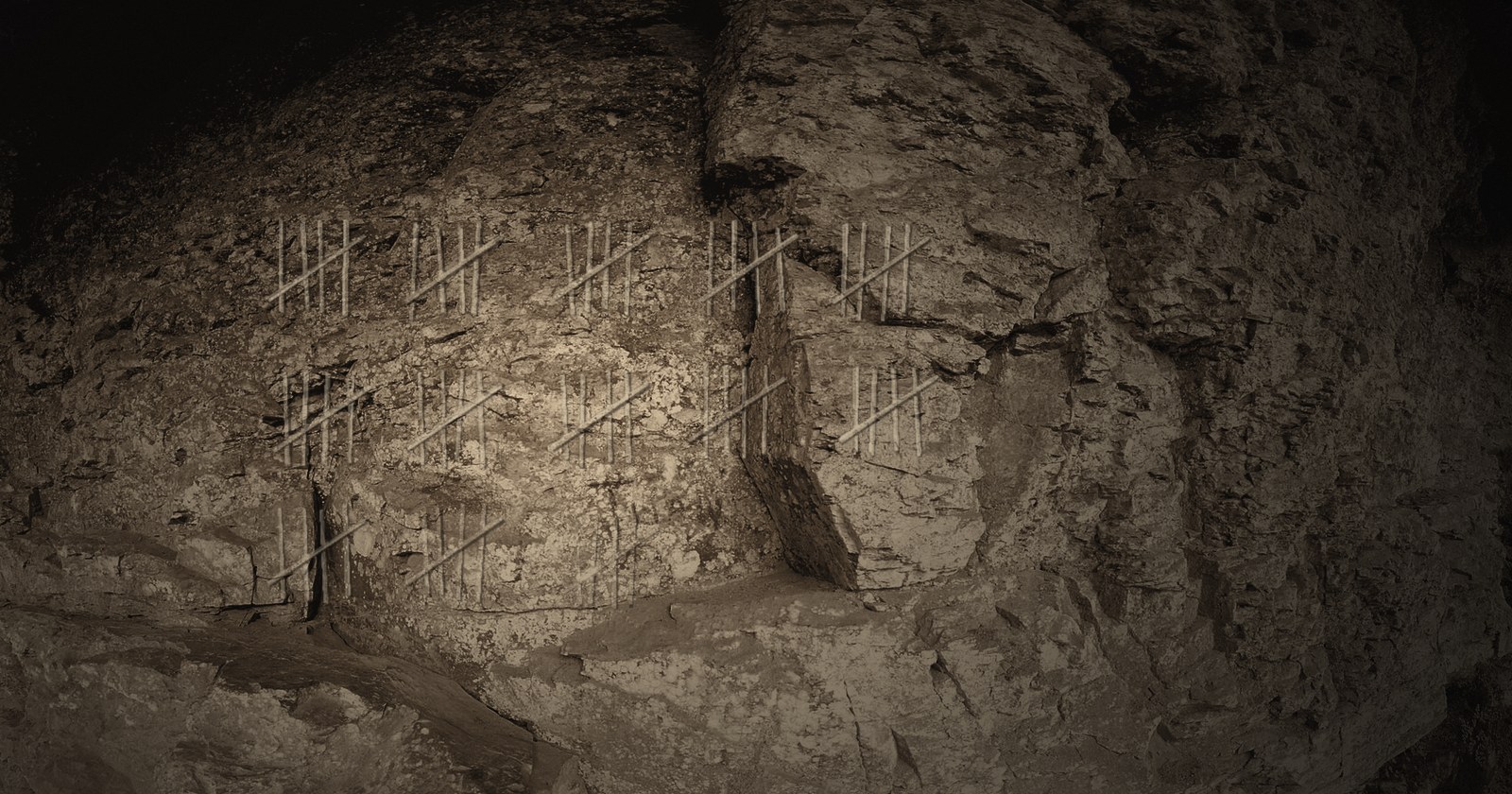
Now imagine that alone, 230 feet underground, with no daylight at all, for 500 days.
Day 65 was the last day she counted
That’s what Beatriz Flamini, a Spanish mountaineer and climber, did. On 21 November 2021 she went down into a cave about 70 meters (230 feet) deep near Motril, in Spain’s Granada province, and she came back up on 14 April 2023, as Ideal, the Granada newspaper, reported from the cave exit.
No clock, no news, and, for nearly all of it, no contact with anyone.
“On day 65 I stopped counting and lost perception of time,” she told reporters afterwards. When the team came down to bring her out, she was asleep. “I thought something had happened. I said: ‘Already? Surely not.’ I hadn’t finished my book.”
How long did it feel?
Between 160 and 170 days, she guessed, according to the BBC. The real number was about three times that. (To be exact, NPR counted 509 days, eight of them spent in a tent after a technical problem.)
It started early. According to The New Yorker, which watched some of her video diaries, on what she thought was day 19 she had actually been underground for nearly twice as long.
I’ll admit, my first reaction was simple: how? How do you lose more than 300 days?
So I asked someone who studies exactly this.
Why 500 days can shrink to 160
Marc Wittmann is a researcher at the Institute for Frontier Areas of Psychology and Mental Health in Freiburg, and he has spent years studying how we experience time. I asked him why a long stretch with very few events seems to shrink so much when we look back on it.
Retrospective time, he told me, “depends upon memory load.” In other words, the more we have experienced and kept in memory, the longer a stretch of time feels afterwards. “The more novel and emotionally exciting events we experience, the longer a certain interval feels.”
So when you look back, your brain goes by what’s stored. And a cave gives you very little to store: the same rock, the same darkness, the same routine. Fewer memories, shorter past. Maybe that’s also why the lockdown months are so hard to tell apart now. We went through lockdown more than once, and those months were so alike that I can’t tell you what happened when. Usually I have a good memory for my own life. My pandemic memories, though, are all blended together. Not in a bad way, just blended.
The memory link shows up in the lab too. In a 2023 study from Sapienza University in Rome, researchers tested 63 people, from healthy volunteers to patients at different stages of memory loss up to Alzheimer’s disease. After a test session, they asked everyone how long it had lasted. “All groups, including individuals with SCD, showed higher errors than controls in retrospective duration estimation,” the authors write. SCD is subjective cognitive decline, when people notice their memory slipping before standard tests do. When memory weakens, the sense of how long something lasted goes with it.
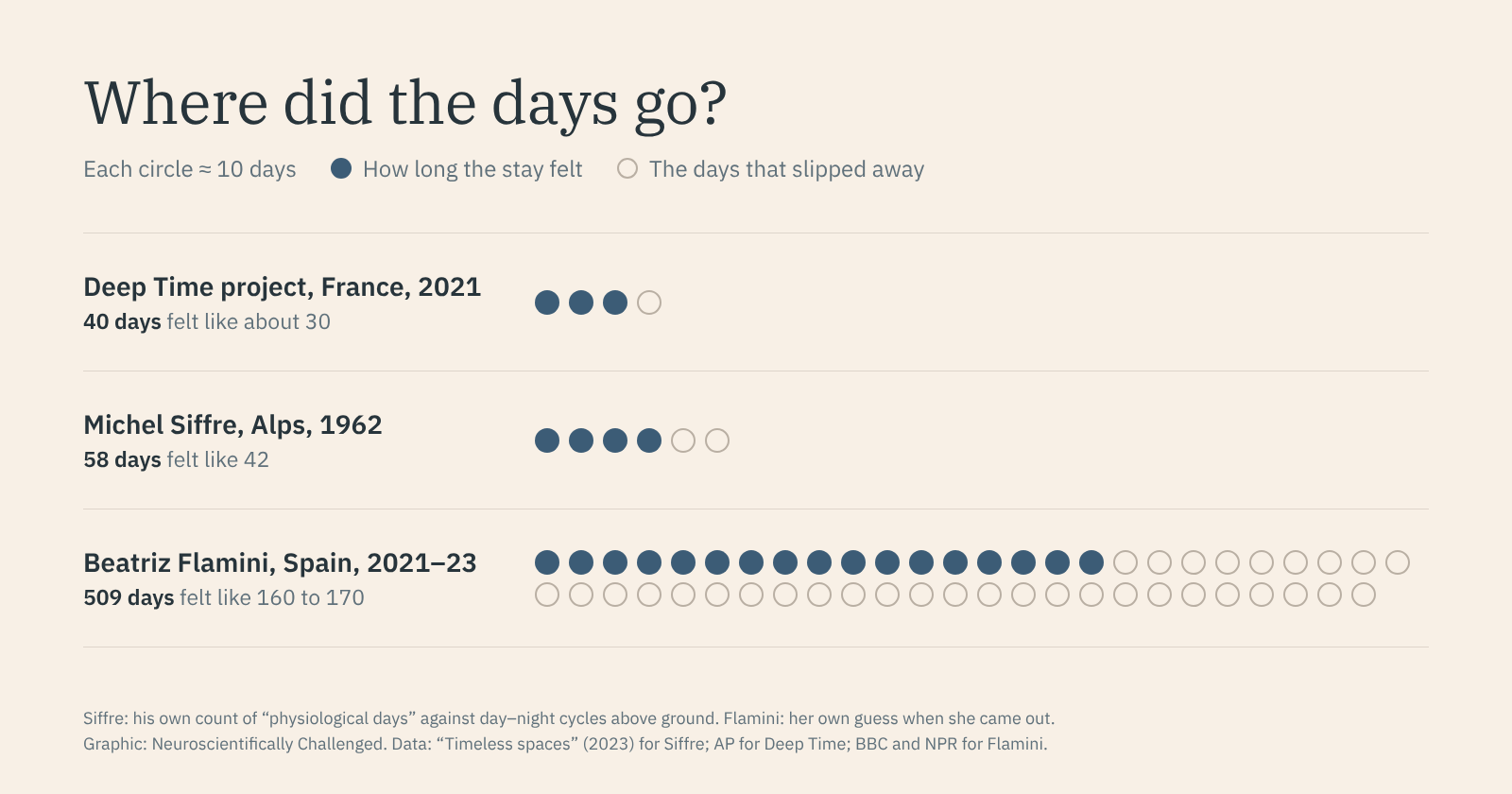
Flamini isn’t the first person to lose time like this. In 1962, the French caver Michel Siffre spent about two months in Scarasson cave in the Alps and counted 42 “physiological days” while 58 day-night cycles passed above ground, according to a history of these cave experiments. And in 2021, after 15 people spent 40 days in Lombrives cave in France for a project called Deep Time, their leader Christian Clot said that for most of them, “in our heads, we had walked into the cave 30 days ago.” In all three stays, people came out believing less time had passed than really had.
That’s not a coincidence. Virginie van Wassenhove, a cognitive neuroscientist at NeuroSpin, part of France’s CEA, reviewed decades of cave and isolation studies in 2022. “Underestimating the number of days spent in total isolation appears to be the rule rather than the exception,” she told me. “It is quite surprising.”
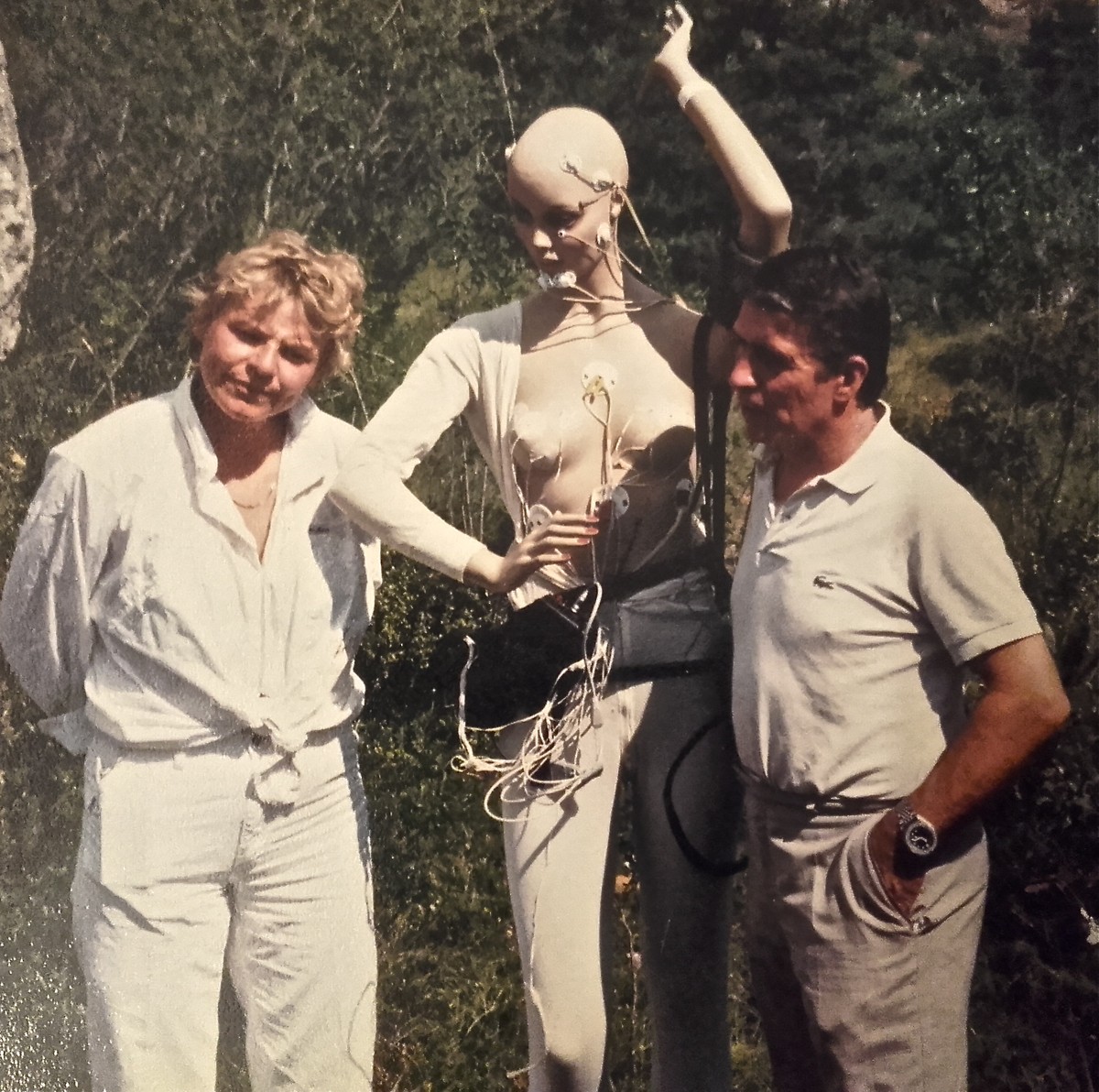
“I wanted to investigate time – that most inapprehensible and irreversible thing.” – Michel Siffre, 1965
Your body runs on a slightly longer day
The second answer is something I hadn’t thought about at all until Wittmann pointed it out.
“There is one more thing, however,” he told me, “because the internal (free running) circadian rhythm is in most people a bit longer than 24 hours, when this circadian rhythm is not synchronized with the sun (making it exactly to 24 hours), across many days internal days are a bit fewer than actual days.”
Your body has its own clock, a tiny cluster of cells in the brain that keeps the daily rhythm of sleep, hormones and body temperature. Daylight resets it every morning. Take the daylight away and it keeps running on its own, a little slow. In one careful study from 1999, that inner day averaged 24.18 hours.
Of course, I had to do the maths.
At 24.18 hours, her 509 real days would add up to about 505 inner days. That’s only four days lost. In real cave stays, sleep can drift much further than that: as the cave history puts it, Siffre’s body began to “free run”, sleeping later and later and “eventually losing entire days.” Still, the body clock can’t take you from 509 to 160 on its own.
The researchers also planned to watch her body clock directly. According to The New Yorker, they gave her a bracelet that tracked her circadian rhythms by measuring her distal body temperature.
Most likely, memory does the rest.
The tests that were never analysed
The stay was Flamini’s own project: a record attempt, which she filmed on GoPros for a documentary by the Spanish production company Dokumalia, The New Yorker reported. Researchers from the universities of Granada and Almería followed it too. One of them was Julio Santiago, a professor of experimental psychology at the University of Granada who studies how people picture time as a line running through space. His team prepared computer tests for her to do again and again, during the stay and afterwards, to see how isolation and losing track of days affect the sense of short spans of time, from seconds to minutes, Ideal reported.
Santiago, who planned to look at changes in her sense of time and space, told D. T. Max of The New Yorker, “You don’t very often find someone who wants to be isolated and disoriented like this.”
That’s a different question from counting days. You can lose track of the month and still know how long a minute is. You can forget what day it is and still feel exactly when the kettle is about to boil.
Her tests could have answered that.
María Dolores Roldán Tapia, who studies neuropsychology at the University of Almería, told me that she and her colleague Adrián Rueda had prepared an extensive set of tasks for Flamini, covering working memory, time perception, attention and more. None of it has been published.
She pointed me to a different case: a person who spent well over a year in a cave, but with contact with the outside world and a dog for company. “Based on the records from that previous case, we know that there were impairments in working memory, attentional processes, and long-term memory,” she told me. How soon that starts in total darkness is still an open question. “I am not certain what the minimum duration is before cognitive issues begin to arise under conditions of total darkness.”
Three years later, I couldn’t find any published results from those tests, so I wrote to the team to ask what they found.
Santiago told me the cave data still haven’t been analysed. The team couldn’t collect the final tests after she came back, he said, and “the whole thing came to a halt and there it remains.”
Still, don’t forget that this is one woman’s story. Her 160 to 170 days was a guess she made the moment she came out, from memory. Someone else in the same cave might have said 300, or 100. The cave stays before hers were small too, so nobody can say yet how much of the gap was memory and how much was the body clock.
Flamini put it better than I can. “In the cave, the line of time disappears, and everything floats around you,” she told The New Yorker. Looking back, she said the time had passed quickly: “For me, it was just a moment—a single night.”
But it does make me look at that straight line differently.
If 500 days can fold into 160 just because nothing new happened, then maybe time isn’t a line we walk along so much as something we build afterwards, out of whatever we kept. And the quiet months, the ones where nothing seemed to happen, might be the ones that slip away without a trace.
We lived every one of those days. We just can’t find them anymore.