

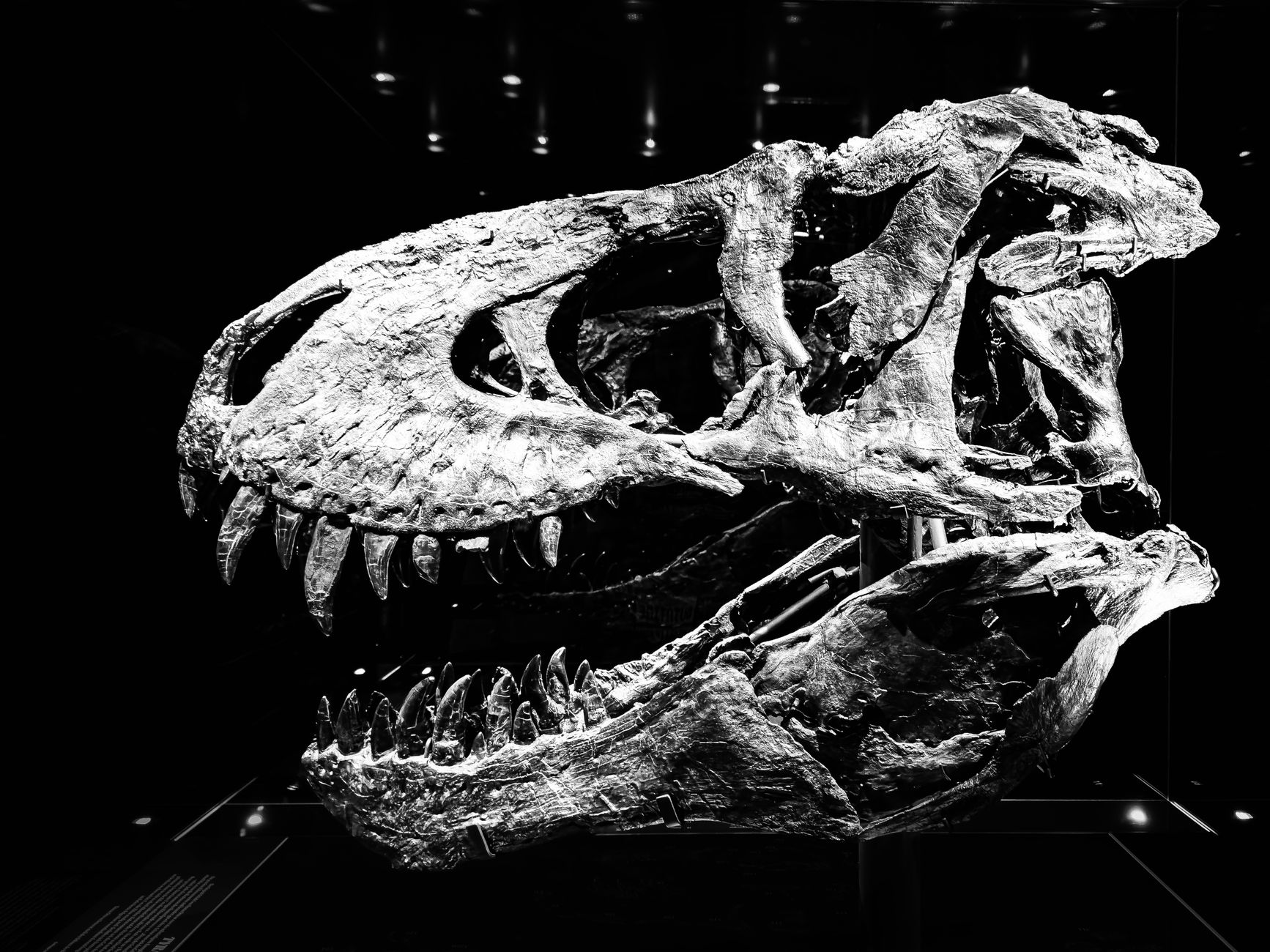
Three fossil teeth from two Tyrannosaurus rex individuals have yielded an estimated average body temperature of 36.3 degrees Celsius. The uncertainty is plus or minus 2.5 degrees at one standard error, and the value comes from 13 chemical measurements of tooth enamel, not from a literal thermometer reading.
Randon J. Flores and colleagues report the result in a peer-reviewed Science Advances paper. Its central estimate sits close to the 36.64-degree mean oral temperature in a large 2023 human study, though human temperature varies. The resemblance does not make a person and a tyrannosaur physiologically equivalent.
This is one study, not settled consensus.
What the paper establishes most directly is that the sampled enamel formed at a temperature above the reconstructed Hell Creek environment. That supports the case for internal heat production in T. rex, but it does not turn one number into a complete account of the dinosaur’s metabolism, speed or behavior.
The average came from three teeth and two animals
All three teeth came from the Late Cretaceous Hell Creek Formation in Montana. Two belonged to LACM 150167, the young-adult specimen nicknamed “Thomas,” which the paper says probably exceeded 3,000 kilograms in life. A partial tooth cataloged as LACM 151468 represented the second animal.
The two Thomas teeth produced estimates of 37.3 plus or minus 3.3 degrees Celsius and 35.9 plus or minus 2.8 degrees. The third tooth yielded 34.7 plus or minus 2.5 degrees. Pooled across all 13 laboratory analyses, the three-tooth mean was 36.3 plus or minus 2.5 degrees.
Thirteen measurements are not thirteen dinosaurs.
Nor is the uncertainty a firm species-wide range. It is one standard error around a mean from a very small biological sample. Enamel mineralizes during a limited interval, so the chemistry is not a continuous lifetime average. Because the researchers sampled only where damage could be limited, they cannot exclude seasonal bias.
How enamel chemistry becomes a thermometer
The technique is carbonate clumped-isotope thermometry. Rare isotopes called carbon-13 and oxygen-18 are more likely to occur together, or “clump,” in carbonate that forms at lower temperatures. As formation temperature rises, that statistical preference weakens in a predictable way.
Flores and colleagues drilled the enamel and reacted pretreated portions of about five milligrams with phosphoric acid, releasing carbon dioxide. A mass spectrometer counted several molecular forms of that gas, and a calibration converted their relative abundance into a temperature estimate.
The headline’s “chemical bonds” is therefore useful shorthand. The instrument did not inspect an intact bond or find fossilized blood. It measured the distribution of rare isotopes in gas released from bioapatite carbonate and inferred the temperature at which that enamel mineralized.
Enamel’s large crystals resist chemical exchange better than bone and dentine. The method also has a history. A 2011 clumped-isotope study reported 36 to 38 degrees Celsius in Jurassic sauropods. Fossil-tooth isotopes have likewise informed ScienceBlog’s coverage of elevated body temperature in megalodon. The advance here is a numerical estimate for T. rex from a few milligrams of museum material.
The crocodilian control is strong but not perfect
To test whether burial chemistry had overwritten the biological signal, the team measured five roughly coeval crocodilian teeth from a different Hell Creek locality in Montana. Their pooled estimate was 30.9 plus or minus 2.6 degrees Celsius, significantly below the tyrannosaur value. One crocodilian tooth did yield 38.2 degrees, so the defensible comparison is between group averages, not every individual tooth.
If burial had driven all the fossils toward one temperature signal, the groups should have looked more alike. Other checks agreed: enamel and alteration-prone dentine retained different isotope compositions, infrared spectra resembled well-preserved enamel, and carbonate content fell near modern reptile values.
The authors describe this as finding “no clear signs” of alteration. That is more careful than claiming the fossils are chemically untouched.
Environmental comparisons widen the gap. Hell Creek bivalves, probably recording warm-season water, averaged 25.9 plus or minus 1.2 degrees. The climate simulations put mean annual regional air temperature between 17.8 and 20.7 degrees. Even the warmer simulation’s maximum monthly value was 33.4 degrees.
A warm animal is not a metabolic diagnosis
A high, relatively stable body temperature is consistent with endothermy, the generation of substantial heat inside the body. It is not unique to that mechanism. Large bodies cool slowly because their heat-holding volume increases faster than their heat-losing surface area, a phenomenon called inertial homeothermy.
That distinction matters.
The paper cautions that body temperature is not an unambiguous indicator of metabolic rate. The result supports endothermy, but cannot divide the measured warmth between metabolism and size. Living reptiles also resist a neat binary, as ScienceBlog noted in its report on seasonal heat production in tegu lizards.
The number cannot establish that T. rex ran fast or actively chased every meal. Locomotion, feeding behavior and daily activity require separate evidence. The university release makes some of those behavioral connections more confidently than the paper’s own limitations allow.
The next test needs more dinosaurs, not more repeats
The team also placed the temperature estimate into Late Cretaceous climate models. In that model, much of North America, including colder high latitudes, could have been thermally accessible to T. rex. This is a downstream habitat projection. It is not direct evidence that the two Montana animals ranged across the continent.
Analytical replication strengthened the three tooth estimates, and the paper’s data and code are public. Biological replication remains the gap. Teeth from more individuals, ages, latitudes and crown positions could test variation with season, growth and body size.
Age is especially useful because T. rex changed enormously as it matured. ScienceBlog recently covered evidence that the species may not have reached its peak size until about age 40. Comparing juveniles with full-sized adults could help separate internal heat production from the thermal inertia of a giant body.
Until those fossils are measured, 36.3 degrees is best read as a carefully reconstructed mean for two animals from one Montana site, and as a method ready for a much larger test.