

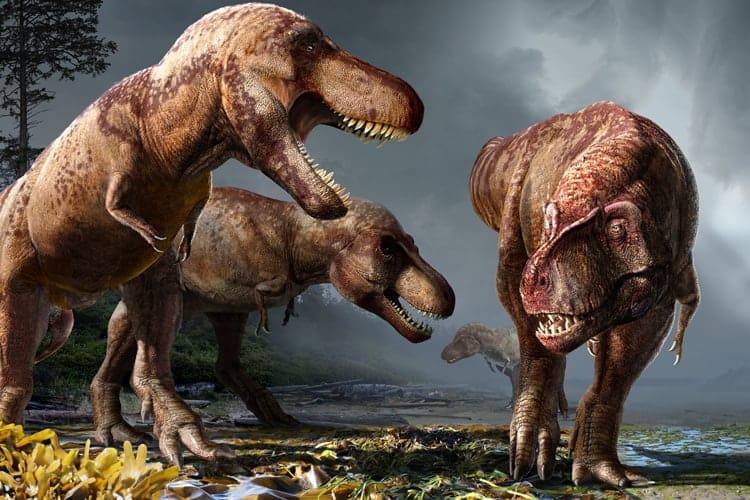
Tyrannosaurus rex took four decades to finish growing. That’s 15 years longer than paleontologists thought and this changes how we picture the most famous predator that ever lived.
The new timeline comes from bone analysis of 17 T. rex specimens, the largest dataset ever assembled for the species. Researchers at Oklahoma State University and Intellectual Ventures examined fossilized leg bones and counted growth rings, similar to dating a tree. They also used circularly polarized light to reveal rings that standard microscopy misses entirely.
Those hidden marks showed that earlier age estimates were consistently wrong. Previous models capped T. rex maturity at around 25 years. This was based on incomplete ring counts. Older animals had remodeled their bones over time, erasing early growth layers and leaving only the final 10 to 20 years visible.
Bone grows in bursts, then crawls
During active growth periods, T. rex could add 25 to 100 microns of bone per day. As the animal aged, that rate dropped below 10 microns daily in the largest adults. The slowdown marks the approach to asymptotic size, roughly eight tons for a fully grown individual.
“This is the largest data set ever assembled for Tyrannosaurus rex. Examining the growth rings preserved in the fossilized bones allowed us to reconstruct the animals’ year-by-year growth histories,” Holly Woodward explains.
The team put together partial records from different individuals to build a composite growth curve. Think of overlapping chapters from incomplete biographies. The result suggests T. rex spent decades in a prolonged adolescence, growing steadily rather than racing to adulthood.
That slower growth likely had ecological consequences. Younger tyrannosaurs weren’t just smaller versions of adults. They occupied different roles, hunted different prey, and avoided competing with their elders. Multiple age classes could coexist without interfering with each other.
Jane and Petey don’t fit
Two famous specimens threw the data off. Fossils known as Jane and Petey showed growth patterns that differed significantly from other T. rexes in the study. They grew much more slowly than their peers.
This mismatch fuels the Nanotyrannus debate—whether smaller tyrannosaur fossils represent a separate “pygmy” species or just young T. rexes. Growth data alone can’t resolve it, but Jane and Petey’s outlier status suggests the Late Cretaceous landscape was more crowded than we thought. It might indicate a species complex or extreme environmental stress. The data doesn’t clarify it.
Beyond Tyrannosaurus, the findings suggest that standard bone-reading protocols may be missing closely packed growth marks across dinosaur paleontology. Age estimates for other species might need to be revisited. A century after its discovery, the king of dinosaurs is still teaching us how to read bones.
DOI: 10.7717/peerj.20469