

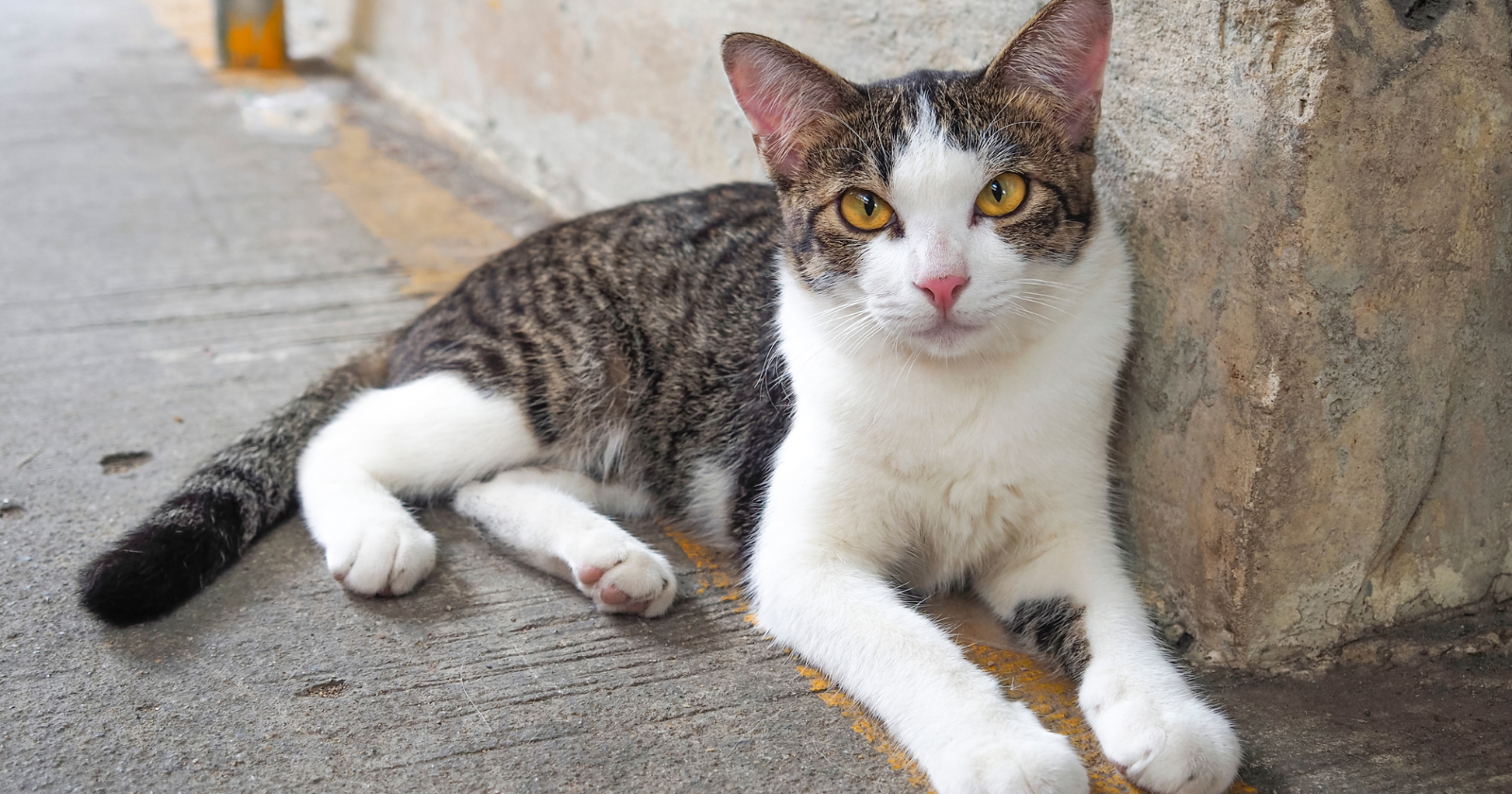
Strap a GPS unit to a house cat and you expect a road movie. What you get is a sitcom, filmed on one street, with the same four gardens as the set.
That is roughly what happened when researchers talked 925 cat owners into fitting their pets with trackers. The project was led by Roland Kays of North Carolina State University, and the results were published in Animal Conservation in 2020. Six countries took part, with most of the cats living in the United States, the United Kingdom, Australia and New Zealand.
Average home range: 3.6 hectares. Most animals stayed within about 100 metres of their own back door. Only three in the whole sample ranged beyond a square kilometre, and larger predators such as coyotes made no measurable difference to how far any of them wandered.
Cats are homebodies with a hobby.
Three and a half kills a month
Alongside the tracking data, owners logged what their cats dragged in. The average came to 3.5 prey items a month, or about 42 a year, which sounds almost civilised. One lizard a week, give or take, and a great deal of sleeping.
That figure is a floor rather than a total, because plenty of kills never make the journey. Kays and his co-authors scaled the owner counts up accordingly, using a multiplier of 1.2 to 3.3 borrowed from earlier predation research. Corrected, the typical tracked cat was killing somewhere between 50 and 139 animals a year.
Divide that by the ground each cat actually covers and the rate comes out at 14.2 to 38.9 prey animals per hectare per year.
Three-quarters of the tracked cats spent at least ninety per cent of their time in disturbed habitat: housing estates, verges, car parks, gardens.
That is exactly where people live, and exactly where the birdsong is meant to be.
Why a small patch makes it worse
Wild carnivores of comparable size roam over ground 11 to 1250 times larger than a house cat’s patch. Same appetite, spread thin.
Per animal, that puts the average pet roughly level with a wild predator. The keen hunters in the sample killed 2.3 to 4.8 times more prey per hectare. Density stacks the effect. Because cats are fed, neighbourhoods can hold 32 to 36 of them per square kilometre, about twice the ceiling for a five-kilogram wild carnivore living on what it catches. Speaking to NC State’s news office, Kays put the combined result at two to ten times the impact of a native predator.
Caveats belong here. This is a single study, and its prey figures rest on owner recall plus a borrowed multiplier, so the kill rates are an estimate with wide arms. The movement data is firmer, having come off hardware.
The kills nobody counts
How do you count something that happens out of sight? The doormat is the usual evidence, which assumes cats file complete returns.
Kerrie Anne Loyd and colleagues at the University of Georgia tested that assumption by fitting cameras to 55 free-roaming pets in suburban Athens. Each cat wore one for seven to ten days across a study year, yielding about 38 hours of footage apiece. Writing in Biological Conservation, the team reported that 23 per cent of kills were carried home. Nearly half were left where they died. The rest were eaten on the spot. That gap is where correction factors like the one above come from.
Scale that habit up and the totals get uncomfortable. A systematic review by Scott Loss, Tom Will and Peter Marra, published in Nature Communications, estimated that free-ranging cats in the United States kill 1.3 to 4.0 billion birds and 6.3 to 22.3 billion mammals a year. Unowned cats do most of that. Pets are the minority partner in the enterprise, which is cold comfort for the wren in the hedge.
What actually brings the number down
“Owners can change what the cats themselves want to do,” Robbie McDonald told the University of Exeter when his team published its results.
McDonald and his colleagues had run a twelve-week trial with 219 households and 355 cats, testing ways to reduce hunting without locking anyone indoors. As Martina Cecchetti and colleagues reported in Current Biology, switching cats to a grain-free food in which meat was the main protein source cut the number of animals brought home by 36 per cent. Five to ten minutes of daily play with a toy cut it by 25 per cent.
Bells did nothing measurable. Colourful collar covers reduced bird captures by 42 per cent but left the mammals alone. Puzzle feeders, intended to occupy the cat, sent the kill count up by a third, possibly because a cat that cannot work out its dinner bowl goes looking elsewhere.
The two interventions that worked share a logic. Neither one stops a cat hunting. Both reduce the urge to bother.
Owners noticed. Of the households assigned to daily play, 76 per cent said they intended to keep it up once the trial ended, beating anything that involved a collar.
A problem the size of a back garden
Conservation arguments usually run aground on scale. Habitat loss, climate, land clearing: all of it sits with governments and timelines measured in decades, leaving the householder with a tote bag and a vague sense of guilt.
This one is different in a way that is almost embarrassing. A pet cat’s entire ecological footprint fits inside a radius most people could walk in ninety seconds. The skinks, the field mice, the fledglings that never make it out of the nesting season: they live on the same block as the animal doing the killing, and often on the same lawn.
So the fix is boring, cheap and entirely domestic. Better food. A fishing toy and ten minutes after work. A cat flap that stays shut overnight.
The cat has already drawn the map. It has been handing it over every evening, one lizard at a time.