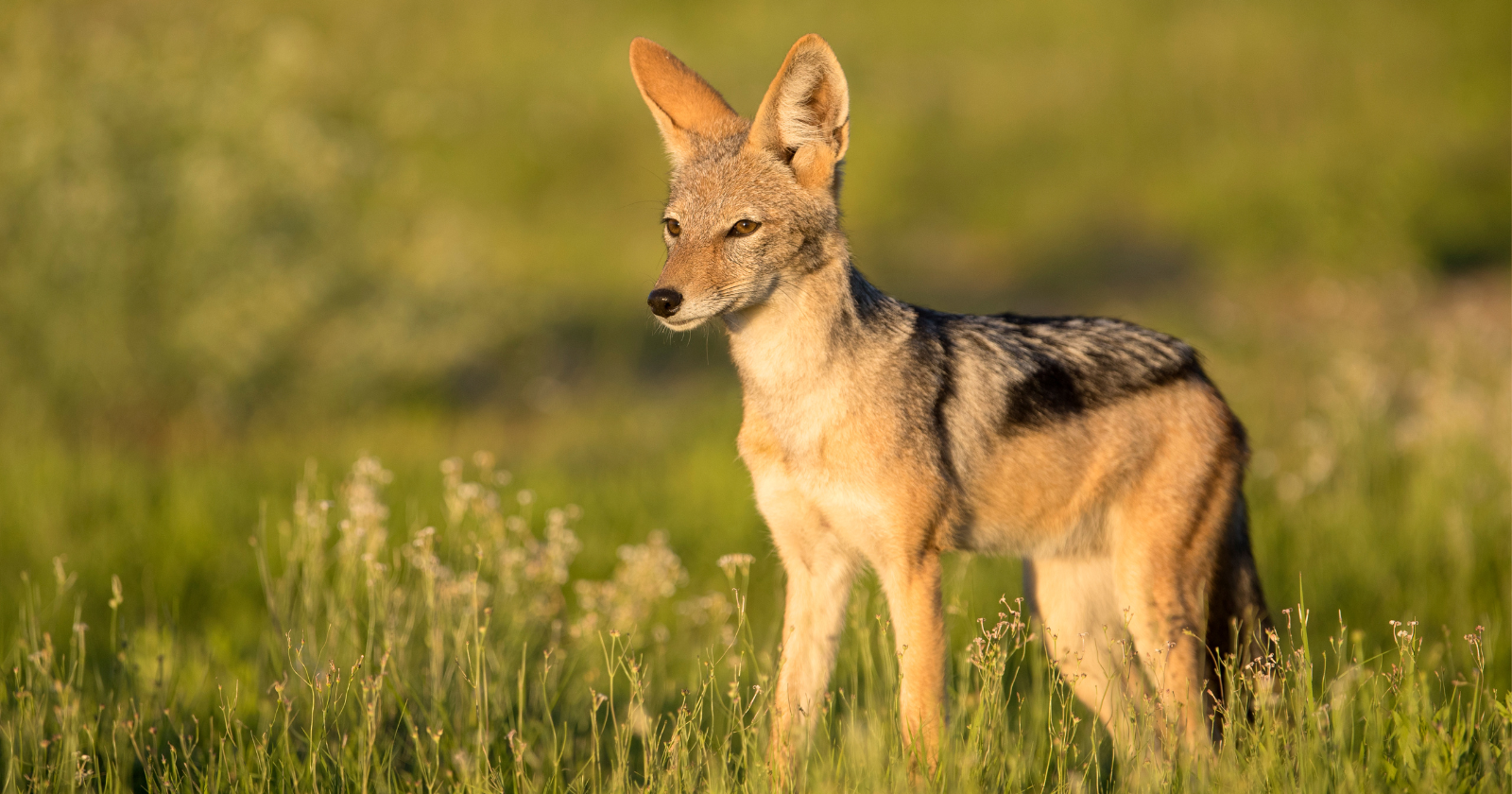
In August 2022, a camera trap on a plateau between the Black Forest and the Swabian Alb, in southwestern Germany, took a series of five pictures of four golden jackal cubs resting together in front of the lens. Two adult jackals had been photographed nearby the day before, and a lactating female earlier in the summer. The cubs were the second confirmed litter of golden jackals ever documented in Germany, following a first litter that had been established through genetic identification of scat samples in the same area in October 2021. According to the paper Felix Böcker and colleagues at the Forest Research Institute in Baden-Württemberg published in Mammal Research in December 2022, this is the westernmost successful reproduction the species has managed in its European history. In the 1980s, none of this was thought to be possible. The species then was largely confined to a handful of populations in the Balkans, particularly Bulgaria, which had kept legal protection on the golden jackal through the general twentieth-century collapse of European canids and was, by most estimates, the last serious reservoir of the animal on the continent.
What actually opened the door
The reason the golden jackal has walked halfway across Europe over the last four decades is not primarily climate, though climate helps, and it is not intentional reintroduction, because there hasn’t been any. It is the collapse and fragmentation of European grey wolf populations across the same window. Golden jackals are considerably smaller than wolves, they avoid areas where wolves are actively defending territories, and where wolves have historically been present in numbers the jackals have been kept out or kept scarce. When wolves were shot out of most of central and western Europe over the course of the nineteenth and twentieth centuries, the mid-sized carnivore niche they had held opened up, and a smaller, more dietarily flexible canid could move into that space without being killed by a resident pack on arrival. Ecologists call this pattern mesopredator release, and it has been documented in a large number of settings. The North American parallel is the coyote, which has expanded across most of the continent over the same period that grey wolves were being extirpated from it.
Europe got its predator back without anyone deciding to give it one. Yellowstone is the opposite case, and the video covers what happened there after 14 wolves were let out of crates in January 1995.
The German case in specific
The Böcker paper describes the German breeding site in some detail. It sits at the edge of a low mountain range in Baden-Württemberg, in a mosaic of bogs, reeds and open oak and pine forest, adjacent to two nature reserves and near the river Danube. The area contains red fox, badger, raccoon, roe deer, fallow deer and wild boar, all of which are the sort of prey and scavenging opportunities golden jackals make good use of. Critically, the area contains no wolves and no other large carnivores. Four camera traps set across roughly 20 hectares registered 90 confirmed jackal events between October 2021 and August 2022. Scat samples analysed with a trained detection dog and subsequent genetic identification at the Senckenberg Center for Wildlife Genetics established five distinct individuals, likely siblings, and a probable father assigned through DNA from saliva left on a scavenged sheep carcass. What makes the case biologically significant is the distance from the nearest previously documented breeding sites, which the paper lists as approximately 400 to 500 kilometres for the closest Italian reproduction, 525 kilometres for a Czech site, 605 kilometres for an Austrian site, and 965 kilometres for the Polish site at Kwidzyn that had held the northernmost reproduction record in Europe up to that point. Whatever animal or animals founded the German population had covered that distance on their own.
How far the dispersers have got
The German case is the westernmost confirmed reproduction. Individual dispersers, without confirmed breeding, have reached considerably further. A 2024 paper in Mammalian Biology by Ilpo Kojola, Heikki Henttonen and colleagues at the Natural Resources Institute Finland describes six verified records of golden jackals in Finland between 2018 and 2022. The first was a camera trap image in east-central Finland in August 2018. The most northerly was a male, weighing about ten kilograms and in good physical condition, that was inadvertently caught in a fox snare in Lapland in March 2022, about 120 kilometres north of the Arctic Circle. His origin is unknown, but the most likely source population for the Finnish records is Estonia, where a resident golden jackal population has been breeding since 2012 on the country’s western coast, and the most plausible route into Finland is the isthmus of dry land between lakes Ladoga and Onega, since the sprawl of St Petersburg blocks the more southerly crossing. In the Netherlands, an individual golden jackal was camera-trapped in the Veluwe Nature Reserve in 2016, the country’s first record, and a second was DNA-confirmed from a sheep predation event in the Ooijpolder in 2021. In Denmark, the species has been recorded sporadically since 2015, again with DNA-confirmed livestock predation. None of these populations are yet reproducing. All of them show the same pattern: single animals arriving from further east and south, hundreds of kilometres from any breeding group.
What the pattern actually shows
On the accumulated evidence from the last decade of European carnivore monitoring, what the golden jackal is doing is a natural experiment in what happens when the top predator in a landscape stops being there. Wolves are now recovering in parts of Europe, including Germany, and where they arrive in numbers the jackal expansion appears to slow or reverse locally, which is consistent with the Balkan pattern where jackal densities are low in areas that hold established wolf packs. In the meantime, the smaller canid has done in roughly forty years what nobody thought a Balkan-restricted species could do, which is walk from Bulgaria to Lapland without a single reintroduction programme, a single translocation, or a single management plan authorising any of it. The species is doing this by using farmland margins, wetlands, river valleys, roadkill, feeding stations set out for other animals, and the sort of human-modified landscape that most rewilding conversations treat as biologically dead. That the jackals are managing it without help is the point of the story. The niche was open, the animal was capable of the movement, and the animal moved.