Briefly disrupting the hippocampus with focused ultrasound stopped healthy adults from using what they already knew about relationships to work out new ones, according to a University of Oxford study published in Nature Human Behaviour on 16 November.
The paper, by first author Deng Pan, joint senior authors Ali Mahmoodi and Matthew Rushworth and six colleagues at Oxford’s Department of Experimental Psychology, combines a learning game, brain scans, a computer model and ultrasound stimulation. The stimulation experiment involved 20 people. A separate group of 36 played the game inside an MRI scanner.
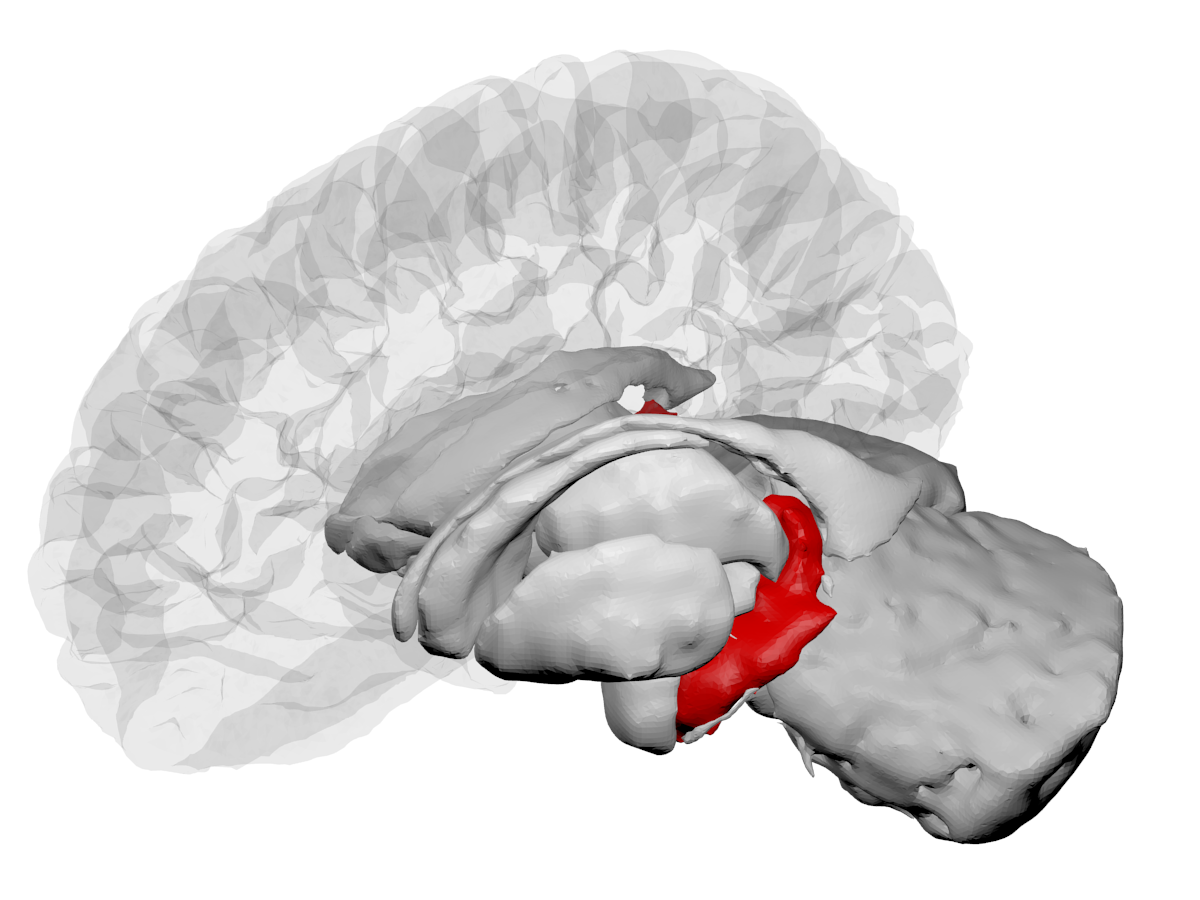
The hippocampus, a curved structure deep in each temporal lobe, has long been tied to memory. Patients with damage to it struggle to form new long-term memories. Researchers have also proposed that it builds mental maps of how things relate, covering abstract and social relationships as well as space. In humans, most of the evidence for that second role has been correlational, because the region sits beyond the reach of standard brain stimulation. The authors write that it “has been inaccessible to conventional non-invasive stimulation tools, such as transcranial magnetic stimulation or transcranial direct current stimulation”.
A 2024 Nature study that recorded single neurons in neurosurgical patients found that abstract representations formed in the hippocampus after patients learned to perform inference. That work showed the brain activity. It could not show the activity was needed.
A goalkeeper’s guessing game
The Oxford team built a task it calls the Goalkeeper Game. Players act as a goalkeeper facing four characters, who take shots in turn. Before each shot, the player guesses which way the ball will go without knowing who is shooting. Once the shooter appears, the player can stick with the guess or switch.
Characters came in pairs. After one character, its partner shot next 80 per cent of the time. Each character also had a preferred direction. Both the pairings and the preferences reversed during the game, so players had to keep updating. Sticking with a correct guess earned two points, switching to a correct answer earned nothing and any wrong answer cost two points. That scoring rewarded players who anticipated the next shooter.
The key question was whether players could infer a pairing they had not yet seen. The paper puts it this way: if A and B keep following each other, can players use “prior relational knowledge to infer that C and D are paired”? Modelling of the 36 scanned participants suggested they could. Their choices were best explained by a model that keeps updating the hidden structure, not one that only tracks what has been seen directly.
The brain scans showed a representation of the pairing structure in the hippocampus that held across contexts, which the authors say was “a property not observed in other brain regions”. The orbitofrontal cortex, just above the eyes, tracked each character’s preferred direction and represented the structure only briefly.
A model first, then ultrasound
Before stimulating anyone, the team trained a recurrent neural network on a similar prediction task. About half of its 64 hidden units came to encode the pairing structure. Switching off those units disrupted the network’s ability to make inferences, which gave a prediction to test in people.
For the human test, 32 volunteers had MRI scans to plan the stimulation. Of those, 23 met the targeting and safety criteria and three dropped out after one session, leaving 20 healthy adults aged 19 to 33. Each came for two sessions at least a week apart. In one, ultrasound was aimed at the hippocampus on both sides of the brain from the back of the head. In the other, it was aimed at a white-matter site of similar depth, as a control. The order was counterbalanced.
Each side received 80 seconds of stimulation, made up of 400 pulses lasting 20 milliseconds each. Participants then played the game for an hour.
After hippocampal stimulation, learning by inference fell compared with the control session, with an effect size (Cohen’s d) of minus 0.89. Its influence on behaviour was no longer distinguishable from zero. Learning from direct experience also fell. Learning each character’s preferred direction showed no statistically significant change. The authors describe the result as “a shift from structure-based to simpler, experience-based strategies”.
The disruption was strongest just after the game reset or reversed and faded as players built up experience. Game scores and prediction accuracy did not change significantly. A further group of 40 people who played without any stimulation performed much like participants in the control sessions. The team says this baseline isolates disruption of the hippocampus as the cause of the deficit.
Participants filled in a symptom questionnaire after each session and again 24 hours later. Most symptoms were rated absent, and most participants said the stimulation felt like “nothing” apart from a ticking sound.
What the study cannot show
The stimulation sample was 20 young, healthy, right-handed adults playing an artificial game with four characters. The paper concedes that such a simple design “may potentially limit generalizability”. Whether the finding holds for the richer relationships of everyday life was not tested.
The effect was temporary by design. The study says nothing about lasting harm, about patients with hippocampal damage or about any treatment. The authors also caution that the effects may not reflect the hippocampus acting alone, because disturbing one region can affect the areas connected to it. They describe the neural network as a computational account, not the biological mechanism.
The behavioural data, model simulations and processed brain data are available on Zenodo. The work was funded by Wellcome and the Biotechnology and Biological Sciences Research Council, among others. As a next step, the authors suggest aiming ultrasound at the orbitofrontal cortex, though they note its position near the eyes calls for specialised protocols.
Spot an error in this article? Email [email protected]