

This is the most important column I’ve ever written. The message is quite complex–dozens of new health parameters to test for and to optimize, all of them interacting in ways that will require new training for MDs. The message is also as simple as it can be: There is a cure for Alzheimer’s disease. You can stop reading right here, and buy two copies of Dale Bredesen’s book, one for you and one for your doctor: The End of Alzheimer’s.
Dr Bredesen’s spectacular success is easily lost in a flood of overly-optimistic, early hype about any number of magic cures. This is an excuse for the New York Times, the Nobel Prize committee, and the mainstream of medical research, but it’s no excuse for me. I’ve known Bredesen for 14 years, and I’ve written about his work in the past. His book has been out for a year, and I should have written this column earlier.
I suspect you’re waiting for the punch line: what is Bredesen’s cure? That’s exactly what I felt when I read about his work three years ago. But there isn’t a short answer. That’s part of the frustration, but it’s also a reason that Bredesen’s paradigm may be a template for novel research approaches cancer, heart disease, and aging itself.
| The Bredesen protocol consists of a battery of dozens of lab tests, combined with interviews, consideration of life style, home environment, social factors, dentistry, leaky gut, mineral imbalances, hormone imbalances, sleep and more. This leads to an individual diagnosis: Which of 36 factors known to affect APP cleavage are most important in this particular case? How can they be addressed for this individual patient? |
Brain cells have on their surface a protein called APP, which is a dependence receptor. It is like a self-destruct switch whose default is in the ON position. The protein that binds to the receptor is a neurotrophin ligand, and in the absence of the neurotrophin ligand, the receptor signals the cell to die.
APP cleavage is the core process that led Bredesen down a path to his understanding of the etiology of AD 16 years ago. APP is Amyloid Precursor Protein, and it is sensitive to dozens of kinds of signals, adding up the pros and the cons to make a decision, to go down one of two paths. It can be cleaved in two, creating signal molecules that cause formation of new synapses and formation of new brain cells; or it can be cleaved in four, creating signal molecules that lead to trimming back of existing synapses, and eventually, to apoptosis, cell suicide of neurons.
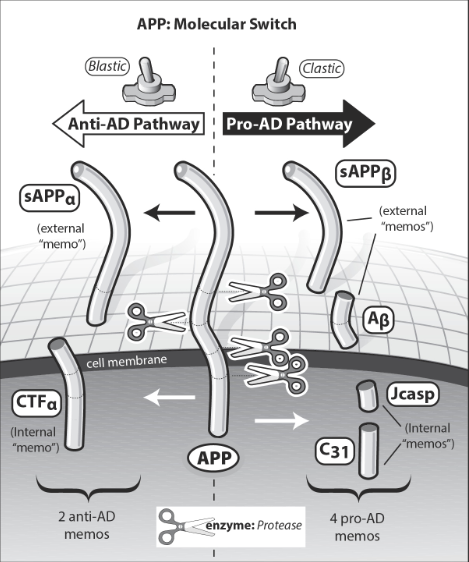
In a healthy brain, these two processes are balanced so we can learn new things and we can forget what is unimportant. But in the Alzheimer’s brain, destruction (synaptoclastic) dominates creation (synaptoblastic), and the brain withers away.
On the right, one of the fragments is beta amyloid. Beta amyloid blocks the dependence receptor, so the receptor cannot receive the neurotrophin ligand that gives it permission to go on living. Beta amyloid is one of the 4 pieces, when the APP molecule goes down the branch where it is split in 4.
One of the signals that determines whether APP splits in 2 or in 4 is beta amyloid itself. This implies a positive feedback loop; beta amyloid leads to even more beta amyloid, and in the Alzhyeimer’s patient, this is a runaway process. But positive feedback loops work in both directions–a boon to Bredesen’s clinical approach. If the balance in signaling can be tipped from the right to the left pathway in the diagram above, this can lead to self-reinforcing progress in the healing direction. In the cases where Bredesen’s approach has led to stunning reversals of cognitive loss, this is the underlying mechanism that explains the success.
Amyloid has been identified with AD for decades, and for most of that time the mainstream hypothesis was that beta-amyloid plaques cause the disease. (Adherents to this view have been referred to jokingly as BAPtists.) But success in dissolving the plaques has not led to restored cognitive function. In Bredesen’s narrative, generation of large quantities of beta amyloid are a symptom of the body’s attempts to triage a dying brain.
To tip the balance back toward growing new synapses
Having identified the focal point that leads to AD, Bredesen went to work first in the lab, then in the clinic, to identify processes that tend to tip the balance one way or the other. He has compiled quite a list.
|
|
This explains why no single drug can have much effect on AD; it’s because the primary decision point depends on a balance among so many pro-AD (synaptoclastic) and anti-AD (synaptoblastic) signals. Addressing them all may be impractical in any given patient, so the Bredesen protocol is built around a detailed diagnostic process that identifies the factors that are most important in each individual case.
Three primary types of AD
Bredesen’s diagnosis begins with classifying each case of AD into one of three broad constellations of symptoms, with associated causes.
Type I is inflammatory. It is found more often in people with carry one or two ApoE4 alleles (a gene long associated with Alzheimer’s) and runs in families. Laboratory testing will often demonstrate an increase in C- reactive protein, in interleukin-2, tumor necrosis factor, insulin resistance and a decrease in the albumin:globulin ratio. Type II is atrophic. It also occurs more often those who carry one or two copies of Apoε4, but occurs about a decade later. Here we do not see evidence of inflammatory markers (they may be decreased), but rather deficiencies of support for our brain synapses. These include decreased hormonal levels of thyroid, adrenal, testosterone, progesterone and/or estrogen, low levels of vitamin D and elevated homocysteine.
Type III is toxic. This occurs more often in those who carry the Apoε3 allele rather than Apoε4 so it does not tend to run in families. This type tends to affect more brain areas, which may show neuroinflammation and vascular leaks on a type of MRI called FLAIR, and associated with low zinc levels, high copper, low cortisol, high Reverse T3, elevated levels of mercury or mycotoxins or infections such as Lyme disease with its associated coinfections.
(This box quoted from Dr Neil Nathan’s book review)
There’s also a Type 1.5, associated with diabetes and sugar toxicity, a Type IV, which is vascular dementia, and a Type V which is traumatic damage to the brain.
These categories are just a start. The patient will work closely with an expert physician to determine, first, where are the most important imbalances to address, and, second, which of the changes that cna address them are most accessible for the life style of this particular patient.
Success
Bredesen wrote a paper in 2014 about successes in reversing cognitive decline with his first ten patients. As of this writing, he has treated over 3,000 patients with the protocol called RECODE (for REversal of COgnitive DEcline), and he claims success with all of them, in the sense of measurable improvement in cognitive performance. This contrasts with the utter failure of all previous methods, which claim, at best, to slow cognitive decline.
Translation to the millions of Alzheimer’s patients will require training of local practitioners all across the country. A few doctors have already learned parts of the Bredesen protocol, and Bredesen’s website can help you find someone to guide your program, but you will probably have to travel. The first training for doctors is being organized now through the Institute for Functional Medicine.
Implications
This is a new paradigm for how to study chronic, debilitating diseases. Type 2 diabetes comes to mind as the next obvious candidate for reversal through an individualized, comprehensive program. Terry Wahls has pioneered a similar approach with MS. Cancer and heart disease may be in the future.
I’ll go out on a limb and say I think Bredesen’s protocol is the most credible generalized anti-aging program we have. (Blame me for the hyperbole, not Dr Bredesen — he has never made any such claim.) Could we adopt Bredesen’s research method to accelerate research in anti-aging medicine? Perhaps biomarkers for aging (especially methylation age) are approaching a point where they could be used as feedback for an individualized program, but Horvath’s PhenoAge clock will probably have to be 10 times more accurate to be used for individuals. Averaging over ~100 individuals can give this factor of 10 in a clinical trial. Still, we don’t have the kind of mechanistic understanding of aging that Bredesen himself developed for AD before bringing his findings to the clinic; and this is probably because causes of aging are more complex and varied than AD.
Disclaimers: I’m pre-disposed to think highly of Dale Bredesen and his ideas for 3 reasons. He was a friend to me, and gave me a platform when I was new to the field of aging. He believes that aging is programmed. And his multi-factorial approach parallels the research I have advocated for researching other aspects of aging.
Discussion
117 reader comments
Imported threads are marked Archive. New comments are welcome and moderated for spam.
My sweet wife has acquired alzhemers and she isn't aware of her disease. I am praying hard every day and night and asking for a cure. I hope Dr. Brednesen has one.
I would give my life for a cure for my perfect wife who loves everyone and is a very great mother of our children.
Hopefully,
William Corp
Harold can we help William's wife with our natural compounds which had significantly dropped IL6 and TNF-a? That would surely ameliorate the symptoms if not prevent Alzheimer's.
Akshay, we could try. No guarantees, but we'd want to make sure it reached the brain; injection into the carotid arteries or other methods we've discussed. Dose is problematic, full rejuvenating dose or special preparation (we've spoken about this), we'd have to make a fair amount of elixir (which will ultimately be cheap, but not now).
Yes, I hate to hear about dementia it's one of the most unfair of life's little ways of insuring out deaths. It would be nice if we can stop or better, reverse it. I know people think those memories are gone, but they are not. .
Harold not Elixir I was asking about the natural compounds via from our very first trial via oral delivery. Of course assuming Williams and his wife wish to try it. I was moved by his message and love for his wife.
hello
check out my ebook about melatonin it is mostly about Alzheimers....high dose melatonin (75 mg/night), pregnenolone (the memeory hormone) , coconut oil, progesterone, ibuprofen and nicotine
these work as follows ....nicotine, ibuprofen and melatonin all supress Luteiniazing hormone which goes up by 1,000 % after menopause and attacks the brain,
melatonin also boosts progesterone which is neurprotective and declines to about 0 after menopause, pregnenolone is the precursor to progesteorne and is known as the memory hormone, only I know- that eating cconut oil increases pregnenolone levels dramatically as well...there are books about how coconut oil works wonders (usually in men) Alzheimers is a bit different in men and women. In women it is driven by the rise of LH mostly (women have 10X more lifetime LH and progesterone than men )
In men AD is driven mostly by a decline in progesterone which protects the brain..So you can get these odd paradoxes like smoking protects women from AD while it accelerates it in men! (because it suppresses both LH and progesterone) ebook link>>>>
https://www.amazon.com/dp/B06Y1QSJ1Q
Akshay, when do we get to hear about these trials? Will you publicise on your blog? Thanks.
It all sounds very interesting Akshay & Harold. I await further updates eagerly!
Facial rejuvenation is big business, mostly populated by charlatans (who nevertheless make a lot of money). And skin rejuvenation is not simple - I believe that anything that is efficacious on skin will work on aging in general. So a gel sounds like a good place to start and a good source of income for further developments.
I have been following the Recode protocol for six months and have not seen a positive cognitive result. My MCI seems to have increased. I severely limited meat and fish, cut out dairy, gluten and soy, keeping my diet plant based. After 4 months I decided to give up on the plant based keto diet and increased carbs because of the loss of feeling love and empathy (I guess you could call it a bad mood) which decreased when I increased carbs. I think the high fat diet is hard without a gallbladder, though I continue with the high "good" fats to tolerance. Realized added non-complex carbohydrates since giving up the keto diet. Have to cut that out. I do think the plant based diet, exercise, sleep (magnesium), fasting, meditation and some of the supplements are beneficial. I appreciate the weight loss, though I don't need to lose more. My friends note that I am not sick as often. The HRT has had non-cognitive benefits as well.
My mother has taken Melatonin for several years but her Alzheimer's decline has not abated. Perhaps the dosage was insufficient.
If you haven't yet read his book, then please don't make assumptions about what is or isn't in it. I have read it and watched as many of his lectures, etc. available on YouTube, and I recommend you do the same before making comments on the protocol or research behind it. Alzheimers runs in my family, my grandmother died from it, my mother is now well into the progression of the disease, and I have the APOe4 allele myself (61 yr. old). As conventional docs have nothing to offer, my bet is on prevention through his cutting edge, science based (25+ years of AD research, and now patients having positive results) results. This is a new paradigm, cutting edge stuff your doc and mainstream knowledge is ignorant of, and one where I believe all medicine is headed. His research is all there for you to examine if you so wish.
Check out this 1 star review for Bredsen's book they spent $30,000!! On doctors and things!!! JACKPOT!!!!
1 star-
We spent 30,000 to participate in Dr. Bredesen's immersion program and saw no benefit. We have been unable to get answeres as to how many people are recovering. The other patients that we are in touch with are not recovering. I trusted Dr. Bredesen because of his impressive credentials. However I have been profoundly disappointed at the lack of candor concerning the immersion program and the outcomes. I am sad that I encouraged my aging parents to spend a huge amount of their money on this program. The priority of proprietary concerns over patient outcomes is a huge red flag. We were vulnerable and fell victim to unsubstantiated claims.. The false hope generated is the worst part. I must agree with the reviewer: BEWARE!!!!!!
Leave a reply
Thank you Jeff, but for a spelling mistake, it was a well-written review (by which I mean the writer wasn't an idiot, so we should pay some attention to his comments. That was my fear, - we still don't know how many successes they had, but we don't read a lot of, "Wow Dr. Bredesen has made me young again!" and that would be my criterion for a successful treatment. It's easy to fool yourself, you can do all the lab tests, adjust all parameters, get measurements telling you it's working, but if the patient doesn't tell you it's working, you are fooling yourself. If indeed what Dr. Bredesen is doing is trying to reproduce young blood plasma in old patients (I suppose young blood is the model for the preferred concentrations for all of the dozens of blood factors that he believes need to be controlled and adjusted.) In that case my published method of HPE (heterochronic plasma exchange) is much better; Dr. Bredesen can only control the concentration of factors he knows about, the importance of any of those factors individually is debatable, but the sum total effect of all of them together seems to be negligible as well. I'm afraid that unless Jesse Karmazin secretly wrote this 'review', I'd have to say there was very little or no benefit from all those tests and 'adjustments', the game isn't worth the candle. I'm afraid Josh, you may have been taken in by another of the many parties trying to cash in on the anti-aging research boom that's occurring, you vouch for his integrity, but people are awfully good at fooling themselves when they want a particular result. What is the theoretical justification for this approach, where is the experimental justification? Where can we read about this, that is, which peer-reviewed publications has Bredesen put out regarding this work?
@ Jeff Bowles,
Jeff,
I skimmed through the majority of your book;
Absolutely amazing and fantastic ... I cross-referenced much as well and I'm a believer in the benefits (and safety) of melatonin - thank you much for your hard work and contribution to health & aging!!
Sorry for doubting you,
Sincerely,
Kirk
Well Im glad you saw the light....I really dont care if I sell an ebook at 2.99 or not I am semi retired and have no wants or needs
.. If you liked the azheimers/melatonin book you will also really like
what darwin could not see the missing half of the theory
Jeff,
How much melatonin do you think I need in my 40's (healthy, fit male).
I honeslty (previously) thought 5mg per night was a high dose ... you talk about up to 120mg on your blog ... I also take 3000-4000IU of D3 on average daily with LEF 'Super K' which has K1, K2-MK4 and 100mg of K2-MK7 (daily)
Sincerely appreciate your input,
Aslan
Hello Aslan
As far as melatonin goes I figured if you want the maxium life extending benefits of melatonin you need to take a dose high enough to shut down reproduxtion in women. The same thing that occurs with extreme caloric restriction. In women the dose that was used for birth control was 75 mg per night so I just assumed men weigh more and randomly picked 120 mg per night. Read my Alzheimers book which is free for 3 more days on amazon it is mostly about melatonin. As far as D3 goes I took 4000 iu a day for 10 years adn it kept me from getting a cold and eliminated cracking in my shoulders But did nothing else only until I upped my dose to 25,000 to 50,000 to 75,000 a day did I get some major results like repair of my hip click of 26+ years it took 2 years of high dose d3 to completely eliminate my adult onset seasonal allergies..Keep in mind if you sit in the summer sun for 1/ 2 hour at the beach your skin will make 20,000 iu of d3...you should also take k2 and magnesium with high dose d3
@ Professor Harold Katcher,
What you are saying about parabiosis and organismic rejuvenation makes complete sense to me.
But where I'm confused is how can we (I) change cell signalling (for example blood plasma biomarkers) to be youthful again?
My first overall approach to health & longevity has been what I think of as Tier 1 (as per Michael Rae PhD over at SENS) refers to which is ensuring RDA levels of micronutrients. I practice some time-restricted feeding (eating approx 16-8 hours per day and meals earlier than later to help with autophagy/cellular cleanup).
Perhaps some more hormonal signalling makes sense such as melatonin and D3 (as per Jeff's extensive research) however I already take these, but perhaps in not high enough quantities to be useful for rejuvenation.
I also think that hormesis (via perhaps something strong and well-researched) such as taking sulforaphane intermittently will do many things such as upregulate glutathione (and other exogenous anti-oxidant production), decrease inflamation, improve just above everything from cognitive function to detox, even reduce cancers ...
Can you provide any further hints/advice here??
I loved your hints about the Tree of Life ... I'm left wondering if the hint is to eliminate the 'Fiery Angel' which represents ?? inflammation (sorry I'm lame) ...
I thought the same about the fiery angel Aslan!
Likely stem cell activation requires inflammation, even though that is what many old people die of (via various diseases). So an antiaging protocol will likely requiring cycling periods of high and low inflammation, high and low ROS, high or low NRF2, Botch or Notch signalling, etc.
I think timing of doses is a factor rarely considered in aging, but also believe there's a strong relationship between aging and the circadian rhythm, especially the deeper more fundamental rhythms behind redox changes. It is, for example, the kinase mTOR that's behind metabolic/redox switching; that is, from OXYPHOS, to aerobic glycolysis (for growth) through shunting through the oxidative parts of pentose phosphate pathway, for the production of NADPH and its use in reducing glutathione, the glutaredoxins, thioredoxins and peroxyredoxins, among others, and basically restoring (almost) the reduced state of the cytosol and nucleus. It is the "(almost)" that matters and is controlled by the body, I think.
As for the solution to my hint, well we'll have to wait. If I'm wrong (but I have evidence that I'm not - but who knows, there's the expression from the gold mining days, 'flash in the pan') then it doesn't matter, if I'm right (and I'm pretty sure I am - it's amazing to have spent much the past decade arguing with everyone in the field of aging (of which I was not even a part, originally) and finally to have been proven correct in the best possible way, makes me feel strange, I can't quite believe it myself. On the other hand, I had the privilege of saving someone's life two days ago, someone I hold dear, and I've been learning a lot about the importance and beauty of life, how even your most profound grief (and fortunately, I was spared that), is as valuable to you as your happiness - both are miracles. So I'm happy to be able to add to its extension - though lately I'm wondering if limiting it's application, so as not to include dictators for life, and would-be such people, might be doable.
Fiery Angels that must be presumably overcome or defeated.
Fire is oxidation; consuming oxygen, so we need to put out the fire; stop oxidizing? Stop production of or quench the damage from ROS...
I’m dying as well... only slowly Professor Katcher.
Give us another hint??
Here is the King James version
Now the serpent was more subtil than any beast of the field which the LORD God had made. And he said unto the woman, Yea, hath God said, Ye shall not eat of every tree of the garden?
2And the woman said unto the serpent, We may eat of the fruit of the trees of the garden:
3But of the fruit of the tree which is in the midst of the garden, God hath said, Ye shall not eat of it, neither shall ye touch it, lest ye die.
4And the serpent said unto the woman, Ye shall not surely die:
5For God doth know that in the day ye eat thereof, then your eyes shall be opened, and ye shall be as gods, knowing good and evil.
6And when the woman saw that the tree was good for food, and that it was pleasant to the eyes, and a tree to be desired to make one wise, she took of the fruit thereof, and did eat, and gave also unto her husband with her; and he did eat.
7And the eyes of them both were opened, and they knew that they were naked; and they sewed fig leaves together, and made themselves aprons.
8And they heard the voice of the LORD God walking in the garden in the cool of the day: and Adam and his wife hid themselves from the presence of the LORD God amongst the trees of the garden.
9And the LORD God called unto Adam, and said unto him, Where art thou?
10And he said, I heard thy voice in the garden, and I was afraid, because I was naked; and I hid myself.
11And he said, Who told thee that thou wast naked? Hast thou eaten of the tree, whereof I commanded thee that thou shouldest not eat?
12And the man said, The woman whom thou gavest to be with me, she gave me of the tree, and I did eat.
13And the LORD God said unto the woman, What is this that thou hast done? And the woman said, The serpent beguiled me, and I did eat.
14And the LORD God said unto the serpent, Because thou hast done this, thou art cursed above all cattle, and above every beast of the field; upon thy belly shalt thou go, and dust shalt thou eat all the days of thy life:
15And I will put enmity between thee and the woman, and between thy seed and her seed; it shall bruise thy head, and thou shalt bruise his heel.
16Unto the woman he said, I will greatly multiply thy sorrow and thy conception; in sorrow thou shalt bring forth children; and thy desire shall be to thy husband, and he shall rule over thee.
17And unto Adam he said, Because thou hast hearkened unto the voice of thy wife, and hast eaten of the tree, of which I commanded thee, saying, Thou shalt not eat of it: cursed is the ground for thy sake; in sorrow shalt thou eat of it all the days of thy life;
18Thorns also and thistles shall it bring forth to thee; and thou shalt eat the herb of the field;
19In the sweat of thy face shalt thou eat bread, till thou return unto the ground; for out of it wast thou taken: for dust thou art, and unto dust shalt thou return.
20And Adam called his wife's name Eve; because she was the mother of all living.
21Unto Adam also and to his wife did the LORD God make coats of skins, and clothed them.
22And the LORD God said, Behold, the man is become as one of us, to know good and evil: and now, lest he put forth his hand, and take also of the tree of life, and eat, and live for ever:
23Therefore the LORD God sent him forth from the garden of Eden, to till the ground from whence he was taken.
24So he drove out the man; and he placed at the east of the garden of Eden Cherubims, and a flaming sword which turned every way, to keep the way of the tree of life.
Here's an excerpt from an old article about the Bresden protocol before they emoved the reference to melatonin>>>>
Memory loss associated with Alzheimer’s reversed for first time
Small trial by UCLA and Buck Institute succeeds using ‘systems approach’ to memory disorders
Mark Wheeler | October 02, 2014
redesen’s approach is personalized to the patient, based on extensive testing to determine what is affecting the brain’s plasticity signaling network. In the case of the patient with the demanding job who was forgetting her way home, her therapy consisted of some, but not all, of the components of Bredesen’s program, including:
eliminating all simple carbohydrates, gluten and processed food from her diet, and eating more vegetables, fruits and non-farmed fish
meditating twice a day and beginning yoga to reduce stress
sleeping seven to eight hours per night, up from four to five
taking melatonin, methylcobalamin, vitamin D3, fish oil and coenzyme Q10 each day
optimizing oral hygiene using an electric flosser and electric toothbrush
reinstating hormone replacement therapy, which had previously been discontinued
fasting for a minimum of 12 hours between dinner and breakfast, and for a minimum of three hours between dinner and bedtime
exercising for a minimum of 30 minutes, four to six days per week
Bredesen said the program’s downsides are its complexity and that the burden falls on patients and caregivers to follow it. In the study, none of the patients was able to stick to the entire protocol. Their most common complaints were the diet and lifestyle changes, and having to take multiple pills each day.
The good news, though, said Bredesen, are the side effects: “It is noteworthy that the major side effects of this therapeutic system are improved health and an improved body mass index, a stark contrast to the side effects of many drug
I'll give you a cure before I give you a hint.
Akshay, Harold - we are all very excited to see your results, when you can release them. And if you want any draft reviewers please let me know! I've read and dissected thousands of papers on aging (I'm really obsessed with this problem, I know!)
Best Regards, Mark.
Final comment on melatonin>>>>
DId you know that it can reverse human menopause if started soon after emnopause starts kicking in?? Yeah google it...
It can also regrow hair in men by boosting progesterone levels which is the original 5 alpha reductase inhibitor which was ripped off and tweaked by bigpharma to bring you ]atentable proscar and avodart each with some deadly side effects (much moe aggressive cancers) compared to progesterone....
and yes melatonin given at the first sign of dementia will reverse it....
here check out this blog post and if you like it you should download my ebook on Alzheimers/ melatonin IT IS FREE FOR THE NEXT 4 DAYS
here is a short article
Amazing! Melatonin Secrets That Almost Nobody Knows About!
https://jefftbowles.com/melatonin-secrets-that-almost-nobody-knows-about-amazing/
Amazing! Melatonin Secrets That Almost Nobody Knows About!
And I am still waiting for josh to ADMIT HIS MISTAKE ABOUT CLAIMING STUDIES IN THE 90\s SHOWED MELATONIN DID NOT HELP AD!! THIS WAS A HUGE ERROR!!!
oops did I do that ? Josh please change that typo!!!
Hi Harold ...melatonin is the caloric retriction hormone
It peaks at night but that peak can be dooubled or even higher duirng periods of starvation...and that is what triggers the other hormone chages that lead to the anti aging cr effect....like after 5 days of fasting n humans>>> suppressing LH and FSH by 33% doubling dhea cutting testosteorne in half in men....here is an excerpt from my 1998 paper on aging>>>
During famine conditions or CR one would expect that in addition to the increase in cGMP activity, that an increase in cGMP stimulating hormones would be seen. Also, one would expect a decline in cAMP stimulating hormones. In a study of human males undergoing 5 days of fasting (136) the following hormone level changes were seen, (for hormones not measured in this study other references are noted):
cAMP stimulating hormones:
TSH declined by 67%-as expected
LH decreased by 33%-as expected
FSH decreased by 33%-as expected
cortisol increased by 110%-unexpected
estrogen -increased by 10%-unexpected
cGMP stimulating hormones
Melatonin increased +/-100% in rats (137)-as expected
GH increased 200%-400% in men (138) -as expected
DHEA-S increased 100%-expected
Testosterone-decreased 50%- unexpected
T3 and T4 were relatively unaffected, and prolactin declined 25% but is not listed because it is an “ambidextrous” hormone stimulating both cAMP and cGMP depending on which receptors it influences.
The above results reasonably conform to expectations based on the prior hypothesis regarding cAMP and cGMP stimulating hormones. However, by examining the exceptions additional important insights can be gained. First, the cortisol increase of 110% is definitely not expected as it is a cAMP hormone and the hormone is widely known to be implicated in accelerating the diseases of aging in persons where it is chronically elevated. What is also known about cortisol
I'm hoping that it's a typo and not a 'Freudian slip', that Jeff Bowles spells 'bowels' as 'bowles'. Now you may have a good point Jeff, melatonin is not a big money-maker, it can't be patented, so Big Pharma has no interest in developing it. And perhaps Jeff's Texan use of several times the recommended dose of a micronutrient which seems (I haven't seen data) to produce an effect (placebo effect?, are there well-controlled studies? Is there a dose dependency?) Personally I've been using melatonin for more than twenty years and at age seventy-something, I haven't noticed any deterioration, in fact, maybe the opposite.
in case you dont know level 5 means you just need help picking out your clothes to wear as one puts it
score 7b means you cannot control your bowles cannot hold your head up and have lost almost all your vocabulary
another one for Josh and the skeptics
J Pineal Res 1998:25:260-263
Two twins with Alzheimer’s and one takes melatonin: A case report
Brusco LL, Marquez M, Cardinali DP. Monozygotic twins with Alzheimer's disease treated with melatonin: case report. J. Pineal Res. 1998; 25:260-263. @ Munksgaard, Copenhagen
Departamente of Fisiologie and Cultadde Medicina
Universidad de Buenos Aires,
Argentina
Abstract: Monozygotic twins with Alzheimer's disease of 3 years duration were studied. The onset of the disease differed by about 6 months between twins and was characterized by a primary impairment of memory function. Clinical evaluation at the time of diagnosis indicated a similar cognitive and neuroimaging alteration in both patients, as well as a similar neuropsychological impairment. A possible genetic origin of the disease was suggested as similar diseases suffered by the mother. Patients were initially treated with vitamin E (800 iu/day|. starting at approximately the same time (about 3 years ago), they received 50 mg/day thioridazine because of the behavioral and sleep disorder. One of the patients was treated with melatonin (6 mg orally) at bed time daily for 36 months. Evolution of the disease in the melatonin-treated patient indicated a milder impairment of memory function, with substantial improvement of sleep quality and reduction of sundowning. This led to discontinuance after 3 months of thioridazine treatment. Present clinical evaluation indicated a difference in functional stage of the disease between the twins (Functional Assessment Tool For Alzheimer's Disease (FAST), with a score of 5 in the twin who received melatonin and of 7b in the twin who did not receive it. Since experimental data on melatonin in Animals indicated its antioxidant, antiapoptotic, and B-amyloid-decreasing activity, the hypothesis that melatonin has a beneficial effect in Alzheimer’s disease patients should be considered.