Wolf Cukier was three days into a summer internship at NASA’s Goddard Space Flight Center when a stray blip in someone else’s data caught his attention. His job that week was to work back through everything volunteers on the Planet Hunters TESS project had already flagged as an eclipsing binary, two stars that circle each other and, from our vantage point, periodically block each other’s light. There were plenty of those to sort through.
TESS, short for the Transiting Exoplanet Survey Satellite, was expected to catch hundreds of thousands of eclipsing binaries over its first two years alone, using four cameras that each photograph a patch of sky every 30 minutes for 27 days at a stretch. One flagged signal, from a system cataloged as TOI 1338, didn’t behave the way the others did.
In his own words, as NASA quotes him: “I was looking through the data for everything the volunteers had flagged as an eclipsing binary, a system where two stars circle around each other and from our view eclipse each other every orbit. About three days into my internship, I saw a signal from a system called TOI 1338. At first I thought it was a stellar eclipse, but the timing was wrong. It turned out to be a planet.”
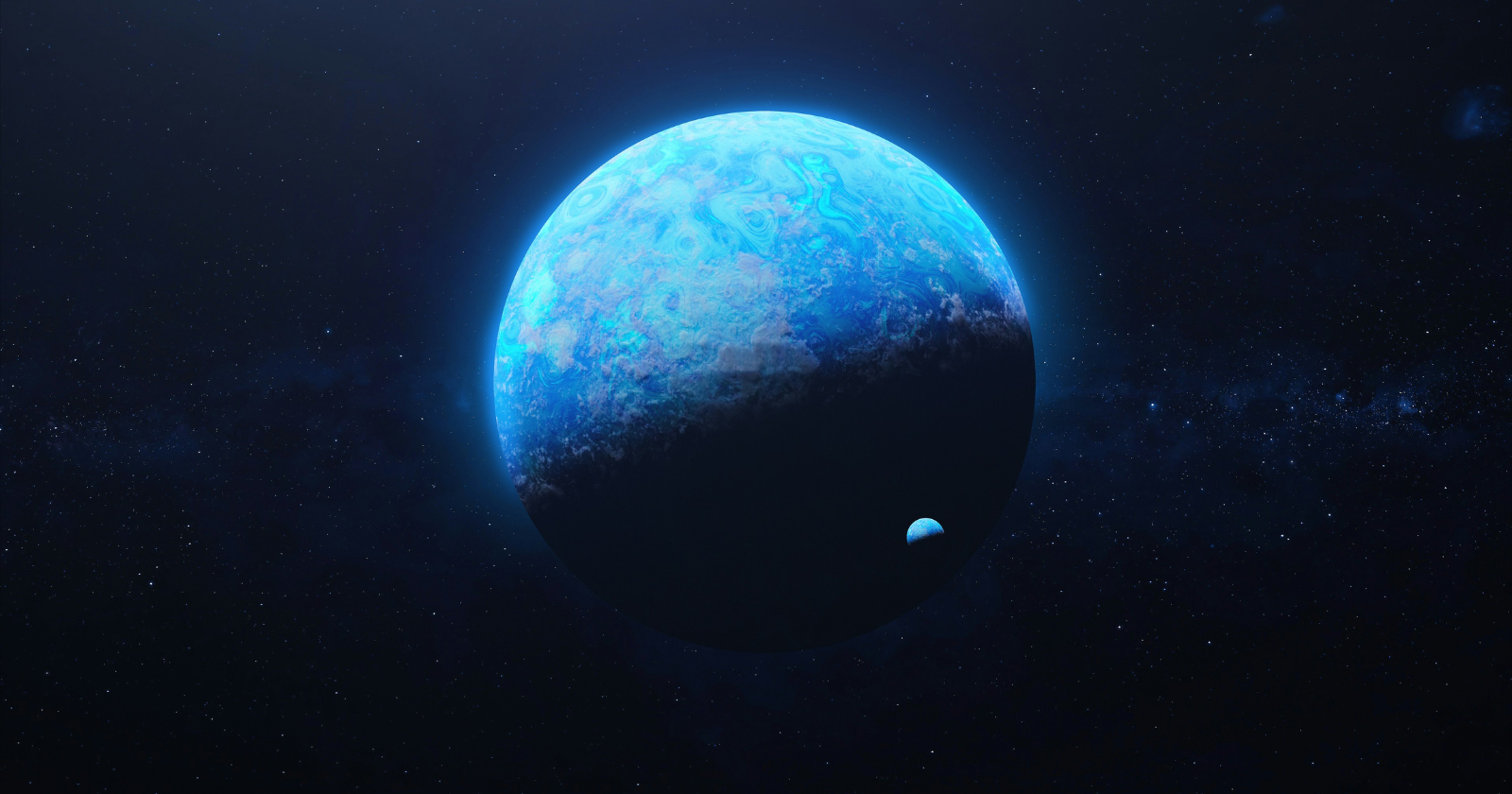
That planet is now formally named TOI 1338 b, and it wasn’t just any find. It’s a circumbinary planet, meaning it orbits both stars in its system rather than just one, and it was the first of its kind that TESS, NASA’s Transiting Exoplanet Survey Satellite, had turned up since launching in 2018. The planet sits about 1,300 light-years from Earth, in the constellation Pictor, and it’s roughly 6.9 times the size of Earth, somewhere between Neptune and Saturn. Worth being precise about that “first of its kind” claim too. It’s specific to TESS. NASA’s own writeup notes that its earlier Kepler and K2 missions had already turned up 12 circumbinary planets across 10 systems before TOI 1338 b came along, all of them, like this one, on the larger side, since a small planet’s transit barely dents a star’s brightness enough to notice.
The numbers get confusing here, and that confusion explains why quite a few headlines from the original January 2020 announcement got tangled. TOI 1338’s two stars, one about 10 percent more massive than our sun and one cooler, dimmer, and only a third of the sun’s mass, orbit each other every 15 days. The planet Cukier actually found takes much longer to loop around that pair: somewhere between 93 and 95 days, according to both the NASA release and the peer-reviewed paper that followed, led by astrophysicist Veselin Kostov. Fifteen days is how fast the two stars swing around each other. Roughly 95 is how long their shared planet takes to go around them both. They’re easy to mix up and worth keeping separate.
Veselin Kostov, a research scientist with the SETI Institute stationed at NASA Goddard, explains why a computer missed what Cukier caught: “These are the types of signals that algorithms really struggle with. The human eye is extremely good at finding patterns in data, especially non-periodic patterns like those we see in transits from these systems.” That non-periodic quality is not a small detail. Because TOI 1338 b crosses in front of two stars that are themselves in motion, its transits don’t land on the same schedule each time, and they even vary in depth and length depending on where the stars happen to be. A single-star planet gives an algorithm a clean, repeating beat to search for. A circumbinary one doesn’t, which is exactly the kind of irregularity a patient, attentive person can catch faster than software trained to look for regular rhythms.
I should say plainly that I have no business explaining orbital mechanics with any real authority. I’m not an astronomer, I never studied physics past what school required, and everything above came from NASA’s own materials and the published paper rather than any expertise of mine. What drew me into this story wasn’t the orbital math so much as its shape: a kid finishes his junior year of high school, spends part of his summer double-checking other people’s flagged data, and ends up with his name permanently attached to a planet.
What strikes me most is how little of that seems to have been about being seen. Cukier wasn’t trying to make news. He had one narrow task, work back through flagged signals, and he happened to be paying close enough attention when one didn’t match its label. I’ve come around to thinking success is a personal measure. Mine looks like financial steadiness and a calm household, and I don’t assume that’s the only valid version of it. Cukier’s version, at least during that internship, looks like doing the task in front of him carefully and letting whatever came of it come. The attention arrived afterward, as a side effect of the work itself.
Something almost anticlimactic runs through how the discovery actually happened, and I mean that as a compliment. No countdown, no on-camera eureka moment. Just a teenager scrolling through a queue of light curves that volunteers on the Planet Hunters TESS project had already flagged, noticing one didn’t fit its own label, and asking why. It’s a decent case for why citizen-science projects staffed by people with no professional background keep turning up things automated pattern-matching walks right past.
Cukier went on to study astrophysical sciences at Princeton, where he later worked on research into meteoroid dust streams, a fairly direct line from a high school internship to a genuine research career. TOI 1338 b, meanwhile, stays on the books as TESS’s first confirmed circumbinary planet, a title that can only be held once. Somewhere in there is a decent argument for what three careful days can add up to, even when nobody involved was trying to prove anything.