A gas giant almost five times the mass of Jupiter circles a small orange star about 89 light years away on an orbit that takes roughly 19 years, according to a study of 16 years of telescope data published in The Astrophysical Journal Letters on 17 November. The authors say the planet is unlikely to have formed in the way most giant planets are thought to.
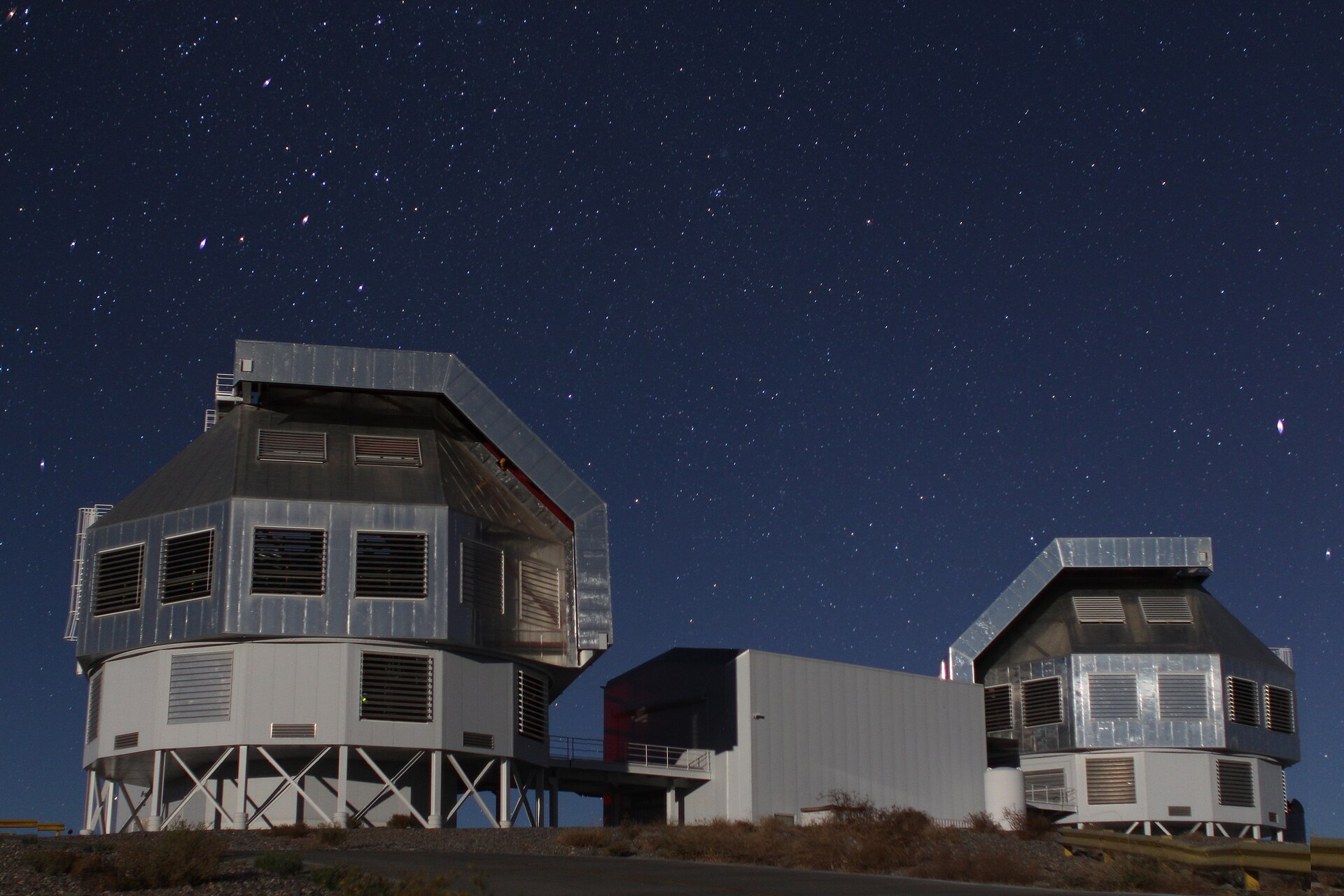
The team of ten, led by Alan Boss of Carnegie Science in Washington with colleagues at Carnegie’s observatories in Pasadena, Shanghai Jiao Tong University and Tsinghua University, found the planet with the Planet Finder Spectrograph on the 6.5-metre Magellan Clay Telescope at Las Campanas Observatory in Chile. The paper is open access and was also posted to arXiv on 11 November.
Boss, a staff scientist emeritus at Carnegie Science’s Earth and Planets Laboratory and the paper’s lead author, said in an email that his colleague Paul Butler, a staff scientist at the laboratory and a co-author of the paper, “found the planet in his PFS data and realized it was an outlier, hard to form by core accretion.” He added: “He challenged me to argue how it probably formed and then to lead the paper-writing effort.”
The star, HIP 88962, is a K7 dwarf. The authors put its mass at 0.62 times the Sun’s. The planet, HIP 88962 b, has an orbit with a semi-major axis of about 6.15 astronomical units, a little larger than Jupiter’s orbit around the Sun.
A wobble that took years to see
The spectrograph does not see the planet itself. It measures the star’s slight back-and-forth motion as the planet’s gravity tugs on it. The team took 47 sets of observations on 41 nights between 2010 and 2025, and found a velocity shift with an amplitude of 94.9 metres per second that repeats about every 19.3 years.
Butler said in an email: “Detecting planets by precision velocities requires following the planet for most of the orbital period, preferably for more than one full orbit. So if you want to detect long period planets, you need to monitor the stars for years and decades.”
An earlier search had missed it. A 2021 survey using the CHIRON spectrograph in Chile found no sign of a planet, but its 10 observations spanned 799 days, which the new paper says was too short to catch the wobble.
This method alone gives only a minimum mass, about five Jupiters here, because it cannot tell how the orbit is tilted. The team combined its data with measurements of the star’s position and motion from the European Space Agency’s Hipparcos and Gaia satellites. That gave a nearly edge-on orbit, with a tilt of 91 degrees, give or take 22, and a true mass of 4.83 Jupiters. The orbit is also stretched, with an eccentricity of 0.718, where zero would be a circle.
Why the authors rule out the usual route
Most giant planets are thought to form by core accretion. Rocky material collides and builds a core about ten times the mass of Earth, which then pulls in gas. The authors compare their planet with published computer models of this process for low-mass stars.
A 2021 population study by Burn and colleagues produced essentially no planets heavier than about one Jupiter beyond one astronomical unit for stars of 0.5 or 0.7 solar masses, the new paper says. A 2022 study led by Schlecker using the same model found no massive gas giants with orbits longer than 1,000 days around such stars. HIP 88962 b takes about 7,055 days. The giants that did form in the Burn models had average eccentricities of 0.19 and 0.14, far below this planet’s 0.718.
The authors favour another idea, gas disk gravitational instability. In this picture, part of a young star’s disk of gas becomes heavy and cold enough to collapse under its own gravity and form a giant planet directly. The paper cites Boss’s own 1997 paper in Science as the source for the mechanism, and the three modelling studies it cites in support are also his, one with a co-author. Those models formed giants of about one to 20 Jupiter masses around 0.5 solar-mass stars, and clumps starting at four to 10 astronomical units.
The paper describes the planet as one “whose existence confounds the conventional wisdom about the formation of gas giant planets.” It lists earlier cases read the same way, including a 3.6 Jupiter-mass planet around the M dwarf GJ 463 reported by Sozzetti in 2023.
Kaitlin Kratter, a professor of astronomy at the University of Arizona who was not involved in the study, said in an email that when considering the viability of gravitational instability versus core accretion, “one of the most important parameters is the system mass ratio.” She wrote: “For this system, M_planet / M_star ~ .008. This is in a tricky regime of parameter space where both mechanisms struggle. It’s still low mass ratio for gravitational instability, but very high for core accretion. It would be equivalent to an 8 Mjup planet in our solar system.”
She added: “For solar type stars, the mass range in which this planet lives is pretty poorly populated. There seems to be a dearth of objects between roughly 4-7 Jupiter masses, and the properties of objects below the gap are systematically different from ones above the gap. For lower mass stars, the gap could easily shift to lower masses, suggesting that at ~5 Mjup, this objects falls in the “high mass” population, and fits better with GI than with core accretion. The high eccentricity is a puzzle for either mechanism.”
What the study cannot show
No one has watched this planet form. The case for disk instability rests on the planet’s mass and orbit not matching core accretion models, and the authors concede the supporting models are less complete. “While none of these GDGI models performed a population synthesis model on the scale of the core accretion models previously described, it is clear that the GDGI mechanism is quite capable of having formed an exoplanet similar to HIP88962 b,” they write.
“For any individual planet, it’s hard to say we will ever know for *sure* how something formed.” Kratter said. “Nevertheless, I think it’s quite reasonable to think this object could be one of the “failed binaries” formed through disk fragmentation that we’ve hypothesized about.” She also wrote: “One of the best pieces of evidence for core accretion in general is the very substantial metal enrichment of gas giants, as evidenced by their high densities. Unfortunately, density information is really only accessible for systems that are close in, transit, and also have RV measurements.”
Other uncertainties remain. The star’s mass, on which the argument depends, was not measured directly. It was estimated from the star’s colour through a temperature-to-mass relation, with an uncertainty of 0.084 solar masses. The 16 years of data cover less than one full orbit. Fits that add a long-term trend give periods up to more than twice as long, though the team kept its original solution. Gaia’s individual measurements are not yet public, so the team built simulated ones from the mission’s forecast of when and how it scanned the star.
The star is also active. Its velocity data scatter by about six metres per second around the single-planet fit, against about three for four quiet comparison stars. Its calcium emission, a marker of magnetic activity, is about twice theirs, and data from NASA’s TESS satellite suggest it rotates every 17 days or so. A possible second planet with a 4.11-day orbit showed up in the leftover signal, but the authors write that they “do not consider the 4.1 day signal to be a robust planet candidate.”
The paper says continued monitoring should clarify the planet’s orbit, and that evidence of several more cold gas giants around K7 dwarfs awaits confirmation by future Magellan observations.
Boss wrote: “One strong observational test for disk instability will be the results of the Roman microlensing survey … which may uncover large numbers of distant gas giants that core accretion fails to predict.”
Spot an error in this article? Email [email protected]