

My theory of aging is about predator-prey dynamics. By the broad definition, all animals are “predators”. They require another species to make food for them, and hence they are vulnerable to population overshoot. They can drive their food source to extinction by over-hunting or over-grazing, and then it’s curtains for the predator/animal.
This creates a dynamic of evolutionary ecology in which it is easy to understand natural selection for aging. The simplistic neo-Darwinist framework told us that every individual must maximize his reproductive potential. In the neo-Darwinist framework, speed of reproduction is the very definition of fitness, the exponential growth rate r (from Euler-Lotka). But for any animal species, reproducing faster than its prey species must sentence his grandchildren to starvation.
Every animal species has learned to temper its exponential growth rate to avoid wiping out its food supply, and in this context, more subtle aspects of fitness, including group-level adaptations like aging, can emerge.
This, in a nutshell, has been my contribution to the field of aging in the last 30 years. It applies to animals. Maybe it applies to fungi, too. To the extent that fungi rely on dead organic matter, they don’t have to worry about driving a prey species to extinction; but some fungi parasitize living plants and animals.
But my theory, the Demographic Theory of Aging doesn’t apply to plants. Why, then, do plants senesce? Or do plants senesce at all?
Start with the observations, the phenomenology. It’s true that a lot of plants do not senesce. Indefinite lifespans are common in the plant world (though rare in the animal kingdom). Perhaps this adds plausibility to my Demographic Theory. But the next step is to ask about the varieties of aging behavior in plants. Which plants age and which do not? How might we understand the difference? A few weeks back, Rupert Sheldrake challenged me to address this question.
Catalog of evolutionary explanations for aging
I’ve described above my Demographic Theory. In addition, there are other proposals for potential evolutionary advantages of aging.
Population turnover. In species that reproduce sexually, each new generation adds diversity, keeping the population robust against any kind of environmental change or challenge, and increasing the pace of evolution. Aging shortens the effective generation time. [Andre Martins]
Pathogen resistance. A population that ages has greater resistance to epidemics of pathogens, both because of lower population density and greater variety that makes it more difficult for the pathogen to jump from one host to the next. If individuals can recover from a disease while still harboring transmissible pathogens, then dying early can be even more advantageous [Peter Lidsky].
Youthful epigenetics carried past their sell-by date. Before we knew that genes could be turned on and off, George Williams (1957) proposed that there are genes necessary for growth and reproduction that eventually kill the organism. Mikhail Blagosklonny adapted this idea to the 21st century with the idea that TOR was a gene necessary for growth and development which never gets turned off, with the consequence that animals age and die. There are some animals that go on growing bigger without end, and they don’t age [Kenneth Sebens]. Examples include clams, lobsters, and perhaps some sharks and rays. We’ll see that indefinite growth can kill trees because they’re not in a gravity-free water environment.
Spectacular longevity in plants
When it comes to extreme longevity, plants have animals beat hands down. There are animals that live for centuries, but there are plants that live for millennia.
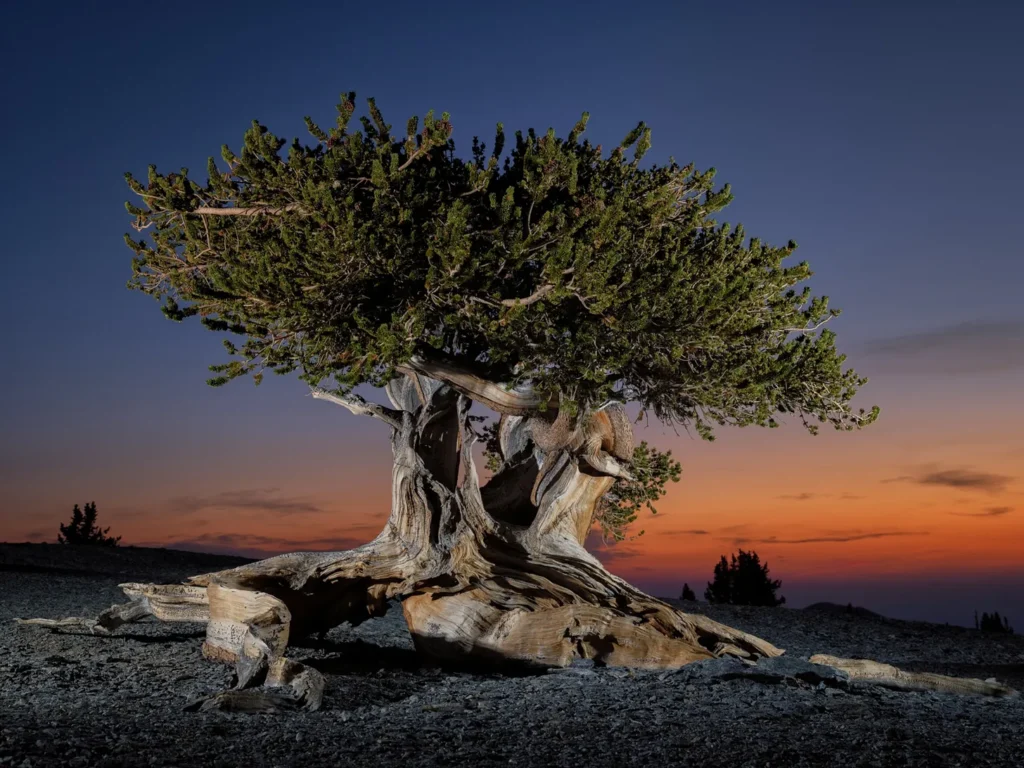
There are Bristlecone Pine trees in California that are more than 5,000 years old. Giant Sequoias commonly live more than 2,000 years, and sometimes over 3,000. The oldest Baobab is “only” 2500 years, but Japanese Sugi Cedars are up to 7,000 years old.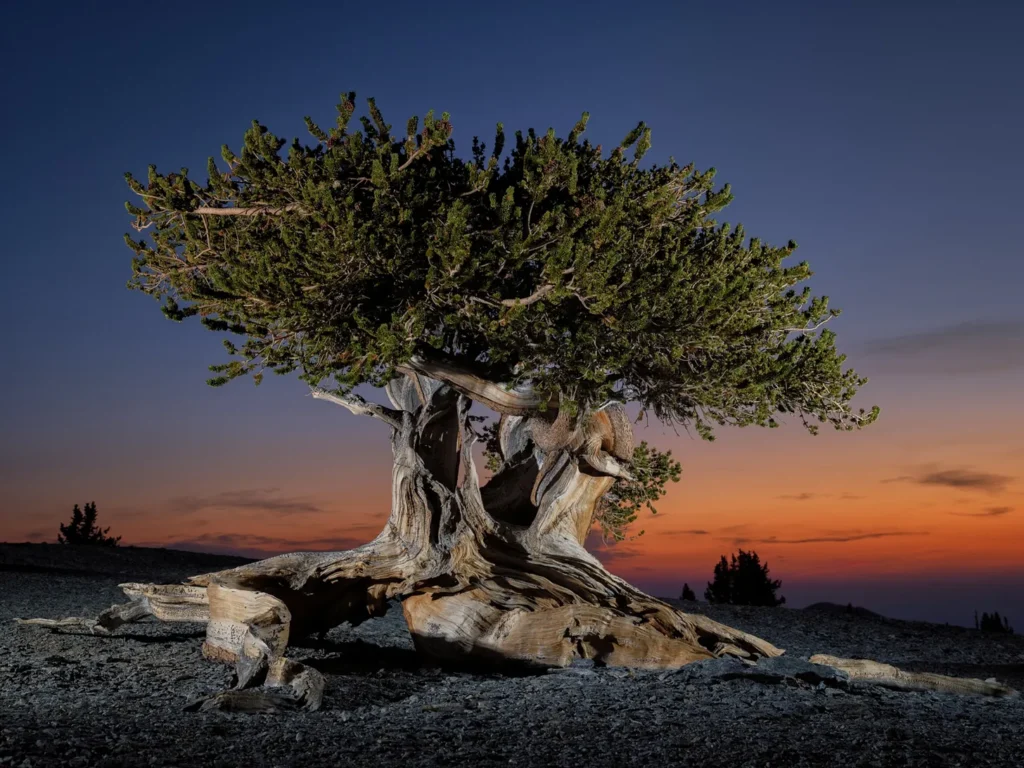
Creosote Bushes and Cypress Groves are in a different class — root systems that can be thousands of years old. Many plants that look like individual trees, but in fact they have grown from a single seed via the same roots. The Pando Cypress grove in Utah is said to be 80,000 years old.
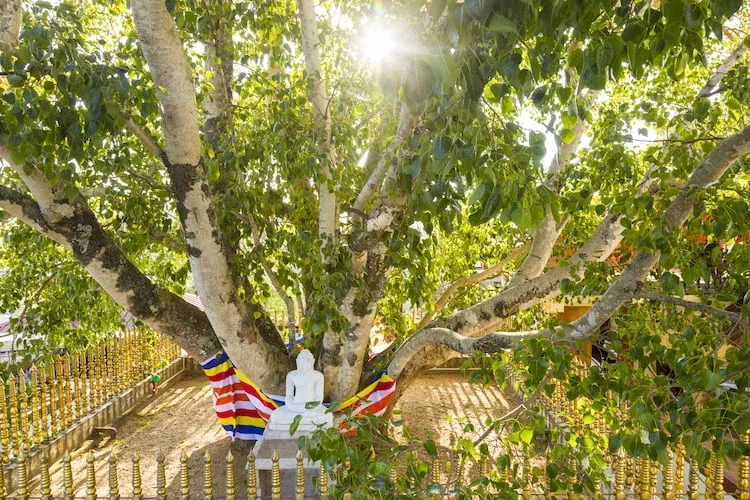
Plants can propagate from cuttings. A cutting from a cutting from a cutting from the banyan fig tree under which the Buddha was enlightened 2500 years ago is still growing in Sri Lanka.
Three aging behaviors in plants, and how to explain them
There are three modes that cover most plants, I believe.
- Annuals, grow for a summer and die. Only seeds survive the winter.
- Plants that leave a bulb or taproot over the winter are a variation.
- Plants that spread horizontally and don’t age at all
- Trees that grow vertically until they become vulnerable to wind or lightning
1. Annuals
Every gardener is familiar with plants that grow through the summer, then flower and die after the flower goes to seed. Marigolds, Zinnias, and Sunflowers are common examples. Classical evolutionary theorists would like to say that they use up all their energy in the process of flowering, and that’s why they die. But the gardener knows that if she pinches the flower off before it goes to seed, the plant recognizes that it has not yet successfully reproduced, and grows another flower. And another. And another. So why does it normally die after flowering once? There are no satisfactory answers either from the classical explanations (individual selection) or even the alternatives listed above (based on evolutionary advantage to the community). The only communal advantage I can think of is avoiding the danger articulated by Darwin 150 years ago, and that is collapse of diversity as a few of the fittest specimens dominate the next generation with their offspring.
Pansies are an illustrative case. Whether they die after going to seed depends on the climate. With hot summers and cold winters, the pansy bolts and dies in the heat of summer, and in any case can’t live through the deep frost. But in milder climates, pansies (the same species) can live two or three seasons, so long as the flowers are snipped off and not allowed to go to seed.
2. Horizontal spread, no aging
In a meadow in Sweden, the Sanicula shrub has been studied continually since the middle of the last century. It is a common plant and not particularly impressive to look at and perhaps the only remarkable thing about it is that it has been studied intensively. About one shrub in 70 dies each year, apparently from environmental factors, so that the plants have an average lifespan of 70 years. But the curious thing is that a 70-year-old plant does not seem to have a different mortality risk than a 10-year-old plant. Humans have a comparable lifespan to Sanicula, but because we age, very few humans reach 100 years old and none reach 150 years. Aging means that death is biologically determined and this limits our lifespan. But in Sanicula, death is merely a matter of constant chance. With one plant in 70 dying each year, there will be about half left at the end of 48 years (because exp(–48/70 = ½); but that half will be untouched by age. So at the end of another 50 years, one quarter still remain and an eighth are still alive after 150 years. At this rate, about one in a million would live a thousand years. If human lifespans followed the same distribution as Sanicula, there would be a few people still alive who could give firsthand accounts of Leonardo da Vinci (1452-1519) and perhaps one or two who were in England at the time of the Norman Conquest (1066).
The Swedish Sanicula is interesting because it doesn’t sprout from ancient roots, but it is closely related to the American Sanicula, which does. We can speculate that its indefinite lifespan evolved in the root-propagating species.
Plants that grow from bulbs or tubers can look like annuals, and in fact some (Dahlias, Gladiolus, Begonias) have the same ability to flower multiple times if the flowers are snipped. But most other plants that store up energy in bulbs or tubers will not re-flower if they are deadheaded.
Tubers like potatoes (that do not age) seem continuous with plants (like Aspens) that have root systems that can go on for tens of thousands of years.
All of these are capable of sexual reproduction, which adds to diversity and evolvability on a very long time scale; but they reproduce most of the time by spreading from their root systems.
In the animal kingdom, flatworms seem to have evolved the same strategy. They reproduce vegetatively, as any piece of a planarian can regrow an entire worm. But they’re also capable of (rare) sexual reproduction.
3. Trees that grow vertically
Most trees seem to do what Blagosklonny predicted: They keep growing past the stage when their size becomes a liability.
If you define aging as “increasing probability of death with each passing year”, then trees age backwards for decades, sometimes centuries. The larger they grow, the less likely they are to die. If you define aging in terms of declining fertility, your verdict is the same: “negative senescence” for trees, which produce ever more seeds as they grow larger.
But there comes a time when size becomes a mechanical liability. The stress on the trunk is proportional to its weight times the lever arm, which is its height. The strength is proportional to the cross sectional area of the trunk, but a fatter trunk also multiplies the liability because of increased weight. Eventually, growing taller becomes a losing game, and more branches at the top create a fat target in a windstorm.
Old trees have a greater probability of dying because they are tall, they are exposed to wind and lightning, and they are too big for their bases. Do they undergo replicative senescence at the end, producing fewer seeds than in their youth? Some do (Birch, Jack Pine), most don’t senesce.
Fungi
Quick review of mushroom biology — In field and forest, mycelia form a dense web of underground fibres, consuming the organic matter as they grow fibres thinner than a human hair. Of course, they are important for recycling organic material and fixing nitrogen. And since the work of Suzanne Simard, we understand that mycelia extend the reach of plant roots to bring water and nutrients, and that mycelia exchange sugars as well as minerals between plants, exacting a toll along the way in order to keep themselves alive.
Mushrooms are the occasional fruiting bodies formed from large underground networks of mycelia. Like cypress or creosote groves, the mycelia propagate underground indefinitely, and take the opportunity for sexual reproduction only rarely. A mushroom typically contains many billions of spores. Each one contains only half a set of chromosomes (like an animal sperm or egg cell) and needs to find another spore from a different mushroom in order to seed a new mycelial network.
Here’s a mystery: In the wild, in old growth forests, mycelial networks have been observed that are thousands of years old. But in the laboratory, mycelial fibres grow for a few weeks or months and then stop growing. It has been understood since 1980 that there is a mechanism of programmed senescence through fragments of mitochondrial DNA that leak into the cytoplasm and poison the organism.
Yeast
For anyone who studies fungi, the Latin name of ordinary Brewer’s Yeast is familiar. Saccharomyces cerevisiae is a favorite laboratory model for the study of aging. Its lifespan is measured not in days or weeks but in replication counts. The time rate of reproduction is very temperature dependent, but the replication count is not. The mother cell reproduces asymmetrically, spinning off daughter cells until she becomes exhausted after 20 or 30 replications. She succumbs to telomere shortening, while her daughters have fresh, newborn telomeres. Saccharomyces makes an interesting model because her lifespan is plastic, responsive to feeding most famously. The less food available in her liquid culture, the longer she goes on reproducing.
In the 1990s, Valter Longo famously discovered that yeast cells, when starved, have a communal life-prolonging behavior. 95% of the cells will die via apoptosis, feeding themselves to the remaining 5%. The cells are identical clones. How they decide who will be in the lucky 5% is still not known.
Fungi and theory
Fungi are not producers (green plants) but consumers (like animals). So maybe the Demographic Theory ought to apply, and fungi ought to have limited reproductive rates and aging in order to protect their “prey” species. So why do fungi in the wild tend to have unlimited lifespans like plants, rather than programmed lifespans like animals?
Also like plants but not animals, fungi reproduce copiously, producing far more spores than are necessary for replacement. A tree over its lifetime can produce billions of seeds. A single mycelial network generates mushrooms with trillions of spores. Animals lay only a few hundred eggs, and mammals’ fertility is yet less profligate.
Animals can over-graze or over-hunt, and drive their food species (locally) to a point of unsustainability. This is why animals must limit their growth rates with evolved birth and death rates matched to their ecology. Plants don’t have to worry about using up the sun. And fungi don’t have to worry about driving their food source to extinction because they live on dead matter. Most fungi don’t have to kill to live. I suspect that this is why they can afford to live for thousands of years.
Here’s a fact from the animal kingdom that might support this way of thinking: Animals that live on dead carcasses tend to have longer lifespans than animals that hunt or peck. For example, vultures live 30-40 years, compared to 10-20 for eagles and 5-15 for turkeys. Hyenas live longer than wolves. Jackals live longer than coyotes. Catfish live longer than trout or perch. (These are consistent tendencies, but not strict rules.)
What of fungi that parasitize living organisms?
Armillaria ostoyae looks like an ordinary mushroom, and spreads underground via mycelia. But Armillaria feeds on living wood, and kills trees by the forestfull.
Like other fungi (that don’t need living wood), Armillaria shows signs of senescence in the lab, but in the wild lives for an indefinite period. That looks like an exception to the Demographic Theory.
But somehow, Armillaria is taking care of its host. In the middle of Oregon is Malheur National Forest, where there is an Armillaria mycelium network spanning thousands of acres, sometimes claimed as the largest organism in the world. It is thousands of years old, and that means that, despite killing trees, it has been careful not to kill the forest that sustains it. This is wise parasite behavior, even if it doesn’t include senescence.
Discussion
10 reader comments
Imported threads are marked Archive. New comments are welcome and moderated for spam.
I like the idea Darwin put that the fittest could become too much a component of subsequent generations reducing diversity. During competition the fittest animals and their direct offspring is likely to outcompete most of the other animals. Though there is also another potential issue that could arise, if gamete mutation occurs through time, increasing through time, and isn't weeded out, we could have the fittest animals being the best breeders and introducing ever more mutations into the population, akin to inbreeding this could destroy the genetic quality of the population.
Mr. Katcher, could you give us an update on your E5 situation?
Hi Josh et al.,
So there were various issues raised, two stand out, whether or not plants age, and 2. How can it be that fungi in the wild are immortal while those grown in the lab have a short lifespan.
So, as to whether plants age, you divided plant aging into three categories, annuals (why not biennials?) - horizontally spreading and vertically spreading plants, though I don’t know why you chose those categories – but the lifespans of those species named seem to illustrate the two modes of aging you propose, programmed aging and immortality. Annuals and biennials are semelparous, the develop to the point of sexual maturity, produce seeds and die. They respond to an environment (the coming of winter) they cannot survive, so in order for the species to persist, they must use their resources to advance themselves (annuals are the first to colonize virgin ground) and to load their genomes into seeds that can survive the winter. I believe, as in mammals, the cessation of growth, or the gaining of sexual maturity stops growth and leads to death (which would occur anyway). When the flowers are cut, they regrow multiple times, while without cutting, those same flowers would only appear once and die is easily explained by this paradigm, the dying (or better, fertilized, flower) sends a signal that stops flowering (a phytohormone?) , telling the plant it’s reached its goal of reproducing, and not to bother further. Cutting leaves the plant feeling unfulfilled and proffers its flowers for its next attempt at love. As for the vertical and horizontal, there are some apparently immortal tall trees, like sequoias, but as you say, short ones, like Joshua pines as well that appear immortal. What about all those spreaders, like grass, is it immortal. I asked Chat, which said, leaves are mortal, they live for days or weeks, whither and die. The grass persists as its meristems lie close to the ground and apart from reproducing sexually (wheat, rye, corn, rice, etc. are all grass seeds), it reproduces by rhizomes, runners, roots. So, it’s really hard to say if its immortal or not. But clearly “immortality” (non-aging) is possible for the plant kingdom, as is programmed development. As with animals, like the shark, it may be the case that continual growth simply makes the organism prey to natural causes of death. (It’s said that as the shark grows, as surface area grows by the square of the size, while mass by the cube, until the gills no longer have the surface area to provide enough oxygen to the body.
As to the immortality of wild fungi, I think the answer is to be found in your observations that the same fungi immortal in the wild, are very mortal in the laboratory. The first thing that crossed my mind was that there was something missing in laboratory conditions that was present in the wild. So, what was missing was the connection with plants. We know that beneath the forest floor lies a complex network of fungal mycelia, and that those fungal hyphae penetrate plant cells providing an intimate connect between the cytoplasm of the fungus and the cytoplasm of the plant cells.
Now, as some of you know, I’ve long held the belief that exosomes are one secret to immortality. Anyone who knows the literature would agree that exosome can have healing properties, in fact, anything that can be done with stem cells can be better done with exosomes. So, let’s imagine, as most do, that aging is caused by accumulated damage (it’s not – exactly) and that vertically and horizontally spreading plants are immortal. Then let us suppose that they never stop growing and therefore must be continually providing repair exosomes for their tissues. Now, the intimate connection between fungus and plant allows the fungus access to the plant repair exosomes, which it uses to repair its own damage. I’ve already shown that pig exosomes can be used to promote rejuvenation in rats (and also increased longevity, though with a small sample size) – and so the homology of exosomes may go back past the division of the higher Eukaryota from Protista, so that perhaps tree exosomes might help us as well? Anyway, that’s my take on your interesting essay.
Harold, does this mean that in your opinion, exosomes are exosomes and they don't necessarly have to be derived from blood to have healing properties for humans? I've looked different sources of exosomes up some time ago. There's certain sources that really have a lot, and I thought that's super interesting and might somehow be helpful to live longer.
It is crazy the difference in senescence of things. Even in animals you can have ones with similar max lifespans but one will have a long period of senescence before death while the other has a very small time frame of that near the end. I wonder if anyone has researched why that is the case with say humans compared to turtles and cŕocodiles etc.
How do you explain that one type of tree lives to the same age all over the world?
This would mean that the noxa that causes aging acts with the same force all over the world.
Good write-up of the plant kingdom and longevity.
But what can we learn from this for HUMAN longevity ?
Your theory on ageing makes sense from an evolutionary viewpoint. However, in my opinion you must take it a step further and rephrase it from the perspective of the survival of the gene/s for ageing; the animal or plant merely being a vehicle for the replication of the gene/s. Then your theory is complete.
There are details in my book and in this blog from long ago.
https://scienceblog.com/joshmitteldorf/2013/07/01/the-demographic-theory-of-aging/
Hi, 5 fungis that parasitize insects and modify the behavior of their hosts https://www.nationalgeographic.com.es/medio-ambiente/hongos-zombificadores-muy-eficientes-mas-alla-the-last-of-us_24801. One of them is an exceptional, very expensive adaptogen (Cordyceps Militaris).