

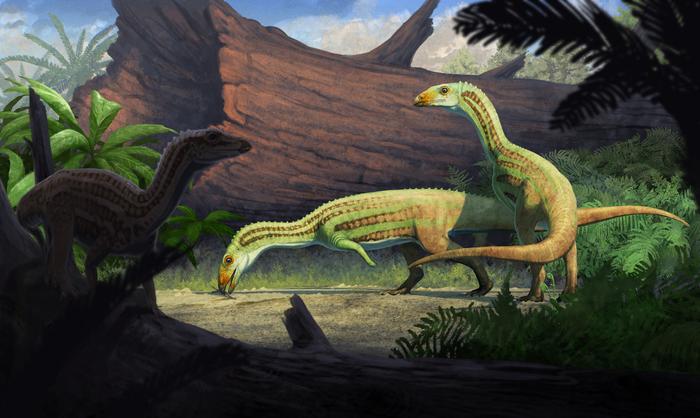
The left femur is about as long as your finger. Seventy-five millimetres of hollow bone, light enough that a poodle-sized animal could carry it without much effort, robust enough to reveal something odd: it grew faster, and thicker at the top, than the corresponding arm bone from the same species. Thirty-three complete femora from a single quarry in Arizona, ranging from that shortest specimen all the way to 178 millimetres, told a story that took a decade of excavations and careful measurement to read.
The animal was Sonselasuchus cedrus, a newly named species of pseudosuchian archosaur that lived roughly 215 million years ago in what is now Petrified Forest National Park. It belongs to a group called the shuvosaurids, distant relatives of modern crocodilians, though you would never guess that from its appearance.
Shuvosaurids are perhaps the strangest case of convergent evolution the Triassic produced. They evolved toothless beaks, large eye sockets, hollow bones, and upright two-legged stances that mirror, almost exactly, the body plan of the ornithomimid dinosaurs they shared the landscape with , the long-necked, ostrich-like runners familiar from late Cretaceous fossil beds. The shuvosaurids did all of this independently, on what palaeontologists call the croc-line of the archosaur family tree, roughly a hundred million years before ornithomimids existed. It’s a remarkable instance of two distantly related lineages arriving at the same solution to what was probably the same ecological problem.
Sonselasuchus adds a wrinkle. Most bipeds are born bipedal.
The new species appears to have started life as a four-legged animal and transitioned to two as it matured, a developmental sequence that’s essentially unheard of in this group. “By analyzing the proportions of the limb skeletons of different animals, they determined its bipedal stance (standing on two feet) may have been the result of a differential growth pattern,” said lead author Elliott Armour Smith, a graduate student at the University of Washington. “We think that Sonselasuchus had more proportional forelimbs and hindlimbs as young, and their hindlimb grew longer and more robust through adulthood.”
That conclusion rests on a reduced major axis regression analysis: a statistical technique for comparing how two measurements scale against each other as body size increases. The femur, the upper leg bone, grew under positive allometry relative to femur length, its proximal end becoming proportionally wider and more robust. The humerus, the upper arm bone, did the opposite, scaling at a rate below isometry , meaning that as the animal got bigger, the arm got comparatively smaller. “Essentially, we think these creatures started out their lives on four legs… they then started walking on two legs as they grew up,” said Armour Smith. “This is particularly peculiar.”
Peculiar is perhaps an understatement. The finding sits in a broader context of what palaeontologists are still working out about shuvosaurid biology. The three previously known North American species , Shuvosaurus inexpectatus from Texas and Effigia okeeffeae from New Mexico, plus the Argentine Sillosuchus , were each known from individual or near-individual specimens, which makes population-level questions like “did the limb proportions change through ontogeny?” basically impossible to answer. Sonselasuchus, by contrast, is represented by more than 950 skeletal elements recovered from a single quarry, the Kaye Quarry at the heart of the park, and those elements preserve individuals across a wide range of body sizes.
The bonebed itself may represent a social group caught by drought. Isotopic evidence from the Sonsela Member of the Chinle Formation records the onset of increasing aridity at around 215 million years ago, consistent with the collapse of the Late Triassic megamonsoon, and the skeletal assemblage is dominated by what bone texture, co-ossification patterns, and size demographics suggest were mostly subadult animals. Whether they died together in a single catastrophic event or accumulated over multiple cycles of flooding and redeposition isn’t yet clear; the taphonomy is still being worked out. But the preservation is extraordinary. The disarticulated bones come from at least 36 individuals, perhaps more, and include three-dimensional views of skull elements rarely preserved in other shuvosaurids.
Professor Christian Sidor of the University of Washington and Burke Museum, who led the fieldwork, put it plainly. “Since starting fieldwork at Petrified Forest in 2014, we have collected over 3,000 fossils from the Sonselasuchus bonebed, and it doesn’t seem to show any signs of petering out,” he said. “In addition to Sonselasuchus, the bonebed has yielded fossils of fish, amphibians, as well as dinosaurs and other reptiles. Over 30 University of Washington students and volunteers have been involved over the years. It’s exciting to see that the site continues to produce new and interesting fossils.”
The shuvosaurids as a group didn’t survive the end-Triassic mass extinction. Whatever ecological role they filled , soft-vegetation herbivory is the current hypothesis, based on jaw biomechanics and their edentulous, beak-bearing skulls , was vacated around 201 million years ago, and the ornithomimid dinosaurs that came to resemble them so closely didn’t evolve for tens of millions of years after that. The convergence, in other words, didn’t persist: the croc-line solution to a particular ecological niche was tried, perhaps refined through a growth-stage transition that shifted weight-bearing from all four limbs to two, then erased.
What the Kaye Quarry dataset will enable next is a histological growth series: thin sections of femoral bone that can reveal growth rings, growth rates, and the age at which individuals died. That work is already under way. It should eventually confirm or complicate the allometric picture, and could clarify whether the quadrupedal-to-bipedal shift happened gradually through ontogeny or as a relatively abrupt transition at a particular developmental stage. Sonselasuchus cedrus, named for the cedar tree and the geological member from which it came, has only just started talking.
DOI / Source: https://doi.org/10.1080/02724634.2025.2604859
Frequently Asked Questions
Why would an animal switch from four legs to two as it grew up , doesn’t that seem backwards? It’s counterintuitive, but developmental shifts in locomotory mode aren’t unknown in the fossil record. What’s unusual here is the direction and timing: most bipedal archosaurs appear to have been bipedal from hatching. The proposed shift in Sonselasuchus is inferred from the fact that its forelimb grew proportionally slower than its hindlimb as body size increased, suggesting that as juveniles their arms were weightbearing, but adult animals had hindlimbs robust enough to support the body alone. Whether that shift was abrupt or gradual is something bone histology may eventually answer.
Are shuvosaurids actually related to crocodiles, and how is that possible if they looked like dinosaurs? Shuvosaurids sit on the pseudosuchian, or croc-line, branch of the archosaur family tree, making them more closely related to living crocodilians than to birds or non-avian dinosaurs. Their dinosaur-like body plan evolved independently through convergent evolution: similar ecological pressures in the same Late Triassic ecosystems apparently favoured the same suite of traits, including bipedalism, a toothless beak, large orbits, and hollow bones. The shuvosaurids reached this body plan roughly 100 million years before the ornithomimid dinosaurs they resemble.
What happened to the shuvosaurids? The entire lineage appears to have died out at or around the end-Triassic mass extinction, approximately 201 million years ago. The ecological niche they occupied, probably something like soft-vegetation herbivory in open woodland environments, was later re-filled by other animals, including the ornithomimid dinosaurs they so closely resembled. Their extinction was part of a broader collapse of pseudosuchian diversity that ultimately cleared the way for crocodylomorphs, the ancestors of modern crocodilians, to become the dominant croc-line lineage of the Mesozoic.
How do palaeontologists tell a crocodile relative from a dinosaur relative when they look the same? Primarily through detailed features of the ankle, hip, and skull. Pseudosuchians have a distinctive crurotarsal ankle joint in which the fibula articulates with the calcaneum in a way that differs from the mesotarsal ankle of dinosaurs. Other diagnostic features include the orientation of the pubis, the structure of the quadrate bone in the skull, and various forelimb and hindlimb proportions. Sonselasuchus was identified as a shuvosaurid using an apomorphy-based identification approach that cross-references specific skeletal features against a defined list of clade-level characters.