
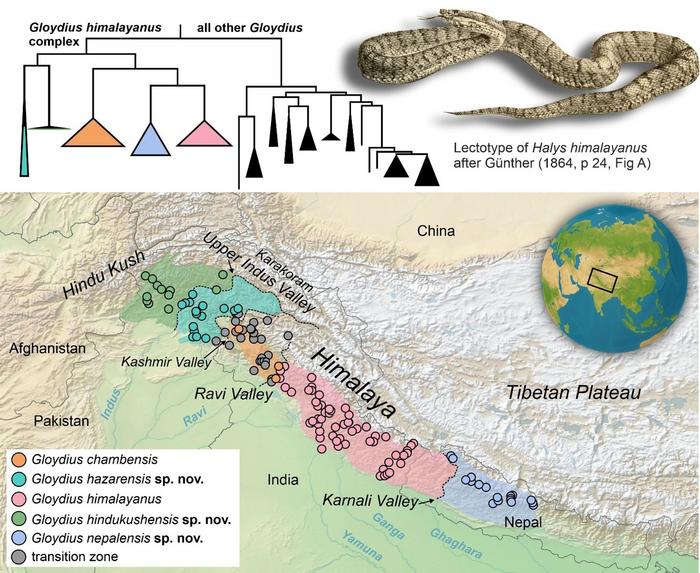
Somewhere in a basement drawer at the Natural History Museum in London, sealed in a jar of ethanol that has since outlived the man who collected it, a snake has been sitting. It arrived in 1860, brought back from the Garhwal Himalaya by the brothers von Schlagintweit during a four-year expedition on behalf of the British East India Company. It was examined, named, catalogued. And then, essentially, forgotten. The specimen is now the official holotype of the Himalayan pit viper, Gloydius himalayanus, described by the herpetologist Albert Günther in 1864 as a single wide-ranging species. For 160 years, that was more or less where the story ended. It turns out the story had barely begun.
A new study published in the journal ZooKeys has used genetic analysis, skeletal anatomy, and field surveys across some of the world’s least-accessible terrain to show that what everyone thought was one species is actually five. Three of them are new to science entirely.
The Himalaya and the Hindu Kush, the mountain ranges that sprawl across Pakistan, India, and Nepal, are spectacularly understudied. The terrain is brutal, the logistics nightmarish, and in large parts of Pakistan and Afghanistan the politics have made systematic fieldwork close to impossible for decades. What lives up there, exactly, is genuinely unknown in many cases. Pit vipers of the genus Gloydius are venomous, heat-sensing ambush predators, masters of the boulder field and the pine-needle litter, and they had been sampled almost nowhere across their full Himalayan range before Daniel Jablonski of Comenius University Bratislava and his colleagues set out to fix that. “These mountain systems still harbour overlooked vertebrate diversity and hold important clues to the biogeography of Asia,” says Jablonski.
A Mission into the Hindu Kush
Fieldwork in Pakistan’s Khyber Pakhtunkhwa province is not a straightforward proposition. The research team managed to collect specimens from the Kumrat Valley in Upper Dir District in September 2020, and it was there that the holotype of what is now named Gloydius hindukushensis, the Hindu Kush Pitviper, was found freshly killed by local villagers who had encountered it on a path. That specimen, an adult female, now resides in Vienna. A second new species, G. hazarensis, the Hazara Pitviper, turned up in the northeastern Pakistan region between the Indus and the western Himalayan foothills. And a third, G. nepalensis, the Nepali Pitviper, has apparently been sitting in museum collections from western Nepal since the 1970s without anyone realising it didn’t belong to the species everyone assumed it was.
Together with the previously recognised G. chambensis, described from India’s Chamba Valley as recently as 2022, the five lineages are separated by genetic distances ranging from roughly 9 to 14 percent in mitochondrial DNA, well within the range expected between distinct species. River valleys seem to be doing a lot of the evolutionary work here. The deep gorges of the Upper Indus, the Kashmir Valley, the Ravi, and the Karnali rivers have probably kept these populations isolated for long enough that they’ve become genuinely different animals, with distinct skull proportions, scale counts, and colour patterns. The Hazara species, for instance, is nearly uniform dark brown, where the classic Himalayan pit viper has a reticulated pale-and-dark dorsal pattern. The Nepal species has an unusually wide head relative to the others.
“By combining modern field sampling with data from historical museum specimens, we uncovered evolutionary lineages that had remained hidden for more than a century after the original description of the Himalayan pit viper,” says Jablonski.
What the Dead Can Tell Us
The piece of the research that may matter most in the long run has nothing to do with fieldwork at all. Seven of the specimens analysed genetically were historical museum material, some of it collected before Darwin published the Origin of Species. This included the 1854 von Schlagintweit type specimen itself, BMNH 1946.1.19.64, from which the researchers extracted mitochondrial DNA to confirm definitively which lineage the name himalayanus should apply to. Working with DNA from 170-year-old ethanol-preserved tissue is not trivial; it requires dedicated ancient-DNA lab protocols, specialist library preparation, and shotgun sequencing on modern platforms. The team did it, and it worked. “Museum specimens are not just records of the past. They are active research tools and essential infrastructure for future science,” says Sylvia Hofmann of the Leibniz Institute for the Analysis of Biodiversity Change, who has spent two decades working on Himalayan and Tibetan fauna. “Some of the key evidence had been sitting in museum collections for more than a hundred years. We just didn’t have the tools to recognise it.”
The finding extended G. chambensis westward by some 260 kilometres into the Kashmir Valley, based on a specimen collected around 1880 and preserved in Vienna. Nothing about that specimen changed. Its locality data didn’t change. What changed was the analytical capacity available to examine it.
This is, broadly, the promise of what’s now called museomics: the large-scale genomic study of natural history collections. Natural history museums worldwide hold an estimated three billion specimens, a vast proportion of them collected before any modern genetic tools existed. Applying sequencing to that archive is turning up surprises everywhere, from extinct birds to range shifts driven by climate change to, now, cryptic pit viper species in the world’s highest mountains. Hofmann puts it plainly: as methods improve, she says, “the scientific value of these collections will only grow.”
A Conservation Problem Without a Map
Frank Tillack of the Museum für Naturkunde Berlin, who has been collaborating with Nepalese colleagues on Himalayan herpetology for 35 years, notes that pit vipers in this region play real ecological roles as predators, particularly of small mammals, and that snakebite from these species does occur. “Our work aims to close these gaps in knowledge and to lay the groundwork and provide inspiration for further, in-depth studies on this ecologically and medically relevant group,” he says. The medical point is perhaps easy to underestimate. If you’re bitten by a Gloydius in Pakistan, the species identity of your attacker matters for understanding venom composition and, potentially, treatment response.
Rafaqat Masroor of the Pakistan Museum of Natural History, the country’s most prominent herpetologist and a co-author on the study, frames the difficulty plainly. “Pakistan’s high mountains are still full of biological surprises,” he says, though he acknowledges that realising this is one thing and acting on it is another: “This finding highlights how little we still know about a region long shaped by socio-political instability.” Each of the newly recognised species probably has a restricted range, fragile habitat, and essentially no legal protection at present, since conservation law applies to G. himalayanus as it was previously defined, not to the new entities carved out from it.
That’s the uncomfortable endpoint of a discovery like this. Three animals that didn’t officially exist last week now do, and they inhabit only a sliver each of the high Asian ranges, with climate change bearing down on exactly those elevations. The dead snakes in Victorian jars helped us find them. What we do with that knowledge is, as yet, unresolved.
https://doi.org/10.3897/zookeys.1280.182768
Frequently Asked Questions
Why did it take 160 years to realise there were five species instead of one?
Several factors compounded the delay. The Himalaya and Hindu Kush are extraordinarily difficult terrain to survey, and political instability in Pakistan and Afghanistan has blocked systematic fieldwork for decades. Museum collections held specimens from different lineages, but without genetic tools no one could tell them apart from external appearance alone. The DNA sequencing methods needed to extract readable genetic data from Victorian-era preserved specimens simply didn’t exist until recently.
How do researchers extract usable DNA from specimens that are over 150 years old?
Ancient-DNA techniques developed initially for mammoth and cave bear bones now work on wet-preserved museum material too. The DNA is highly degraded and fragmentary, so researchers prepare single-stranded DNA libraries and use shotgun sequencing to generate millions of short reads, which are then mapped against a reference genome. It requires a dedicated contamination-controlled laboratory and significant computational effort, but it’s now routinely successful on specimens from the mid-19th century.
Are these newly named snakes dangerous to people?
Pit vipers of the genus Gloydius are venomous, and snakebite incidents do occur in the regions where they live. The species identity of any given population potentially matters for understanding venom composition, though detailed toxicological work on the newly described species hasn’t yet been done. Ironically, the holotype of G. hindukushensis was found freshly killed by villagers who had encountered it on a path, which points to the human-wildlife tension these animals navigate constantly.
What does “museomics” mean and why does it matter?
Museomics refers to applying large-scale genomic sequencing to natural history museum collections. Museums worldwide hold roughly three billion preserved specimens, collected over centuries before genetic tools existed. Sequencing that archive is revealing cryptic species, extinct populations, climate-driven range shifts, and evolutionary relationships that field surveys alone could never reconstruct. This study is a good example: a specimen collected in 1880 and stored in Vienna helped extend the range of one species by 260 kilometres.
What conservation protection do the new species have?
Essentially none, at present. Conservation law in India and Pakistan applies to Gloydius himalayanus as previously defined, and the newly split species haven’t yet been assessed by the IUCN Red List. Each appears to occupy a relatively restricted range in high-altitude habitat that’s particularly vulnerable to climate change. Formal threat assessments and updated legal protections will need to follow the taxonomy, though the pace of that process in remote, politically complex mountain regions is uncertain.
Discover more from Wild Science
Subscribe to get the latest posts sent to your email.