

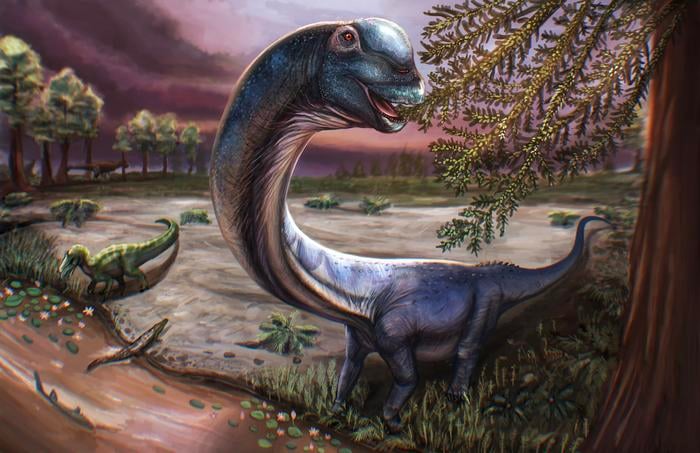
Hold a ruler alongside a standard doorframe and you get roughly two metres. The front leg bone of Nagatitan chaiyaphumensis is 1.78 metres long. A single limb, roughly as tall as a person, from an animal that nobody in science had heard of until last week. The bone sat in northeastern Thailand’s youngest dinosaur-bearing rock for somewhere between 100 and 120 million years before a local resident noticed it protruding from the bank of a communal pond during the dry season of 2016, when receding water had left the sediment exposed. Palaeontologists from Thailand and, eventually, University College London have spent the years since figuring out what it was.
What it was, it turns out, is the largest dinosaur ever found in Southeast Asia.
Nagatitan belongs to the sauropods, those long-necked, barrel-chested plant-eaters that produced some of the most implausible body plans in the history of vertebrate life. At around 27 metres in length and an estimated 27 tonnes, it comfortably outweighs Dippy the Diplodocus, the skeleton that has greeted visitors to the Natural History Museum. “Our dinosaur is big by most people’s standards,” says Thitiwoot Sethapanichsakul, the Thai PhD student at UCL Earth Sciences who led the study, “it likely weighed at least 10 tonnes more than Dippy.” That said, he adds, it “is still dwarfed by sauropods like Patagotitan (60 tonnes) or Ruyangosaurus (50 tonnes).” Size is relative when you’re dealing with the largest animals ever to walk on land.
A Titan With a Name and a Mythology
The new species has been named with deliberate care. “Naga” invokes the mythological serpentine creature venerated across northeastern Thai and broader Southeast Asian Buddhist traditions, often associated with rivers and water. “Titan” is the Greek giant. The species name, chaiyaphumensis, fixes it to Chaiyaphum Province, where the fossils were found. It is, formally speaking, a somphospondylan titanosauriform within the clade Euhelopodidae, a group of sauropods thought to be largely restricted to Asia. Phylogenetic analysis places Nagatitan as an unexpected sister taxon to Europatitan, a Spanish sauropod, which, if confirmed, would raise pointed questions about just how geographically confined euhelopodids really were. The team is cautious on that point: two different statistical methods produce slightly different results, and the authors consider it premature to conclude the group ranged beyond Asia.
What the rock record does allow, rather more firmly, is a picture of the world Nagatitan moved through. The Khok Kruat Formation, where the bones were found, represents an arid to semi-arid environment cut through by meandering rivers, perhaps something like a savannah floodplain. Crocodiles lurked in the water. Freshwater sharks too, and various fish. Above and around the giant, the fauna was ecologically busy: smaller plant-eating iguanodontians, early ceratopsians (cousins of Triceratops, though at this point far more modest in size), and big theropods including carcharodontosaurians and spinosaurids. Pterosaurs worked the rivers from the air.
Sauropods were, it seems, rather well suited to this kind of environment. The prevailing thinking is that their extraordinary surface area, spread across those extraordinary necks and tails, helped regulate body temperature in the heat. Rising global temperatures across the Aptian into what geologists call the Cenomanian-Turonian Thermal Maximum may have expanded the suitable habitat for large primary consumers, driving a broad increase in sauropod body mass across Asia from roughly this period onwards. Pre-Aptian Asian titanosauriforms averaged perhaps nine tonnes. Most of those found from the Aptian onwards exceed 20.
The Last Titan in a Closing Window
The dig itself took years. Initial fieldwork at Ban Pha Nang Sua, in the Nong Bua Rawe District, ran from 2016 to 2019. Excavation of remaining specimens didn’t conclude until 2024. What emerged were four dorsal vertebrae, sacral vertebrae and ribs, the right humerus, parts of the pelvis, and a mostly complete right femur, all apparently from a single individual. The bones were sent to the Sirindhorn Museum in Kalasin Province for preparation; copies made via 3D scanning allowed UCL researchers to work on them without international travel. “The material was studied both in Thailand and at UCL,” says co-author Professor Paul Upchurch, “3D scanning and printing has meant that we can study the specimen and collect data without having to travel.” He adds, perhaps with a trace of satisfaction, “good for reducing carbon footprint.”
The new description appears in Scientific Reports and formally identifies Nagatitan as Thailand’s 14th named dinosaur species. Sethapanichsakul calls it “the last titan” of Thailand, and the phrase carries more weight than it might initially seem. The Khok Kruat Formation is stratigraphically the youngest fossil-bearing Mesozoic unit in the country. “Younger rocks laid down towards the end of the time of the dinosaurs are unlikely to contain dinosaur remains,” he explains, “because the region by then had become a shallow sea.” There is no rock left to search. Whatever dinosaurs lived in Thailand after Nagatitan’s time left nothing behind. “So this may be the last or most recent large sauropod we will find in Southeast Asia.”
That geological closure makes what has already been found all the more significant. Dr Sita Manitkoon, a National Geographic Explorer and researcher at Mahasarakham University who led fieldwork, notes that Thailand’s dinosaur record is richer than most people realise. “Although Thailand is a small country within Asia, we have a very high diversity in dinosaur fossils, possibly the third most abundant in Asia in terms of dinosaur remains.” She points out that serious scientific engagement with that record is, in palaeontological terms, quite recent: Thailand has only been studying its dinosaurs for about 40 years, since the first species was formally named in 1986, yet it has already produced a surge of younger researchers actively working in the field. Sethapanichsakul is one of them. “I’ve always been a dinosaur kid,” he says. “This study doesn’t just establish a new species but also fulfils a childhood promise of naming a dinosaur.”
A life-size reconstruction of Nagatitan is now on display at the Thainosaur Museum at Asiatique in Bangkok, which at least gives visitors some sense of scale. The humerus alone, remember, is 1.78 metres. And somewhere in the region, Sethapanichsakul says, there is a large collection of formally undescribed sauropod fossils still waiting. “These may include a number of new species.” Whether any of them will be as large as Nagatitan, the current record-holder, there is no way yet to know.
Source: Sethapanichsakul et al., Scientific Reports, 2026
Frequently Asked Questions
How does Nagatitan compare to the biggest dinosaurs ever found?
Nagatitan, at around 27 tonnes and 27 metres long, is the largest dinosaur ever found in Southeast Asia, but it sits in the middle range for sauropods globally. South American giants like Patagotitan reached roughly 60 tonnes, and Ruyangosaurus from China was perhaps 50 tonnes. Nagatitan is, however, considerably heavier than Dippy the Diplodocus, the famous Natural History Museum skeleton, by around 10 tonnes.
Why was Nagatitan discovered at the edge of a pond?
The bones had been buried in the Khok Kruat Formation, an ancient floodplain deposit in northeastern Thailand, for around 100 to 120 million years. In 2016, seasonal water level drops exposed part of the skeleton on the bank of a communal pond in Chaiyaphum Province, where a local resident first noticed them. This kind of accidental surface exposure is one of the most common ways large fossil vertebrates come to scientific attention.
Is Nagatitan really the last large dinosaur we will ever find in Thailand?
Quite possibly, for large sauropods at least. Nagatitan was found in the Khok Kruat Formation, the youngest dinosaur-bearing rock layer in Thailand. Sediments deposited after this period represent a shallow sea rather than a land environment, meaning dinosaur remains are extremely unlikely to be preserved there. That said, Thailand holds many undescribed sauropod fossils from earlier time periods that could still reveal new species.
What does Nagatitan tell us about how dinosaurs grew so large in Asia?
The timing of Nagatitan’s appearance fits a broader pattern of increasing body size among Asian titanosauriforms during the mid-Cretaceous. Researchers think rising global temperatures during this period expanded savannah-like environments in Southeast Asia, creating more suitable habitat for large plant-eating animals. Asian titanosauriforms from before this warming event averaged around nine tonnes; most found from the Aptian onwards exceed 20 tonnes.