

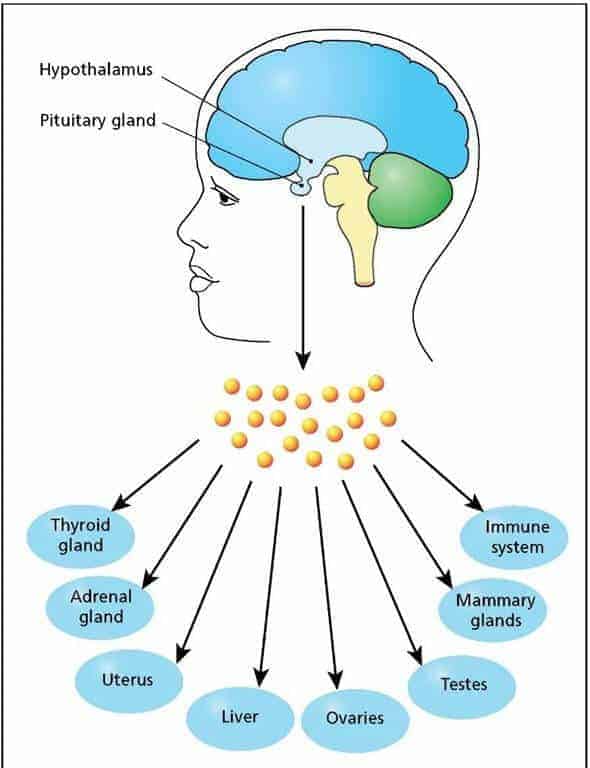
Last week, a new study came out fingering the hypothalamus as locus of a clock that modulates aging. This encourages those of us who entertain the most optimistic scenarios for anti-aging medicine. Could it be that altering the biochemistry of one tiny control center might effect global rejuvenation?
First some background….
I have staked my career on the interpretation that aging unfolds under the body’s full control. Even those aspects of aging that look like random damage are actually damage that is permitted to accumulate as the body pulls back its defense mechanisms late in life and dials up some biochemical processes that look an awful lot like deliberate self-destruction
I believe that aging is governed by an internal biological clock, or several semi-independent and redundant clocks. There are
- A telomere clock, counting cell divisions on a flexible schedule, eventually producing cells with short-telomeres that poison us.
- The thymus, crucial training ground for our white blood cells, shrinks through a lifetime.
- An epigenetic clock alters gene expression over time in directions that give rise to self-destruction.
- A neuroendocrine clock in the hypothalamus
- Perhaps other clocks, yet to be identified.

A dream is to be able to reset the hands of the clock. If we’re lucky, then changing the state of some metabolic subsystem will not just temper the rate at which we age, but actually restore the body to a younger state. Most of the research in anti-aging medicine is still devoted to ways to engineer fixes for damage the body has allowed to accumulate; but I belong to a wild-eyed contingent that thinks the body can do its own fixing if we understand the signaling language well enough to speak the word “youth” in the body’s native biochemical tongue.
Some of these clocks are more accessible and easier to manipulate than others. The epigenetic clock is most daunting, because it presents the spectre of a global network of signal molecules circulating in the blood, transcription factors that mutually support one another in a state of slowly-shifting homeostasis. This system could be so complex that it might take decades to understand, and then hundreds of different signal molecules in the blood would need to be re-balanced in order to recreate homeostasis in a younger condition. (For several years, the Mike and Irina Conboy have been looking for a small subset of molecules that might control the rest, but in a private conversation they recently told me they are less optimistic that a small number of factors controls all the rest.)
At the other end of the spectrum, the hypothalamic clock presents the most optimistic scenario. It is tightly localized in a tiny region of the brain, and might be relatively easy to manipulate, with consequences that rejuvenate the entire body. The hypothalamic clock hypothesis is an attractive target for research because, if correct, it will offer direct and straightforward control over the body’s metabolic age.
That aging unfolds according to an internal clock remains a controversial claim, but what everyone agrees is that the body has some way to know how old it is. There has to be a clock for development that determines when growth surges and stops, when sex hormones turn on and, if it’s not too great a stretch, when fertility ends and menopause unfolds.
The clock that governs growth and development has yet to be elucidated—a major metabolic mystery by my lights. The clock that we know about and (sort of) understand is the circadian day-night clock that governs sleep and waking, giving us energy at some times of the day but not others.
Is the life history clock linked to the circadian clock? Maybe the body just counts days to tell how old it is? This possibility was eliminated, at least for flies, using experiments with cycles of light and dark that were consistently longer or shorter than 24 hours. Flies living with fast day-night cycles (less than 24 hours) lived shorter, as predicted; but flies living with long day-night cycles failed to have longer lifetimes, In fact, deviation from 24 hours in either direction shorten the fly’s lifespan [2005].
But this study suggests the short-term clock and the long-term clock may be linked in a way that is less straightforward. Melatonin may be another reason to expect a connection. Melatonin is the body’s cue for sleep, and Russian studies have documented a role for melatonin in aging. A third motivation comes from the fact that aging disrupts sleep cycles, and (in a downward spiral) disrupted sleep cycles are also a risk factor for mortality and diseases of old age.
Cells seem to have their own, built-in daily rhythms. I want to say “transcriptional rhythms”, adding the idea that gene transcription is the locus of control; however, red blood cells are the counterexample—they exhibit daily cycles, even though they have no DNA to transcribe [2011]. Individual cycles are designed to be 24 hours, but they would soon drift out of phase with day and night if they weren’t centrally coordinated. The reference clock that keeps the others in line is in the SCN, the suprachiasmatic nucleus, a handful of nerve cells in a neuroendocrine part of the brain called the hypothalamus.
Think of a million pendulums that are all tuned to swing with a period of 24 hours. All that it takes is a tiny nudge to all these pendulums each day to keep them in phase with one another, so they are all swinging together. The SCN provides this nudge in a smart way, based on information from the eyes (light and dark) and endocrine signals that indicate activity and sleep. The SCN is upstream of the pineal gland, and supplies the signal that tells the pineal gland when it’s time to make melatonin. The natural resonances of individual cells become entrained in a body-wide response.
What does all this have to do with aging?
Experiments in the 1980s and 90s showed that the SCN is related to annual cycles, but the relationship seems to be not as strong or as simple or as direct. For example, squirrels in which the SCN was removed had no daily sleep-wake cycles at all, but their annual cycles of fertility and oscillations of weight were affected inconsistently, more in some animals than others. Transplanting a SCN from young hamsters into old hamsters cut their mortality rate by more than half, and extended their life expectancies by 4 months [1998].
I have written in this column [one, two] about research from the laboratory of Claudia Cavadas (U of Coimbra, near Lisbon) indicating that inflammation and inflammatory cytokines in the hypothalamus are at the headwaters of a cascade of signals that lead to whole-body aging. They have emphasized the role of TGFß binding to ALK5 and of the neurotransmitter NPY. We usually think of inflammation as a source of damage throughout the body, but in the hypothalamus, inflammation seems to have a role that is more insidious than this, with full-body repercussions. Blocking inflammation in the hypothalamus is a promising anti-aging strategy.
New Paper on micro RNAs from the Hypothalamus
Along with Cavadas, Dongshen Cai (Einstein College of Medicine) has been a leader in exploring neuroendocrine control of aging that originates in the hypothalamus. Several years ago, Cai’s group demonstrated that aging could be slowed in mice by inhibiting the inflammatory cytokine NF-kB and the related cytokine IKK-ß just in one tiny area of the brain, the hypothalamus. “In conclusion, the hypothalamus has a programmatic role in ageing development via immune–neuroendocrine integration…” They summarized findings from their own lab, suggesting that metabolic syndrome, glucose intolerance, weight gain and hypertension could all be exacerbated by signals from the inflamed hypothalamus. In agreement with Cacadas, they identified GnRH (gonadotropin-releasing hormone) as one downstream target, and were able to delay aging simply by treatment with this one hormone. IKK-ß is produced by microglial cells in the hypothalamus of old mice but not young mice. Genetically modified IKK-ß knock-out mice developed normally but lived longer and retained youthful brain performance later in life.
In the new paper, Cai’s group identified micro-RNAs, secreted by the aging hypothalamus and circulating through the spinal fluid, that contribute to aging. A small number of stem cells in the hypothalamus were found to keep the mouse young, in part by secreting these micro-RNAs. Mice in which these stem cells were ablated had foreshortened life spans; old mice that were treated with implants of hypothalamic stem cells from younger mice were rejuvenated and lived longer. A class of neuroendocrine stem cells from the third ventricle wall of the hypothalamus (nt-NSC’s) was identified as having a powerful programmatic effect on aging. These cells are normally lost with age, and restoring these cells alone in old mice extended their life spans.
Exosomes are little packets of signal chemicals. Micro-RNAs from stem cells in the hypothalamus are collected into exosomes and shipped down through the spinal fluid. These exosomes seem to constitute a feedback loop. On the one hand, they are generated by the hypothalamic stem cells. On the other hand, they play a role in keeping these same cells young, and producing more exosomes.
Life extension of about 12% was impressive given that there was just one intervention when the mice were more than 1½ years old, but of course it’s not what we would hope for if the master aging clock were reset. For really large increases in lifespan, we will probably need to reset two or even three of the clocks at once.
The Bottom Line
The reason the body has multiple, redundant aging clocks is to assure that natural selection can’t defeat aging by throwing a single switch. That means the clocks must be at least somewhat independent. Nevertheless, I judge it is likely that there is some crosstalk among clocks, because that’s how biology usually works. To effect rejuvenation, we will have to address all aging clocks, but we see some benefit from resetting even one, and expect more significant benefit from resetting two or more.
The most challenging target is the epigenetic clock,built on a homeostasis of transcription and signaling among hundreds of hormones that each affect levels of the others. Reverse engineering this tangle will be a bear.
The idea of a centralized aging clock in the hypothalamus seems far more accessible, and is promising for the medium term. Still, it does not suggest immediate application to remedies. The hypothalamus is deep in the brain, and you and I might be reluctant to accept a treatment that required drilling through the skull. A treatment based on circulating proteins and RNAs from the hypothalamus would be less invasive, but even that might have to be intravenous, and include some chemistry for penetrating the blood-brain barrier. RNA exosomes seem to be our best opportunity
As Cavadas’s group has already pointed out, it is inflammation in the hypothalamus that is amplified by signaling to become most damaging to the entire body. This raises the interesting question: could it be that the modest anti-aging power of NSAIDs is entirely due to their action within the brain? In other words, maybe “inflammaging” is largely localized to the hypothalamus.
Discussion
115 reader comments
Imported threads are marked Archive. New comments are welcome and moderated for spam.
Nice Josh, I too am of that 'wild-eyed' group and I think we've already proven your contention. I too follow Cai's work and you adequately quoted his results, but he found that exosomes derived from the conditioned media of neural stem cells cultured in vitro had the same life-extending effects as actually injecting the stem cells themselves into the hypothalamus. One 'minor' point is that NF-kB (that's 'kappa' B) and IKK-beta are not cytokines - NF-kB is a transcription factor which is induced by various things including cytokines, esp. IL-6. IKK-ß is a protein to which NF-kB is joined (like many transcription factors NF-kB and its inhibitor IKK-ß form a pair preventing NF-kB from entering the nucleus. Only when the bonds are broken (say by oxidation damage from excessive levels of ROS or by induction through cytokines) NF-kB can leave the nucleus and do its job - which includes the elaboration of the same cytokines (TNF, IL-6 etc.) as induced it - and also prevents apoptosis and leads to cellular senescence. In one study I read, old mouse skin treated so that NF-kB would leave and not re-enter the nucleus of the skin cells (in vivo, on a live mouse), showed a complete transformation of the structure of that aged skin to that of a newborn mouse. So, yes NF-kB is part of the problem. Also please note that while Cai did get life extension - it was not that much. Cai himself states that the hypothalamus is a master clock that controls tissue 'slave' clocks (in Hindi the word 'golam' means slave - a big insult is to say a man is his wife golam - note the resemblance to the Hebrew 'golem') - anyway as you say there are many clocks. The circadian rhythm that you mention is an alternation between a oxidizing cytosolic/nuclear environment (during energy generation) and a reducing one (for redox repair) - and though there is transcription translation feedback look that controls it - there is also an independent system (present in red blood cells - even though the have no transcription) that relies on the omnipresent redox enzymes - glutaredoxin, peroxyredoxin etc (the most common proteins in a cell). I believe that this cycle has much to do with cellular aging. The entire process is however systemically controlled - a big difference in Cai's approach is that he assumes aging is systemic while everyone else, including Lopez-Otin, (Hallmarks of aging) assume aging occurs at the cellular level (which it does, but is controlled at higher levels).
How would RNA reabsorbed by the body via gametes (thinking Celibacy) affect the Hypothalamus and it's Micro RNA function? If at all?
Same with other nutrients that are common in Semen? Phosphatydlcholine for example.
Study was done on Korean Eunuchs that lived in palaces during Monarchical times in that country. Royals lived on avg to 45-50. Eunuchs 65-70
Good article. I can confirm this theory with a clear conscience. I have long been working with biopeptides (= information molecules) isolated from the cells of various organs and tissues of healthy young animals (pig, calf). These biopeptides exactly stimulate protein biosynthesis in the human cells from which they originally came. We also develop and produce preparations for naturopathic practitioners with these substances. We have seen that with regular use of these peptides, the functions of the organs (from which these peptides are derived) can be improved or maintained. Particularly effective are pineal gland peptides. The pineal gland is also considered a biological clock. I agree with Josh that you can have a very good anti-aging effect by turning back several biological clocks. I can well imagine that combination of hypothalamic peptides + pineal gland peptides would lead to a very good effect. However, I must mention at this point that the use of these peptides only rejuvenate the body's endocrine system. In order to rejuvenate the entire body as possible, functions of other systems must be rejuvenated, such as immune system, nervous system, etc.
Josh,
How is this theory of aging different than Olivnikov’s Chronographic Theory of Aging as detailed in his 2015 paper: “Chronographic Theory of Development, Aging, and Origin of Cancer: Role of Chronomeres and Printomeres”?
I think this study goes in the face of the extrinsic / systemic clock hypothesis.
http://www.haematologica.org/content/102/8/e321
There is an older article corrobating the findings
Although there is a spurt of rejuvenation after the hematopoietic stem cell transplantation, epigenetic age of blood continues to be correlated to the donor instead of the recipient.
Again I believe those parabiosis - exosome mediated effects might be just due to alleviating some problems at tissue level healing, but not really making the individual cells any younger.
Seems to me that Simulation of what Dr Katcher calls HPE is possible. How close? Don't know for certain, but I believe very close.
1 - Slough off Aging Factor tainted plasma via Red Cross blood donations. The RC is in great need of platelet donations. A lot of plasma is also taken during platelet apheresis. (I got rid of 2.5 liters of plasma in 4 months.)
Assumption : Most (all?) aging factors are inflammatory or triggered by inflammation.
2a - Trigger Muscarinic - Acetylcholine Receptors in the Hypothalamus which triggers the Cholinergic Anti-Inflammatory Pathway to reduce inflammation in Splenic Macrophages. Doing so has been shown to reduce inflammation in the circulation (see Tracey youtube discussion in 20 minute talk to DARPA in 2016).
2b - Trigger Heat Shock Protein 70 to reduce inflammation.
This isn't a silver bullet that cures aging, but it is a bullet that can be fired Now.
There are loads of research papers on using exosomes as a replacement for mesenchymal stem cell therapy. Seems like the way to go!
https://www.researchgate.net/profile/Verena_Boerger/publication/292342201_Mesenchymal_stemstromal_cell-derived_extracellular_vesicles_as_a_new_approach_in_stem_cell_therapy/links/56bc45b408ae3f9793155ce2.pdf
Eventually- but there's so much to know- it will be years - and that's of course making the untoward assumption that that is all there is - which I don't believe.
The point is everybody reading this website will be dead before Harold's idea becomes actual FDA approved treatment used in USA by physicians.
The point is that if rejuvenation worked, it would solve many of society's problems - not the least of which is the coming of the baby boomers to senescence. That the FDA would approve it is shown by Alkahest which is doing something similar and by our own Jesse Karmazin whose Ambrosia is doing well - but so far as I'm concerned no one is doing it correctly. So FDA has already approved similar for experimental purposes and some companies are already trying to harness the technology - without even doing the required proof-of-concept studies or exploring important variables.
Has Karmazin's study been reviewed by the Institutional Review Board? Are patients taken through the consent form process, etc.? All I know is what I read here:
https://www.technologyreview.com/s/603242/questionable-young-blood-transfusions-offered-in-us-as-anti-aging-remedy/
Exosomal therapy sounds exciting but I guess it is already part of young plasma? But the challenge remains as to where is the clock that is driving all of this - how does biological system as a whole decide when to grow teeth, when to launch puberty when to start aging. Besides the 'when' there is also instructions on 'what' to do at a particular juncture. The day we discover wherein lies this clock we may be able to address the cause of aging. And then to confuse us there are pertinent questions from other scientists as to whether there is a clock at all.
Dear Akshay,
Who has expressed doubt as to whether there are biological clocks - chronobiology is a well-established branch of biology, something like a third of all genes are clock-controlled, some directly by having an 'E-box' recognized by the transcription factors whose entry to the nucleus and binding to DNA are involved in circadian rhythms of abundance and reactivity, but my guess is that you are specifically talking about an aging clock? If so the best evidence (to me) comes from studies of mutants or animals raised under conditions which increase or decrease lifespan - under these condition you see that the basic structure of the life-span is kept - embryo, larvae (in the case of some, could be generalized to 'children'), young adult middle aged adult old adult - with the same phenotypes in all cases - however in short-lived animals (short-lived for their species) each stage takes a shorter time, and in extended-life animals, each stage takes a longer time (including the stages of decrepitude). Fontana's lab showed this with C. elegans - but it applies all the way up the hierarchy.
Harold yes the aging clock or the central clock that triggers major changes in us in a linear fashion from fertilised egg till old age. If we can see aging as an orchestra and all the different pathways and sub pathways as musicians I am trying to understand where is the conductor. Although we can't see the conductor we know there is one by observing the musicians. All our recent efforts in the anti aging community has been towards discovering the musicians and trying to influence them to change the tune (symptoms of aging). If one day we can decipher the conductor then hopefully we would need only one intervention to stop or even reverse aging. There is now sufficient evidence to show us that theoretically reversal is possible. If only.....
You seem particularly clear-sighted, yes - instead of trying to correct each out-of-tune or out of sequence musician, correcting the conductor - in your analogy - would be the better way to get the desired harmonious result. Using HPE is in essence intercepting the blood borne commands of the old body and substituting the communications of the young body (a fresh young 'conductor') with its cells.
Dear Gabor, those were good citations. One in particular, the one by Tom Rando - and the reference given to the work in C. elegans concerning a trimethylation complex that affects lifespan - I think solve your problem.
It was exactly the 2012 paper by Tom Rando, in which he asks about the possibilities of changing the epigenome through Yamanaka factors to bring about reversal of aging and whether aging can't be reversed without changing the differentiated state of the cell. I wrote him and told him that the 2005 experiments he performed in conjunction with the Conboys, showed that you could change the age-phenotype without changing the differentiated state of the cell - and it was following that that Wyss-Coray - under Tom, began investigating human blood transfusions a al Alkahest.
The second paper about the histone trimethylase complex and lifespan shows a similar thing - the epigenetic state of cells is not determined by any sort of internal 'template' or 'mask' but by signals from other parts of the body (as the hypothalamus paper at the center of this forum indicated) - in the case of the trimethylation complex in somatic tissues regulated by the ovary. Of the case of daf-2 mutants causing life extension when only expressed in two (VMI) neurons in its 'brain'.
So the epigenetic state of a cell is controlled by transcription factors which are often histone modifying enzymes in their mechanisms of action, other histone and non-histone binding proteins (like the HMG proteins) and all sorts of functional enzymes and ribozymes concerned with transcription and splicing, functional long, non-coding RNA molecules - etc. all of which function in determining chromatin state, whether open, closed or 'poised'. So my point here is that 'it's complicated' but that among the factors - important factors controlling chromatin state are the cell's metabalism - the methyl groups come from SAM (S-adensyl-methionine), the acetyl groups from acetyl-CoA (and lots of other acyl groups are also added to histone tails) and removing acetyl groups takes oxidized NAD (NAD+) all of which are available at some times and not others (as levels depend on a circadian clock) and external signals maybe completely change chromatin markings and cell behavior - the clearest example is the receipt of hormones causing drastic changes in transcriptional activities.
So to boil it down - the histone code is the working language of the cell, where it tells itself or is told how to behave depending on circumstances. Those epigenetic changes seem to be late and superficial compared with the changes corresponding to differentiated phenotype - remember young blood plasma alone has been shown to change the age-phenotypes of a large variety of stem and progenitor cell types - those changes no doubt occur at the epigenetic level but are externally controlled.
Thanks! Now that we have proof that nucleotide carrying exosomes affect organismal aging I think the pieces are falling into place.
Epigenetic clock can be reset with Yamanaka factors, so there is a way to do it without dedifferentiation.
Exosomal communication between cells maybe a good way of synchronizing the epigenetic state. Cells can directly exchange different RNA content that can act on other chrchromatin.
Exosomal therapy is probably much much easier to do than stem cell therapy also much less risky.
I wonder if feeder cells or serum utility is not at least partly due to exosomes.
Dear Gabor,
When I've proposed protocols for HPE (heterochronic plasma exchange) I've always taken that exosomes and protein complexed polynucleotides would have a direct effect on aging. There are precautions that must be taken to make sure the exosomal delivery is intact. I don't know why I thought so, but I think you will find reference to them in my 2015 paper (Towards and evidence-based model of aging) - I always believe this very direct transmission of information would be important in aging and always believed that HPE using the proper techniques and schedules would replace the exosomal content of the plasma and that the plasma communicated with the stem cell niches.
Sincerely,
Harold
Thanks again. I wonder if anyone is doing very simple experiments, like growing different kinds of embryonic tissue in dish like MEFs or iPSCs and then injecting the liquid from the culture into aging mice.
People have done such basic experiment with mixed cultures of hold and young stem cells - and found that the young stem cells could rejuvenate the older ones. Now with a greater knowledge (exosomes) as to how that age-information is transmitted, we should be doing those sorts of experiments - to begin with. Following that, the characteristics that cause exosomes to be taken up by some cells (and not others?), and the contents of these exosomes - how do they produce their youth-inducing effects - which miRNAs/mRNAs/lncRNAs/proteins/enzymes do what? It really depends on to what extent these exosomes influence aging - I wouldn't imagine they've be all of it - but I don't know. As I said, I supposed in my protocols for HPE that exosomes would be important constituents.
Yes, it seems that this is an empty field - the most dramatic and hopeful experiments concerning the only known process able to produce in situ rejuvenation in living animals, and at the cellular level, isn't being investigated by those whose entire careers are based on self-deception and clinging to an untenable hypothesis - denying the evidence by never mentioning it and ensuring that no one undertaking that challenge will be supported or published.
Dear Harold,
I have just finished your 2015 paper. It is very concise and has moved me away from the intrinsic view towards the extrinsic view. I understand you feel frustrated as your research ideas did not gain enough attention? But isnt HPE something similar to what Rando and Conboys are doing? Do you feel it is very hard to obtain a grant for HPE? Could you possibly be much luckier with crowdsourcing? If the general public understood the opportunities there would be some financing I guess. However I guess one would need funding on the order of 10s of millions of dollars just to do the experiments with the mice.
I also read the MDSPC paper.
https://www.nature.com/articles/ncomms1611
Interestingly it seems they did not have results with MEF cells, though I guess they only tried it with implantation, and probably the MEF cells didnt engraft. I wonder MEF co-culturing could have helped?
Also there was a reference to a 2007 Rando paper stating that aging in hematopoietic cells might be intrinsic afterall.
Regards,
Gabor
I like the concept of this research, though it is only a beginning. I feel there is too much discussion of so-called anti-aging procedures without taking into account whether it actually results in a youthful appearance:
The MC1R Gene and Youthful Looks
http://www.cell.com/current-biology/abstract/S0960-9822(16)30184-1
The standard evolutionary explanations of why we age have never seemed plausible to me-but it seemed counter-intuitive to me that we would actually be programmed to age.
I finally hit me that evolution would program us to age for the same reason it developed sexual reproduction.
Animals need sexual reproduction in order to give them genetic variation. Without this genetic variation, parasites, diseases, and other enemies would eventually come up with ways to crack our defenses. Some people call this the “Red Queen” theory.
if you think about it a bit, it seems obvious that organisms that didn’t age, would also end up with a lack of genetic diversity. Give me back my 20 year old body and health and let me keep the wealth, experience, and general craftiness I now have. I would then get nearly all the girls I didn’t get then, and only a few real 20 year olds would be able to compete with me. But, in any population where the older males got most of the females, and kept on getting them indefinitely, genetic variation would be severely reduced, and the species would be vulnerable to its enemies. Of course females also compete, and in an ageless species, older females would dominate younger females and monopolize resources.
Pardon me if the above seems just too obvious, and I’m sure that many others have already written about this.