

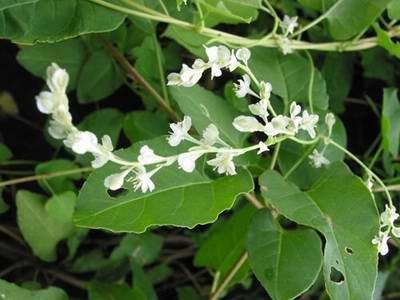
Fo-ti is a root herb from traditional Chinese medicine that has been used for centuries as an anti-aging tonic, and has shown promise in limited Western-style analyses. Interest has been held back by reports of liver toxicity, but there is some indication that the benefits can be separated from the toxic effects. In my readings, I found anecdotal evidence for rejuvenation plus one older study of impressive life extension in quails. I also found many more recent studies documenting beneficial biochemical effects which may be counted indirect evidence that makes life extension more credible. There were two clinical trials, both with promising results.
I’ve been looking into the effects of a root herb called Fo-ti or He shou wu (何首乌) or Polygonum multiflorum Thunbergia, since a friend emailed me about rejuvenating effects when he fed it to his ancient German shepherd. I’ll call it PMT for the remainder of this page. I’ve consulted the usual PubMed sources, in addition to books on Traditional Chinese Medicine (TCM), and some scientific articles in Chinese, which I ran through Google Translate, with fair results.
TCM is based on herbal combinations and formulas. Each ingredient has many active compounds, and the art of TCM is to combine the combinations. Western medicine likes to study one compound at a time, based on a scientific tradition (reductionism) that tries to understand each separate piece, then study interactions from that understanding as a foundation. The reductionist approach was responsible for the explosive success of 19th Century physics, and has been popular ever since, but it is not obviously the best way to make progress in 21st Century biology [Carl Woese philosophy piece]. Another reason for the Western preference for single-compound treatments comes from patent law, which encourages the testing of purified compounds and disallows patents for whole plants. But our bodies are complex, homeostatic systems, and it is rarely true that the combined effect of two drugs is just the sum of the effects of each separately. Strong interactions are the rule, rather than the exception. I believe that we are not going to find a single Fountain of Youth molecule, so I have been an advocate for high-throughput screening of many combinations of treatments, looking for combinations that stand out as especially effective. If we continue to study purified molecules in isolation, it may be a long time before we get to the point where we understand the biochemistry well enough to identify magic combinations on theoretical grounds.
A curious side-note: It is reasonable to expect some combinations of biochemicals to synergize in the human body. But why should we expect these combinations to be found regularly in a single plant? Herbal medicines are unreasonably effective in this regard.
Here [1988] is the one lifespan trial that I was able to find, which reports 50% life extension in Japanese quails. I looked on Cochrane and Examine.com, and found nothing. However, Joe Cohen over at Self-Hacked has an extensive article. “More than 100 chemical compounds have been isolated from Fo-ti, and the most biologically relevant components have been determined to be from the families of stilbenes, quinones, flavonoids, and phospholipids…Fo-ti exhibits a wide spectrum of pharmacological effects, including anti-aging, immunologic, neuroprotective, anticancer and anti-inflammatory effects.” Stilbenes are molecules in the resveratrol family; quinones are like CoQ10, and flavonoids are polycyclic molecules in the quercetin family.
Most of the rest of what I report here comes from this Chinese review [王伽伯, 2016] and this English language review [Bounda & Feng, 2015].
Laboratory studies and clinical practice have demonstrated that PMT possesses various biological and therapeutic actions, including anti-tumor,[16,17] antibacterial,[18] anti-inflammatory,[13] anti-oxidant,[19,20,21] anti-HIV,[22] liver protection,[23,24] nephroprotection,[25] antidiabetic,[15,26] anti-alopecia,[27,28] and anti-atherosclerotic activities.[29,30] It has been also reported to exert preventive activity against neurodegenerative diseases,[31,32,33,34,35] cardiovascular diseases and to reduce hyperlipidemia as well.[36,37] — Bounda & Feng
Anti-inflammatory: [13] is a Korean study that found inhibition of inflammatory cytokines in white blood cells of mice. Other studies [77] show suppression of NFκB.
Liver protection: [23] A Taiwanese study that demonstrated reduced toxicity from CCl4 after mice were treated with PMT extract. [24] PMT reversed liver cirrhosis in mice.
Antidiabetic: [15] inhibits enzymes that digest starch [26] is an impressive study, that demonstrates inhibition of TGF-β1 and COX-2, and simultaneous enhancement of SOD and glutathione from a chemical extract of PMT called 2,3,5,4′-tetrahydroxystilbene-2-O-β-d-glucoside (TSG). TSG is chemically similar to resveratrol, and in a worm study was more effective than resveratrol at increasing lifespan (22%).
Anti-atherosclerotic: [29] Mice don’t get heart disease so they work with rabbits. Large reductions in measures of arterial blockage in rabbits fed a water-extract of PMT. [30] This is really about anti-inflammatory benefits of TSG fed to mice and rats.
Neurodegeneration: [31] This was about adaptogenic benefit in mice. Mice were protected from nerve damage by paraquat if they had been prepared with extract of PMT. [32] worked with a mice that had been genetically modified to give them Alzheimer’s disease. TSG was found to ameliorate the loss of memory. [33] Older rats lose their memory, as tested in their ability to remember from day to day the location of a hidden platform in a tank of water. TSG protected memory in older rats. [34] This is a study for people who believe in the Amyloid-β theory of Alzheimer’s disease. A large number of herbal substances were screened in cell lines that generate Amyloid-β, and the only effective inhibitor was found to be PMT extract. [9] Suppresses lipid peroxidation in response to Amyloid-β in a mouse model and increases glutathione. [116] Another successful trial, this time of TSG in a mouse model of AD. [119, 120 is in Chinese] Two clinical studies found substantial improvement in cognitive performance of AD patients with PMT.
Liver injury from PMT is linked to a certain genetic difference, labeled CYP1A2 * 1C. I didn’t find anything more about this genetic variant. Curiously, I found several studies that claimed that PMT protects the liver, for example this.
My inclination is to look for empirical evidence and downplay theory (both Western and Chinese theory). I believe that the emphasis on single compounds is a serious limitation of Western medical research, because the interactions are more important than the individual effects. For me, it is an attractive feature of TCM that there is so much accumulated wisdom, not just about herbs that contain many active ingredients, but about potions that combine typically a dozen or so herbs that have been found to work well together. So the maddening thing I’ve found is that the Chinese scientists who have studied PMT and other promising Chinese herbs fall into the Western trap and isolate one compound at a time to study their effects. What is missing is the lifespan studies based on whole herbs, or combinations of herbs, as they would be prescribed by a traditional Chinese herbalist.
I went to a local herbalist this week and asked for advice about He Shou Wu. She explained to me that in TCM, herbs are always given in combinations. There are classic formulas with 6 or 10 or 20 herbs, and these are adjusted for individual prescription. The main ingredients are large quantities of the herbs that move the metabolism in some direction, and the lesser ingredients counterbalance the main ingredients by pushing in the opposite direction. Some of the directions they talk about correspond to observables we might recognize (high or low energy, sexual stimulant), and some of them are more esoteric (wet or dry, hot or cold, yin or yang). She gave me a formula with He Shou Wu as the main ingredient, and I’m going to do some more reading before I decide whether to take it.
In the meantime, I’m taking a gram of He Shou Wu extract processed with black beans each morning before breakfast and I think I detect an increase in aerobic stamina which has not listed anywhere as one of the benefits.
Acknowledgement: The idea for this research came from Jeff Bowles, who is a frequent commenter on this blog. The Chinese research was kindly supplied by Wen-jun Li, a post-doc in the Beijing lab where I have worked the last 3 summers.
Discussion
43 reader comments
Imported threads are marked Archive. New comments are welcome and moderated for spam.
Josh, you should look at Ayurvedic formulation Chyavanprash, whose explicit and only purpose is to rejuvenate an old body into a younger one. Chyavanprash is a jam of Indian Gooseberry fruit which has highest anti-oxidant capability of any edible vegitation. It a mixture of 80 herbs like Ashwagandha, Long pepper, Cinnamon etc which all have been found to have active compounds identified as having profound bioactive effects. And this formulation predates modern clinical methods. My guess is, these traditional medicins are all based on empirical observations, trial and error approaches, so they are effective without a doubt, even if their mode of action may not be known.
Here's another Chinese herb to add to your list. I make tea with it to add to my occasional Fo-Ti beverage. Jiaogulan.
I love your in depth research. Very informative.
Most diseases are either caused by inflammation or are indirectly related so how about experimenting with Boswellia Serrata? I find it to be the best and safest anti-inflammatory herb. It seems that it's anti-inflammatory properties would aid in life extension.
I tried Fo-ti several years ago but like most herbs it seemed estrogenic and my prostate did not react well to it. About the only age reversing compound I take now is melatonin as per the research of Dr. Walter Pierpaoli.
It makes sense to use time released melatonin, in order not to disrupt circadian rythm. Ideally, it should be released from 1 am-3 am in the morning. Any thoughts?
Hello Josh Mitteldorf,
Yesterday (19-1-2019) a friend brought me directly from China He Shou Wu, 500g, closed with aluminium foil. It is mixed with black bones. Pure=poison. So, I took 1g, mixed it with oats (one of the possibilities mentioned) and will do so for the coming period.
How are you doing with it? Any new ideas? Experience?
With friendly greetings
I'd like to try it. Would taking NAC and or milk thistle offset the dangers of taking this supp?
No one knows.
I understand the reductionist problem. By the combinations will never tell which compound or combination of compounds is responsible for the positive effects (if any).
The only way out would be to study the components first in separate, then in groups of only two (to look for synergisms), then 3, etc
That is a huge expenditure of resources and time because the number of combinations would rocket with 20 30 different herbs.
But this reality. The alternative is to try the whole mix and, if it works, and is safe, use it for health. But in this way we weill never known which componds, or combinations of some (not necessarily all) the combinations was responsible for the positive effect. Checking potential toxicity by the other non effective compounds in the mix would be also necessary
Josh, are you seeing/feeling anything from the fo-ti?
Nothing I notice.
From what I gather, it seems that sometimes the root is used raw (called white) and sometimes cured in a black bean sauce (called red).
Some report that the worst side-effects are associated with the raw root and that possibly some of the more toxic substances in the root are removed or reduced in the prepared product.
I would be interested if anybody has any more information on this - risk profiles for the raw vs prepared root.
Yes, this is true. And all the reported cases of acute toxicity came from the "white" raw form. But, of course, many of us would want to stop far short of acute liver toxicity, and only a small percentage of toxic cases have been reported.
"Fisetin is a senotherapeutic that extends health and lifespan."
https://www.ebiomedicine.com/article/S2352-3964(18)30373-6/fulltext
A very interesting senolytic candidate, but once againg a big issue seems to be the usual bad oral bioavailability of polyphenols because of their poor water solubility.
Anyone uses it as part of ther AA supplements, or know of a good source of nanofisetin or liposomal fisetin?
What's the difference between Polygonum multiflorum Thunbergia vs. Polygonum cuspidatum ?
Polygonum cuspidatum is much cheaper source of resveratrol than grapes and is claimed by some sources to be the best cure against arteriosclerosis.
....add nephrotoxicity to the list as well.