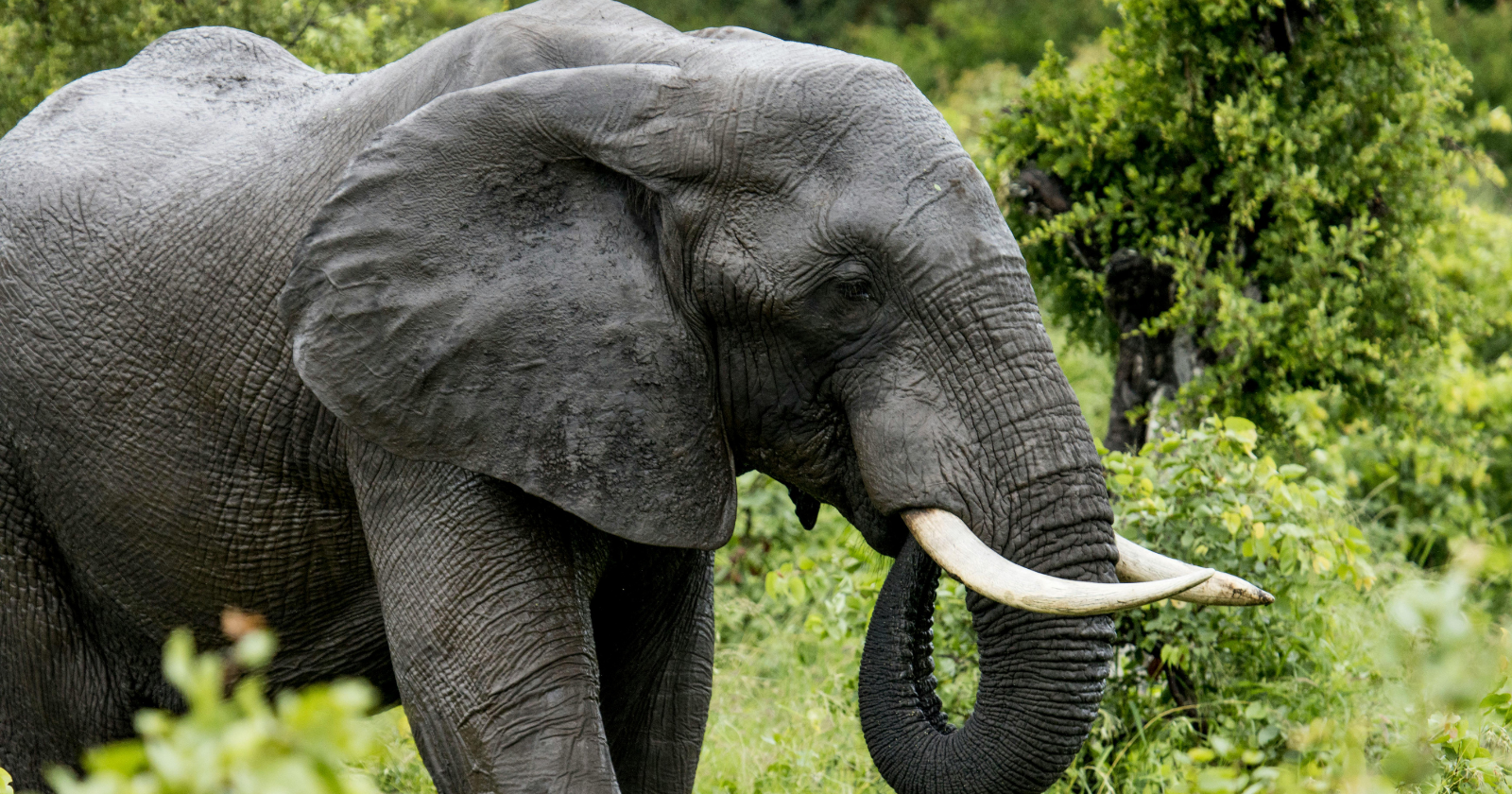
Somewhere in a Cameroonian rainforest, a pile of elephant dung is quietly doing the work of a plant nursery, and until recently nobody had thought to check.
That is the finding of a nine-year study published in Science Advances by a team led by UCLA’s Congo Basin Institute. Its title nods to Paul McCartney and Stevie Wonder, and the pun earns its keep, because the fates of ebony and ivory are genuinely tangled. Across stretches of the Congo Basin where African forest elephants have been poached out, researchers recorded 68 per cent fewer small ebony saplings.
Not fewer adult trees. Fewer replacements. Adult ebony still stands, which is precisely what makes the loss easy to walk straight past.
What the dung is actually for
Forest elephants eat the fruit of Diospyros crassiflora, the West African ebony, then carry the seeds in their digestive tract for kilometres before depositing them intact on the forest floor. That part was expected. Seeds land far from the parent tree, the gene pool stays mixed, everybody wins.
Dispersal turned out to be only half the mechanism. Experiments run across a gradient of hunting pressure showed that the dung itself works as cover. With the sweet pulp digested away and the seed buried in manure, rodents and other seed predators struggle to locate it. Researchers call this a previously unrecognised mutualism, the academic phrasing for two species helping each other in a way that had gone unrecorded.
Elephant manure, in other words, is armour.
Camera traps aimed at fruiting trees gave the team its confirmation. Elephants were eating the fruit, and nothing else was moving the seeds anywhere. Forest elephants preferentially eat fruit from carbon-dense trees, the slow-growing hardwoods with the heaviest timber, so the same broken arrangement may be reshaping which species the basin holds in a century.
A line you can walk across
Lead author Vincent Deblauwe, a tropical forest ecologist with the institute, told UCLA’s newsroom that his team had not expected big geographic differences, and then found “practically no young saplings in the parts of the forest without elephants”. Where saplings did turn up in hunted zones, they sat bunched under their parent trees, going nowhere.
Members of the Baka, the Indigenous community who guided the fieldwork, had been saying as much for years before anyone wrote it down. Deblauwe asked them why the young trees were missing and they told him. Baka elder Gaston Guy Mempong appears as a named co-author on the paper, alongside members of neighbouring Bantu communities, which happens less often in ecology journals than it should.
One paper, one forest
This is a single study, in one forest, on one tree species. It does not demonstrate that every large-seeded tree in Africa depends on elephants, and its authors make no such claim.
What it does demonstrate is a mechanism that had never been tested, in a place where the experiment has effectively already been run. Forest elephant numbers fell by more than 86 per cent over 31 years before the IUCN reclassified the species as critically endangered in 2021.
In a companion piece for The Conversation, one of the study’s co-authors points out that elephants have now been hunted out of roughly two-thirds of ebony’s natural range, leaving most surviving adult trees stranded with no disperser. Other large-seeded species there may be running an identical deficit, undetected, because the surveys do not exist.
Ebony takes anywhere from 60 to 200 years to reach usable size, per the University of California, so a shortfall in seedlings now will not be made good within any living person’s lifetime.
Where the funding came from
Ebony is the black wood on piano keys, violin fingerboards and guitar fretboards, and this research exists partly because a guitar maker went looking. Taylor Guitars and tonewood supplier Madinter bought the Crelicam mill outside Yaoundé in late 2011, and Bob Taylor went to see where his wood came from.
He learned that roughly one ebony tree in ten carries the uniformly black heartwood his industry had always insisted on. Loggers felled the rest, found streaky brown timber inside, and left it lying on the ground. A cosmetic preference, inherited and unexamined, was writing off nine trees out of ten.
Taylor began paying the same price for the marbled wood, multiplying usable supply without a single extra tree coming down. Then he funded the science. Village nurseries came with it, supplying local growers with fruit-tree saplings, ebony seed and training, and the resulting trees belong to them. CNN eventually carried the finding to a general audience under a headline about guitars owing a debt to elephant dung.
Certification schemes track the felling. Chain of custody, legal permits, species verification, all of it trained on the moment a tree hits the ground. Mongabay, reporting on the paper, framed the wider lesson as the price of losing ecosystem engineers.
Ebony happens to be the species someone had a commercial reason to count.
Nothing on a timber manifest records whether the forest still holds the animal that makes the next tree possible. That is the audit nobody is running.