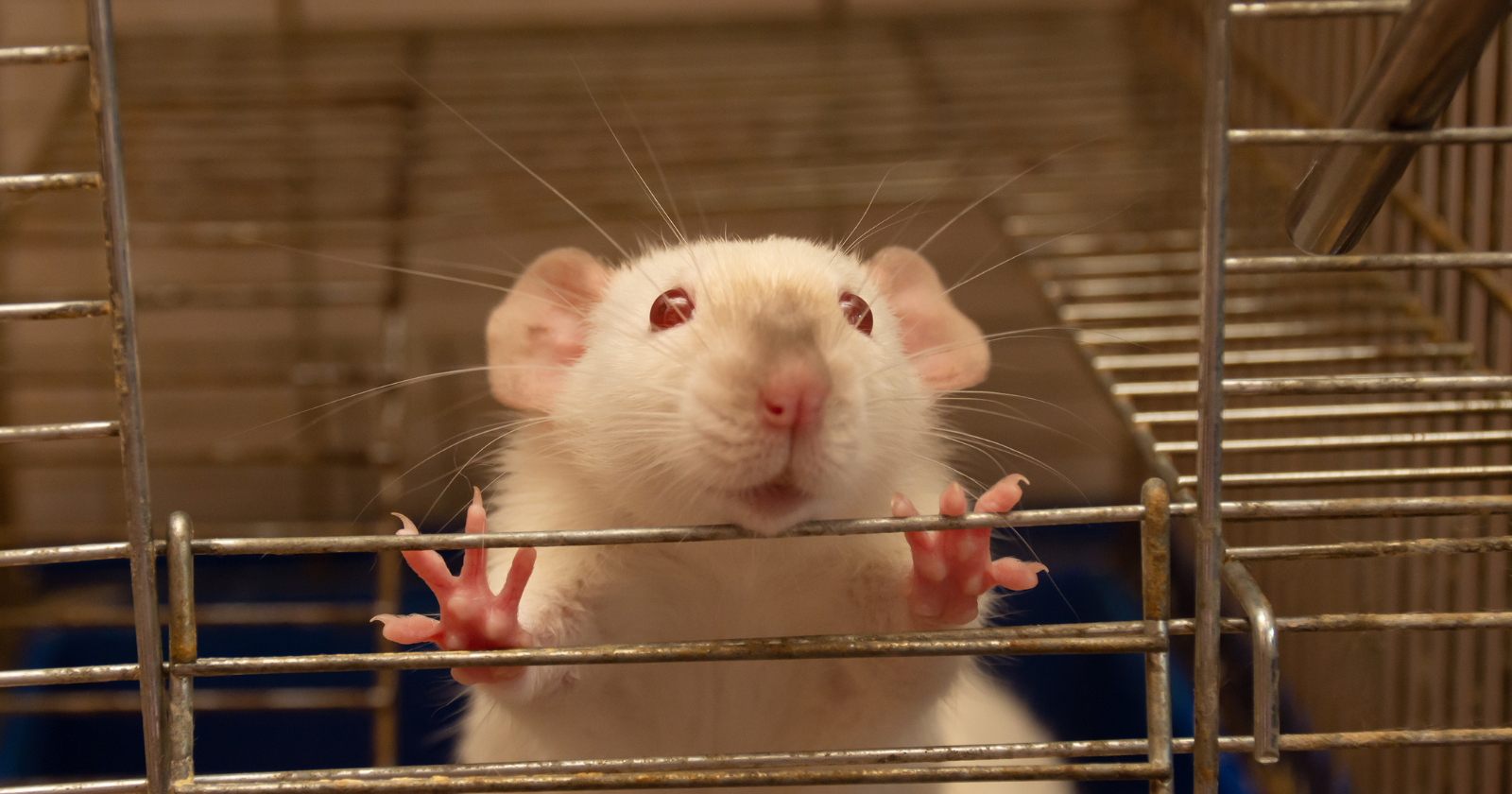
A mouse prised open its unconscious cage mate’s jaw, took hold of the tongue and hauled it clear of the throat. Nobody had taught it that.
It had never seen an unresponsive mouse in its life, which is most of why the footage out of a University of Southern California lab is so hard to look away from.
How the lab stumbled onto it
Li Zhang’s group at USC’s Keck School of Medicine had been chasing something else. Co-author Wenjian Sun told Annenberg Media the team “found this phenomena accidentally” while studying the way a mouse’s tongue lolls out under anaesthetic.
What kept interrupting the work was this. An anaesthetised mouse would go back into the cage, and its companion would start working on its face.
Sniffing first. Then grooming, then biting around the mouth, then the tongue itself. Writing in Science in February 2025, Zhang and his colleagues documented the whole escalating sequence, with tongue-pulling turning up in roughly half of all trials. Animals that got the treatment were up and walking sooner than those left to sleep it off alone.
What the tongue-pulling actually does
It opens the airway. That is the unglamorous mechanical reason a slack tongue matters, and it is why human first aiders get drilled on the head-tilt chin-lift.
Zhang’s team pushed further and slipped small objects into the mouths of the anaesthetised animals. Bystanders dug them out about 80 per cent of the time. Coverage by ScienceAlert picked up the detail that gives the response its shape: objects placed in the rectum or genitals drew no interest at all.
Discrimination turned up elsewhere too. Dead partners drew the same face-directed attention for a while, sleeping or active ones barely any, which points to unresponsiveness as the trigger rather than stillness.
Huizhong Whit Tao, a physiologist on the study, told Scientific American that oxytocin-releasing neurons in the hypothalamus appear to switch the routine on. Oxytocin turns up in helping behaviour across a range of species, which makes its presence here suggestive rather than decisive.
Three labs, one strange behaviour
Independent confirmation arrived almost simultaneously. In the same issue of Science, Fangmiao Sun, Ye Emily Wu and Weizhe Hong at UCLA reported the same face-directed attention and traced it to the medial amygdala, a brain region that seems to register when another animal has stopped responding.
A month earlier, a group led by Peng Cao at the University of Science and Technology of China had published a paper in Science Advances explaining why the manoeuvre works so fast. Dragging on the tongue fires a direct line to the mesencephalic trigeminal nucleus, which wakes the locus coeruleus, the brainstem’s alarm clock for alertness. Switch that circuit off artificially and the quick revival vanishes.
Three groups, three methods, one very odd result.
Whether any of it counts as helping
Here the agreement stops.
Peggy Mason, a University of Chicago neuroscientist with no involvement in the work, told NPR she has no quarrel with what the animals did, only with what people are reading into it: “I dispute the interpretation of it.” Her analogy is neat. Drop a twenty on the footpath, someone picks it up, and they have certainly been helped. You have not helped them.
Her alternative is ordinary curiosity. An unresponsive mouse dumped into the cage is a deeply strange thing, and she thinks interest in that strangeness could still account for what follows.
Zhang’s team anticipated the objection and ran the experiment across five consecutive days, on the logic that novelty fades. Whit Tao says the opposite happened, with the rescue attempts holding steady and ticking slightly upward. Mason’s reply is that habituation in mice may take longer than five days to show.
James Burkett of the University of Toledo, also outside the study, reads it differently again. Mice intervened far more readily for animals they knew than for strangers. A reflex doesn’t check the guest list. Burkett takes that familiarity bias as a sign the animal is weighing the situation, while still cautioning that intention cannot be read off a brain circuit.
Both can be right about the evidence and still disagree about the label, which is roughly where the field has parked itself.
“First aid” is a human phrase, freighted with training courses and good intentions and a certificate on the wall. The mouse with its jaws around a friend’s tongue has no opinion about the wording, and no plans to stop.