

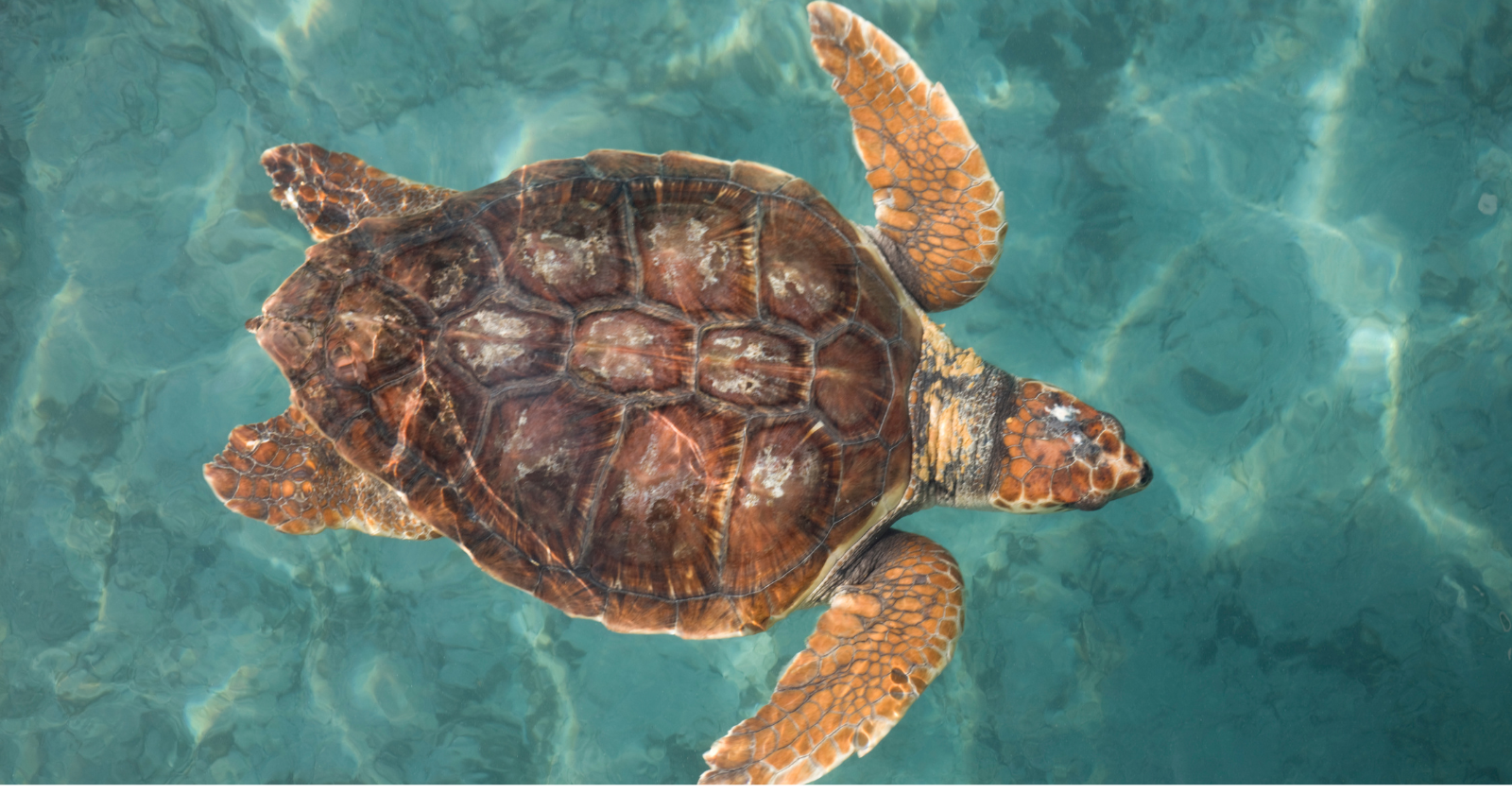
Seven miles south of Sugarloaf Key, on a July day, a very old animal forgot which way was forward.
She was about 270 pounds of loggerhead, roughly 120 kilograms, flippers slapping at nothing, head barely clearing the water, turning slow circles that led nowhere. Recreational boaters spotted her and did the useful thing. They radioed it in and stayed put until the US Coast Guard could reach her. She was taken to the Turtle Hospital in Marathon, Florida, where staff named her Timmy and started asking an awkward question. What breaks in an animal that has already survived everything else?
The patient looked almost untouched
Her body offered few obvious clues. Hospital manager Bette Zirkelbach told A-Z Animals that the turtle arrived with all four flippers and a shell in sound condition. For a female estimated at 70 to 80 years old, that is close to miraculous. There was one small exception, which she pointed out to Keys Weekly: a little mark on the head and neck, the kind a passing boat might leave, though she was careful to say the team would never know for certain. Her blood chemistry came back within normal limits, and after a rocky first day in the tank she ate more or less anything put in front of her.
Even her size was a moving target. Initial Coast Guard reports put her at around 450 pounds, and CBS12 reported that hospital scales later brought that down to 270. She was given fluids and vitamins while veterinarians waited on lab work.
Why a turtle swims in circles
Circling is a symptom with a long list of possible causes. Vets check the nervous system first, and the candidates include head trauma, infection, and toxins picked up from the water or from prey. Hospital staff weighed all of them, along with the possibility that her surface behaviour was connected to mating activity, which looks erratic at the best of times. Her blood plasma screened negative for biotoxins, and Zirkelbach said the early worry about a neurological condition eased once she failed to show the signs for it.
Data compiled by NOAA Fisheries puts injuries consistent with vessel strikes in 20 to 30 per cent of stranded sea turtles in Florida, with hundreds to thousands hit nationally every year. Adult sea turtles are particularly vulnerable during nesting season, when they spend weeks working close to shore in exactly the water that boats like best. A long-running review of Florida strandings between 1986 and 2014, published by Foley and colleagues, found roughly a third of stranded loggerheads showed sharp or blunt injuries indicating a vessel strike.
A propeller leaves obvious damage. A hull does not always, and a hard knock to the skull can leave an animal looking untouched while scrambling its balance and sense of direction.
How loggerheads normally find their way
So how does a loggerhead know where it is in the first place?
These turtles navigate by magnetism. Earth’s magnetic field varies in a patterned way across the ocean, so a turtle can in effect read its own position from the field strength and angle around it, the way a sailor once read latitude from the sun. Work by Brothers and Lohmann in Current Biology examined 19 years of loggerhead nesting records in Florida. Nest density rose where the magnetic signatures of neighbouring beaches drifted together, and fell where they drifted apart. That is what you would expect if females were homing on a remembered magnetic address rather than a remembered stretch of sand.
Then there is the sense itself. A 2025 paper in Nature, led by Kayla Goforth, trained juvenile loggerheads to expect food in one artificial magnetic field and not another, and the turtles learned the difference and still remembered it four months later. The same experiments suggested the map sense and the compass sense run on two different mechanisms. That is one study, not a settled body of knowledge, though it fits a pattern three decades of work has been building.
None of this was tested in Timmy’s case. Swimming abnormally at the surface is what gets a turtle noticed and rescued, and the cause behind it tends to be worked out, or left open, on far plainer evidence.
What her tags had recorded
She was not anonymous. Flipper tags applied earlier by Mote Marine Laboratory identified her and showed she had nested three times during the 2026 season, most recently on 9 July, ten days before the boaters found her. Decades of swimming, and a productive summer, logged in a bit of metal on a flipper.
She recovered. On 14 August, as WGCU reported, staff carried her across the sand at Fort Zachary Taylor Historic State Park in Key West while hundreds of people watched her put her nose in the Atlantic and go. Keys News had been advertising the release for days, and people turned up in the kind of numbers usually reserved for fireworks.
Which is the odd part of it. If the hospital’s age estimate is right, she hatched on a dark beach sometime in the decade after the Second World War and may have imprinted on a magnetic signature that has been drifting ever since. She has been finding her way through an ocean that keeps adding hardware nobody briefed her on. No one ever worked out what put her in those circles. She swam off with the same map, into the same traffic, and the only thing that had changed was that for a few weeks a lot of people were watching.