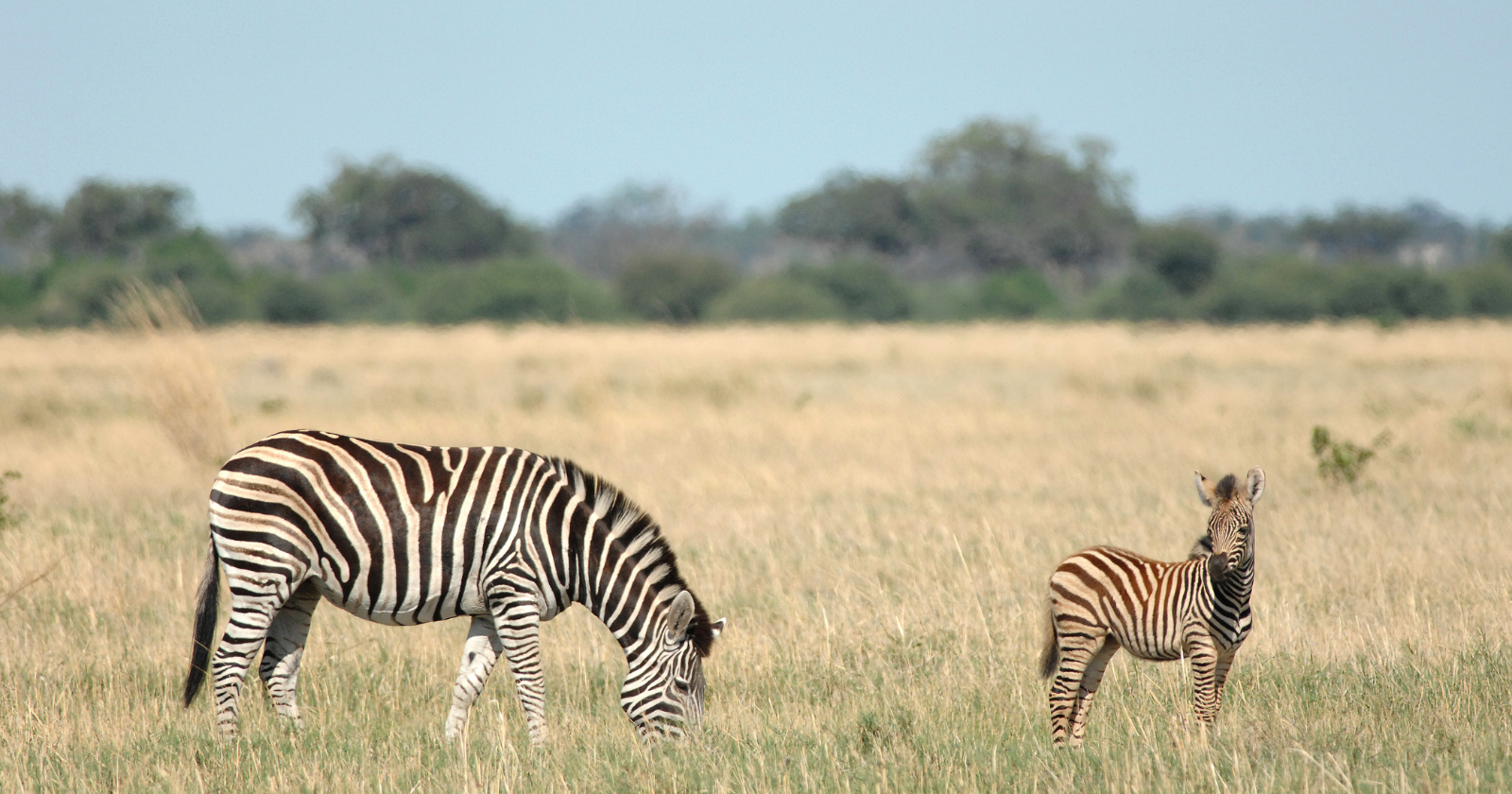
The horses in a North Somerset paddock were dressed as zebras, and the horseflies could not cope.
That was the point. Tim Caro, Martin How and colleagues studied tabanid horseflies at a livery yard in North Somerset, filming their attempts to land on captive plains zebras and ordinary domestic horses kept in the same enclosures. Their results, published in PLOS ONE in 2019, were blunt. Flies circled zebras and horses at much the same rate, but landed on the zebras less than a quarter as often.
Circling is cheap, so the team ran a tighter version. Each horse wore a black coat, then a white one, then a striped one, in sequence. Landings dropped sharply on the striped coat. On the animal’s bare head, left uncovered throughout, nothing changed.
Why the flies keep missing
Slow-motion video supplied the mechanism. Horseflies approached zebras at speed and failed to decelerate, bumping into them or skimming past instead of settling. Caro, quoted in a University of Bristol release, said the flies “seem to fly over zebra stripes or bump into them”. Nothing like that happened around the unstriped horses. Stripes don’t work alone, either: the same paper records zebras swishing their tails almost continuously through fly season, so a fly that lands rarely stays long enough to feed.
The effect appears at close range, during the final approach; stripes did not stop the flies arriving in the first place.
The lion theory was tested, and it lost
For most of a century the favoured explanation involved predators: stripes breaking up a zebra’s outline on open ground, or dazzling a lion mid-chase. That idea was always framed through human eyes.
Amanda Melin, a biological anthropologist at Calgary, worked with Caro to run zebra photographs through spatial and colour filters modelling the visual systems of lions and spotted hyenas. Writing in PLOS ONE, they reported that beyond roughly 50 metres in daylight and 30 metres at twilight, large carnivores cannot resolve the stripes. On a moonless night, nothing sees them past about nine metres. A lion close enough to make out stripes is already close enough for stripes to be beside the point.
Cooling did no better as an explanation. Gábor Horváth and colleagues covered water-filled metal barrels in horse, cattle and zebra hides, left them outdoors for four months and logged their core temperatures continuously. Their paper in Scientific Reports found no meaningful difference between the striped barrels and the plain grey ones, hot days included.
A broader comparison came earlier. In 2014, Caro and colleagues mapped striping across equid species and subspecies against five candidate pressures: camouflage, predator avoidance, heat management, social function and biting-fly annoyance. Writing in Nature Communications, they found consistent associations with one of them, and it was the flies.
What the flies actually object to
So which part of the pattern do the flies actually hate? In 2023, Caro and How went back to the paddock with 11 custom-printed patterns to find out: stripes at four levels of contrast, plain grey, large black triangles, small checks. Their study in the Journal of Experimental Biology found plain grey coats drew by far the most landings. Sharply contrasting stripes deterred flies, faintly contrasting ones did not, and the study found no evidence that polarised light, a long-standing candidate, made any difference.
Horseflies home in on big dark shapes and struggle with big dark shapes that are broken up.
Cows in stripes
Six Japanese Black cows, a breed that comes in exactly one colour, took turns wearing painted-on zebra stripes. Tomoki Kojima at the Aichi Agricultural Research Center, with colleagues at Kyoto University, rotated each animal through three conditions: striped, painted with black stripes only, and left alone. That middle condition controlled for the paint itself, which matters more than it sounds. As documented in PLOS ONE, the striped cows drew about half as many biting flies as the other two, and spent noticeably less time twitching, stamping and flicking their tails. The researchers framed it as pest control with no chemical involved, insecticide swapped for a paint job.
Every one of these findings rests on a single study, and a single study is a fragile thing to hang a conclusion on. The case for biting flies holds up because it doesn’t rest on any one of them: separate teams, on different continents, working with different animals and testing different predictions, keep arriving in the same place.
None of which makes stripes a force field. Flies still find the head, the legs, the ears, every bare patch the pattern does not reach, and zebras still swish and twitch all day long. What stripes buy is a margin, and against insects that carry trypanosomes and drink blood by the millilitre, a margin compounds across a few million summers.
Darwin and Wallace both had a crack at this question, and disagreed over whether stripes could hide a zebra from predators. Neither thought to ask the flies.