

I am a passionate life extensionist. I am a passionate conservationist. I have been living with a contradiction, increasingly stark as my understanding of both these causes, and my commitment to them deepens.
Nearly 20 years ago, I first became convinced by a variety of experimental evidence that aging is programmed into our genes by evolution. It was five years after that that I had my first inkling how this could be. This led to a study of evolved population regulation, and I became exquisitely aware of the entanglement of evolution and ecology.
Why would evolution create something as antithetical to the interests of her children (individually) as aging unto death? A gene for aging is the opposite of a selfish gene. And yet it is abundantly clear that we have genes* with no other purpose than to kill us. Suicide genes.
My principal contribution to the field of aging research is the Demographic Theory of Aging, which says that aging evolved for the purpose of population stabilization. There have been other theories of programmed aging in the past, usually based on the need for population turnover to assure adaptability, ongoing evolution and the ability of a population to change as conditions change. What I demonstrated (first in a 2006 paper ) is that population dynamics provides a far more potent selective force than this. Yes, the need to maintain population diversity and to change over time is certainly real . But (for animals) the need to avoid population overshoot and subsequent crashes to extinction is far more urgent (not so for plants). All animals depend on an ecosystem, and if they grow faster than their ecosystem, they are doomed. Not doomed “eventually” in some abstract, far-off morality tale. They are doomed within a generation or two.
Every animal population must have the latent capacity to grow quite rapidly in a pinch. You can translate this to mean, roughly, that a population must be able to double in each generation when it is threatened or expanding freely into a new and fertile environment. Human families in indigenous cultures can produce 6 or 7 babies, 4 of which survive to breed. Roundworms can lay 300 eggs, 2 of which survive to breed**. And, of course, microbes reproduce by cloning and double exactly with each generation.
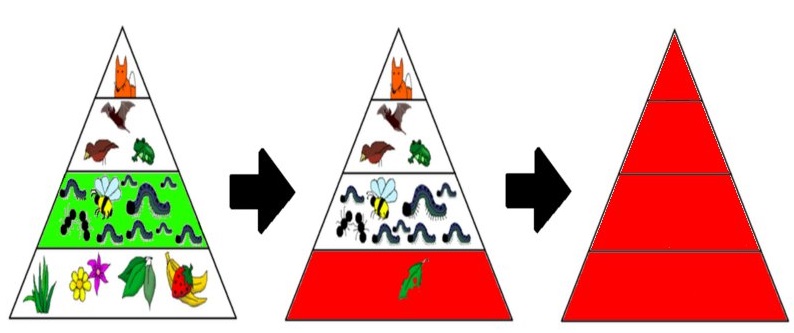
But the doubling of a population that is already at carrying capacity can spell disaster. Every blade of grass is eaten, or every rabbit is hunted, or every tree is denuded, and the ecosystem crumbles from the bottom up.
An ecosystem is a food web–predator and prey, the predator’s predator and the prey’s prey, multiply, connected and entangled, in an intricate network of interdependencies. Stability of the network does not come for free. There is no “invisible hand” that produces a grand harmony from a thousand selfish actors. Rather, there is deep and ongoing coevolution. Natural selection has taught each species cooperation and restraint via a billion years of tough love. Those species that overreached to trash their own ecosystems brought their ecosystems crashing down, and their rapacious behaviors died with them.
(To this thesis, scientists in diverse fields say, “of course–that’s the essence of natural selection”. But professional evolutionists have been trained to deny that such processes as this can occur. Many still insist that evolution can only work to promote selfishness, never cooperation.)

Ecosystems are resilient. There is an ability to bounce back after disturbance, from a natural disaster or the loss of a keystone predator. This, too, is a property honed by natural selection, a strength of the community that has evolved gene-by-gene in its component species. The unexpected happens, and the ecosystem has to deal with it. Those ecosystems that can’t recover from an invasion or a decade of bad weather have long ago disappeared from the biosphere.
But recovery of an ecosystem requires time. Bouncing back after a small disruption may require a dozen years or a dozen dozen. Bouncing back from a major geologic or climate event requires thousands of years. And in the history of multicellular life there have been five major extinctions. Each time, the biosphere required tens of millions of years to recover.
We are now in the midst of the sixth global extinction , and as far as archaeology can tell, the anthropocene extinction is as deep and as rapid as any the earth has seen.
And how did we get here? I believe the road to the Sixth Extinction was paved with ideology. I speak not just of the Biblical ideology that says it is our place to “be fruitful and multiply, and fill the earth and subdue it; and have dominion over the fish of the sea and over the birds of the air and over every living thing that moves upon the earth.” [Genesis 1:28] There is also the dominant version of Darwinian ideology that admits no explicit need for cooperation, but celebrates the creative power of selfishness. Worst, perhaps, is the capitalist ideology that assigns no value to anything that cannot be translated into dollars , and that demands perpetual growth in order to support a return on investments.
Does Life Extension Contribute to Overpopulation?
Well yes, of course it does. Human history since the advent of agriculture has been a quest to tame the environment, to substitute predictable domestication for nature’s wild ride. We have done this to avoid death and the risk of death.
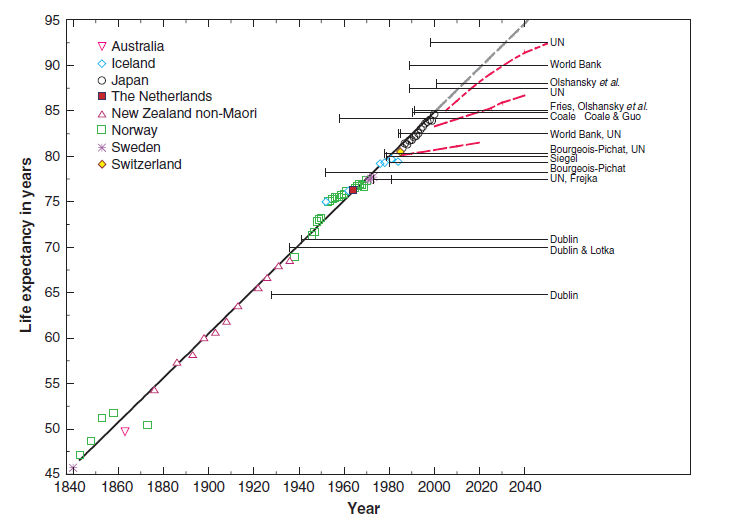
But only since 1840 has there been any significant advance in human life expectancy . Our animal nature has responded reliably, compensating with a lower birth rate that not even fundamentalist religious ideologies have been able to hold back. But between lowered death rates and lowered birth rates there has been a gap of 30-40 years, leading to a dramatic growth in the human population. Aldous Huxley recognized this pattern as early as 1956. “What we’ve done is ‘death control’ without balancing this with birth control at the other end….”
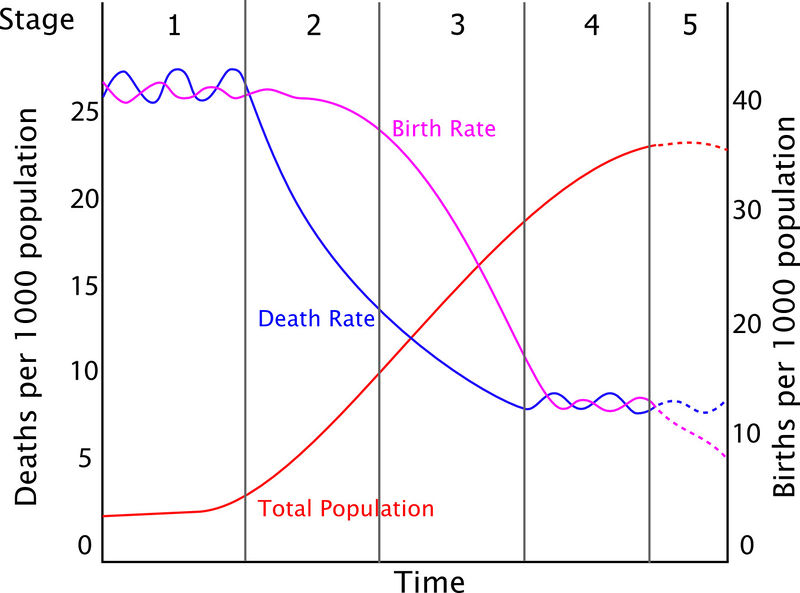
Currently, Africa is the last continent where technology is finally moving in to increase life expectancy, and the African birth rate is coming down, but not fast enough to avoid devastating population increases. Over the next 30 years, the population of Africa is expected to double from 1.1 billion to 2.4 billion, a larger absolute increase than the rest of the world put together.
Life span in 1840 was about 40 years in the world-leading European countries. In 2015 it was 83 in Japan and Scandinavia, the present world leaders. And indeed, the increase has been quite steady and gradual, so that “one year for every four” is an accurate characterization. For the first 120 years, increased life span was a story of early deaths prevented. Before about 1970, all this progress in life expectancy was achieved by preventing people from dying young, benefits reaped from antibiotics, hygiene, and workplace safety. But since then, a remarkable thing has happened: the maximum human life span has risen, and continues to rise at an accelerating pace (as recounted by Oeppen and Vaupel). What is more, people in their seventies and eighties are healthier today than ever before. Although there are dramatically more seniors in the population, the proportion of the population in assisted living and other dependent care situations is not rising. This is just what we wanted–we are staying active and healthy longer, retiring later, delaying the ravages of old age and “compressing morbidity” of late life into a shorter endgame.
Gratifying for the individual–treacherous for the collective
World population at 7.3 billion is about ten times what it was in 1800. A tenfold increase over 200 years is a good run, but it’s not unusual in the context of the biosphere’s history. Far from it. Bacterial populations routinely expand by a factor of a million. Insect populations can boom and crash. There are many examples even of large animal populations that have grown far faster than Man.
But other population increases have been local, while the rise of mankind has been all over the planet. We are now a global population, adapted to living in deserts and jungles, snow-capped mountains and forests and fields. We mow them all down, or burn them, or pave them over. Man has put many other predators out of business, from mastodons and sabre-tooth tigers to moas to a slew of toads and salamanders in the present age. We inhabit every corner of the earth and have wrought just as much devastation on the seas–perhaps more. Technology has enabled us to dominate such a wide range of other species, and it has made human beings a uniquely devastating competitor.
Will we Destroy all Life on Earth?
Don’t give yourself airs.
Eradicate Gaia? Life is bigger and more robust than anything we are able to disrupt. No, the threat is not to Gaia but to ourselves. Life will eventually roar back, more diverse, more wondrously inventive than ever. But recovery from a mass extinction requires, typically, a few tens of millions of years. That’s nothing for Gaia, but for our grandchildren, 30 million years may try their patience.
There is life in boiling hot sulfur pits and life on the pitch black ocean floor, thriving under pressure that would crush a SCUBA tank, and life embedded in dry rock, equally deep under the land, living on who-knows-what. There are spores that were trapped in salt deposits 250 million years ago, recovered by scientists and brought back to life in the laboratory. To eliminate all life on earth is far beyond humanity’s destructive power for the foreseeable future.
But can we imperil the ecosystem that sustains human life? Quite possibly we can.
We may imagine the worst case scenario is that we destroy all of nature, lose all biodiversity and turn the earth into a vast farm to feed 20 or 30 billion humans. But it’s a good bet that this kind of world cannot be, and it is certain that we don’t know how to create it. Ecosystems are complicated and interdependent. From bees to bacteria, our farms and our pastures and livestock all sit atop ecosystems that we do not fully understand. Already, we are washing into the sea each decade topsoil that took 1,000 years to create . Farmers rent hives of pollinating bees, and the beekeepers are keeping them alive with increasing difficulty . For nitrogen-fixing bacteria, we have substituted saltpeter that we mine from the ground until there is no more of it left to mine.
Factory farming and antibiotics are two of mankind’s most successful and heavy-handed biological interventions. Each has worked spectacularly well for a few decades, and we have perhaps a few decades more before each will as spectacularly fail. We have that much time to create more sustainable replacements.
No, a world of monoculture to feed humans is not a viable world. We are animals. From an ecosystem we derived, and, for the foreseeable future, on a natural ecosystem we will continue to depend. We are not nearly smart enough to build an artificial ecosystem to support human monoculture. In all likelihood, the end of natural ecology would be the end of humanity.
Poets bemoan the loss of our spiritual connection to nature. Meanwhile, ecologists warn us that we are starving more than our spirits. We can’t engineer our way out of this. We don’t know how. We can’t understand or model ecosystems, so we have no idea how to move them in a given direction, even if humanity had the collective will to do so. If we destroy the ecosystem we have, we will have to wait for nature to take her course, and the wait is likely to be tens of millions of years.
Libertarian ethic
Many of my colleagues in the life extension community lean to libertarianism, and in some ways I am with them. I am frightened by our disappearing Bill of Rights, corporate takeover of the Free Press, exceptions to habeas corpus, wholesale domestic surveillance–and all this in service to perpetual war which most Americans want no part of.
But overpopulation and ecological collapse are problems that cannot be addressed individually. China realized decades ago that we cannot allow each family to decide how many children they wish to have. Still less can we condone men who impregnate women and walk away; and worst are the institutions that seek to preserve the morals of other people’s children by denying them knowledge of basic reproductive biology.

We will have to find ways to come together. The good news is that polls show consistently that people are aware of the threat and willing to put aside their own (short-term) economic interest to address it. (This despite concerted efforts to downplay the issue in the media.) The bad news is that present political structures will not address the problem. Our existing political order is, in fact, a big part of the problem. Politics is dominated by capitalist megacorporations that have their own agenda, and preserving the ecological foundation of human life is not part of it. Subversion of democracy by capitalism may have taken root in America and West Europe, but it is now a global blight.
We must work around government, the corporate media, the megacorporations and the whole capitalist economy. We must come together to consolidate and act on an existing consensus for
- A rapid transition to renewable energy
- Policies to encourage smaller families
- Limits to fishing, among other measures to protect the oceans
- Protections for natural habitats on land
I invite your thoughts and ideas about how to do this.
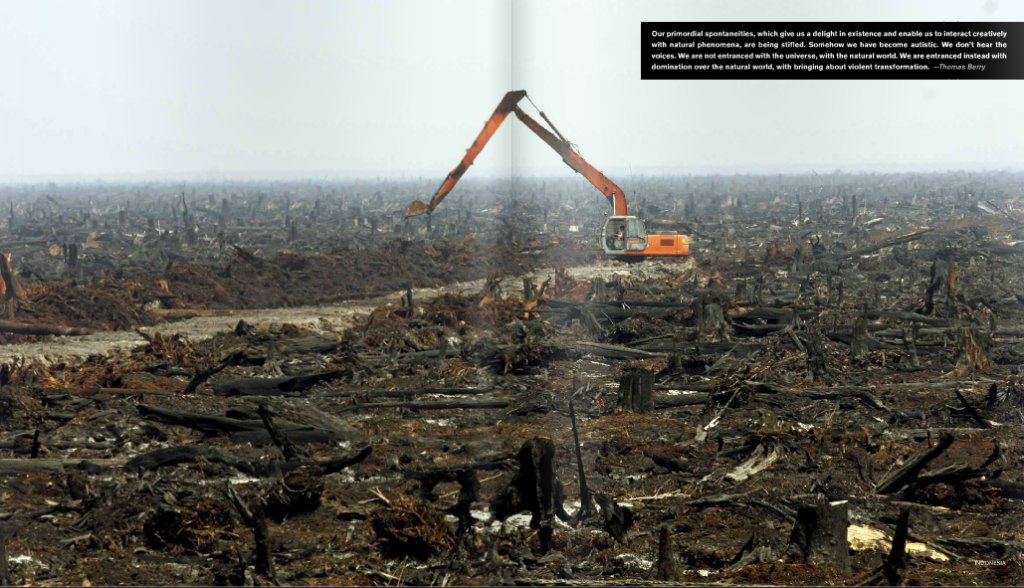
The more dramatic images in this column were taken from the book Overdevelopment, Overpopulation, Overshoot , published this year and available free online or for purchase in hard copy.
* Aging genes or the equivalent, combinations and epigenetic networks that work to ensure that our bodies weaken and ultimately self-destruct over time.
** Since they are hermaphrodites, each worm can breed without a partner, and so needs only 2 surviving offspring rather than 4 to double its population.
Discussion
35 reader comments
Imported threads are marked Archive. New comments are welcome and moderated for spam.
I think that we need to someday discuss what might cause the worst aspects of human nature.
I think our great fear should be what will happen if someone evil becomes immortal and takes over somehow.
IF we are going to reduce birthrates, then women's empowerment should also be a central cause, along with sexual education and efforts to alleviate poverty. Sadly this is not happening with the current politically conservative group of people in charge.
I agree.
I'm not convinced you have separated out the issues clearly enough here, Josh. Population, Environmental Impact, Longevity
Following the sense of the population part of your discussion perhaps I could conclude that the earth already has too many people. Traditional hunter gatherer societies live in environments with high levels of biodiversity, but those same low impact lifestyles require 100's of acres to support for a single family group long term. Our population densities have already outstripped the natural carrying capacity of a, hunter gatherer, earth by, maybe, 10^3 -- 10^4 x. Still I get the sense your not so disturbed that we have outstripped to the extent we have; it's just you don't think it would be good to go beyond current levels. What's your ecological argument for the right levels?
Now, still unclear on your argument I come to the solutions. There seems to be a feeling that the China solution is reasonable - people cant be allowed to procreate to their own discretion. And then other unspecified policies to encourage smaller families. Here is an idea. I cant think of anything that has a proven record of promoting smaller families that the education of women. Its been so successful that industrial European and Asian societies are rapidly approaching or undergoing demographic transitions. Absent immigration populations across Europe and Asai are going to be decreasing and that seems to be guaranteed despite current trends in Longevity in those same societies. My idea here is that you most likely want to go full bore with morally good actions (education), first, before you tread towards the morally ambiguous (suggesting coercion).
On the topic of environmental impact, I not sufficiently convinced that you have separated the issue of population from resource consumption. Are you happy with your current levels of resource consumption in the US. Are you going to be happy living in an identically populated world where everyone in India, China, and Africa lives at your level of resource consumption? No we will destroy the Earth. If you are an environmentalist, have you followed your ideals and voluntarily reduced your levels of consumption? Here is a comparison for you to go by. I live in major east coast Chinese city. If you want to shoot for better than average China levels of resource consumption which may or may not be sustainable (here) long term. You get a standard of living where you get a two room apartment for your family (the in-laws may or may not move in), there is no central heating (its -4 C today everyone wears winter clothes in the house), there is no car for the family(crowded public transpiration), appliances are a refrigerator and washing machine (hang your clothes out to dry). Also sometimes the water supply goes out. If you think your family and, more importantly your, neighbors will go for all that then I applaud you. If not, a workable plan would be to start thinking "how it's going to be done". Because as far as I can tell its not a problem with capitalism destroying the environment. The problem is people want to live a life which is convenient, varied, pleasurable, and comfortable. Those wants are not going to go away regardless of the economic system you choose. People are what they are, as nature made them.
And so we come to Longevity. I have no idea what the effects of longevity will be on society. But I will offer something hopeful. The only reason the human species survives, even as I write this, is because it embodies in its members the knowledge and traditions that builds the modern society that we would all die without. Perhaps extending the life of that knowledge -- allowing for more of its contributions and allowing more time for its traditions to be passed to the next generation will be a net positive effect. I suspect it will. With age comes wisdom, hopefully. In a world already saturated with uncaring and stupidity a bit more wisdom on the margin may have a net positive effect. I suspect it will.
In the blogpost below there is a speculation that a Neu5GC sialic acid in mammals is a vehicle for a programmed aging:
http://eatingoffthefoodgrid.blogspot.com/2010/12/neu5gc-live-fast-die-young.html
Josh, population crashes are well known, Liebig's "Law of the Minimum" and that is where homo sap is heading this century. Despite Economist thoughtless positivism about Africa population growth, a crash there and elsewhere is a much more likely case this century. Our very new agricultural life (10,000 years out of 250,000 species life) yet alone urban/industrial (200 years out of 250,000 species life) should not lead to a surprise re cultural & political almost total lack of feedback - e.g. no consequences for decisions. Nature bats last and the four horsemen and still riding. Further this century will only be the first of a number of crashes as our species attains some cultural & political maturity over time. I recall reading a paper that the average lifespan of species is 7 million years, we have collectively lived 1/28 so in human life terms are 3 years old! I think doing well for 3 year olds.
The problem is not overpopulation but individualism. Everyone thinks that he (she) would deserves more and want to have everything he can. The earth could sustain a population over 100 billion if everyone shared the resources with others and live modestly considering themselves to be integrated part of the society, and nothing without it.
Interesting recent article here:
Dec 15, 2015 Methylene Blue Reverses Human Cell Aging, Treats Progeria Symptoms in New Study
http://nutritionreview.org/2015/12/methylene-blue-reverses-human-cell-aging-treats-progeria-symptoms-in-new-study/
So what do you think is going to happen then? Countries in the west with negative or at replacement birth rates likely won't enforce a population control method, and life extension research also probably won't stop either. Will the countries/regions that really are overpopulated try to self regulate through economic (or other) means? Also, SENS had an independent group model the future population with longevity factored in. http://sens.org/research/past-projects/population-growth-without-aging
I'm pinning my hopes on fusion and solar energy, electric cars, smart grids, 3D printing, vertical farming and synthetic fish foods that allow positive sum fish farming where you don't deplete the aggregate fish stock which is still what happens with contemporary fish farming where they feed minced up wild fish to farmed fish. The CSIRO in Australia has made progress in this direction developing a synthetic feed that works very well with farmed prawns. The wealthier people become and the more education and work they have the fewer children they then have so global development will probably help too.
Solar energy is now cheaper than fossil fuels, if accounting is done including externalized costs and subsidies are removed.
Check out cold fusion. I did some research a few years ago, and was surprised to discover strong evidence that it is a real phenomenon, though hard to pin down. http://www.opednews.com/articles/Show-me-State-Endorses-Col-by-Josh-Mitteldorf-130726-395.html
Hi Josh,
I agree with almost all of what you wrote in this excellent blog post. My only concern with solar energy, especially solar panels, is the production process. Yes, they have fallen in price (which is good), but with a cost of questionable business practices. Ref this article (http://www.washingtonpost.com/wp-dyn/content/article/2008/03/08/AR2008030802595.html) where Chinese solar companies dump the byproduct silicon tetrachloride (a highly toxic substance) of polysilicon production into the nature with devastating consequences.
Btw, looking forward to your new book with Dorion Sagan - one of my favorite science writers . Already pre-ordered.
"Over the next 30 years, [...]"
You forgot to mention India, which is going to surpass China's in HALF that time frame. And to echo a bit of Harold's statement, their literacy ratio is ~66% (China's is 99.5!). Hopefully it will be better then, so you can properly shift your worries back to Africa : ) which will be still growing yes hehehe...
Hopefully by then the Real State will be Real cheap... on Mars ;-) Even more 'shockingly', those Tokamaks may actually have achieved break-even, just in time to be cornered into some niche by even cheaper solar. Ah the irony... seldom absent.
If that's too SciFi yet, then here are my suggestions for, in the meantime, proper investment in your 4 areas of mitigation:
"A rapid transition to renewable energy"
Tesla. And more specifically, the batteries they produce[1]. Make everyone use that stuff, not only for cars (there are many other, no less fun, ways to kill themselves). Btw, this is from the same guy of the Mars idea above, his open source approach ("All our patents are belong to you") makes me recover a bit of my hope for humanity. (their re-usable stage 1 rocket could use a few simple ideas to work better tho)
"Policies to encourage smaller families"
We can kill, so to speak, 2 rabbits with 1 stone here and make your present blog post moot :) Here's how: When the first, actual working, senolytic terapies begin to come online and, of course, cheap enough to make a difference (actually this will work better right before that point, so you can provide a discount for the following), make people have either sterilization procedures in exchange OR sign a contract to wait, say, 40 years (or, set an age minimum, say 80) to have kids. Better yet, have them have kids ON MARS. hahaha [2]
" Limits to fishing, among other measures to protect the oceans"
Game theory got that one figured out. That is, if your "libertarian friends" can stop their free market invincibility delusion long enough to pick up an economics 101 book. =)
"Protections for natural habitats on land"
And for my last investment suggestion, roll the drums, Seasteading [3][4] (did I hear someone whisper spacesteading, lol, "yeah send all those humans 35 million miles away! Out of sight, out of mind.")
Cheers!
MM
[1] http://waitbutwhy.com/2015/06/how-tesla-will-change-your-life.html
[2] Fun future of Mars jokes: https://www.youtube.com/watch?v=WBQn0nD27nc
[3] http://www.coindesk.com/bitangels-floats-blueseeds-boat/
[4] Going around govs you say? You'll love the very 1st paragraph here: http://www.coindesk.com/why-do-seasteaders-love-bitcoin/
The conclusion that we must rapidly switch from consuming CO2 producing fossil fuels to consuming renewables is not scientifically supported, all research conducted to date having been been pseudoscientific. Rather than rapidly switching to renewables we should rapidly switch to the scientific method in conducting the associated policy research. Among the acts needing to be accomplished is to fire Obama's "science" (actually pseudoscience) advisor.
Terry - If what you mean is that we don't know enough about climate dynamics to predict the consequences of global warming, I agree with you.
But, in my opinion, global warming is not the worst consequence of fossil fuels. Ripping up the ground, destroying habitat, oil spills that poison, for example, the entire Gulf of Mexico and Gulf of Alaska. The US is now on a path to energy self-sufficiency that depends on fracking, which is far more environmentally destructive than classical extraction methods.
- Josh
Josh:
I mean, actually, that methodological errors make of global warming climatology a pseudoscience; I prove this conclusion in the peer-reviewed article at http://wmbriggs.com/post/7923/. In my view, policy research on environmental issues (including the issue of whether fracking shall be prohibited or modified to eliminate its ill effects if any) should be conducted under the scientific method of investigation for only by conducting scientific research do we gain control over the ill effects from our interactions with our environment. Conduct of pseudoscientific research creates the illusion of providing for control without the reality of it.
Very interesting and thought provoking. There is always the issue of balance between the interests of the individual and the group in a social society. We struggle for our own success at the expense of the group every day. This will never change. You can't legislate out self interest. But through education we can modestly lean toward more social responsibility. That said, almost everyone wants to be healthier and live longer even if we are quick to criticize others for pursuing their own self interest.
I believe dramatic life extension will become a reality. Right now, those who are lucky and are doing the right things, will extend their lives by 10-20 years. At the rate of the growth of our understanding of biology, a breakthrough will happen in the next 20 years. This will at least extend longevity even longer for those who can afford it and possibly allow some rejuvenation. Don't expect to be pretty again, you'll start to look like Yota. If free society remains intact, eventually death by old age will be eliminated for the rich. Reduced access to food and water by the poor will lead to war and terrorism and attacks on the old-ones by extremist groups. That's the optimistic scenario. What will most likely happen is world war/world terrorism will squash our free society, or eliminate free thought, or simply destroy our economy to the point where scientific progress is stopped or pushed backward and without our magic pills, we will die just like biology programmed us to do. Happy new year!
In the end, we're all dead......
Well, I think technological advance is unstoppable. If there's a way for life extension, people will take it. 99 of 100 will. Also I think in the near future we might even forget about agriculture the way we know it. I think it could be entirely possible to substitute photons with electrons in plastids or directly drive the electron transport chains of thylakoid and mitochondrial membranes. So that we could produce organic materials like food in factories using electric power. I once calculated that one hectare produces 40 W/m2 in southern Europe from solar power. If you use the same area to grow a corn field, you get 0.25W/m2 in organic materials mostly polysacharids. There is a tremendous room for improvment here. I think it might very well happen that by 2100 we will have 100 billion people living on earth.