

This week, a headline-making study in the New England Journal of Medicine sought to cast doubts on long-established science that says daily aspirin can be a broadly-effective anti-aging tonic. I’m writing this response because I think that this new, small study has to be viewed in the context of many larger studies over many decades that together make a solid case for aspirin’s benefits.
Aspirin has two kinds of effects: First, aspirin thins the blood, reduce clotting, which lowers the risk of most kinds of heart attacks and stroke (ischemic) while raising the risk of bleeding ulcers and hemorrhagic stroke. Second, aspirin lowers the level of systemic inflammation, which reduces risk of heart disease, stroke, most cancers, and Alzheimer’s disease.
Historically, daily low-dose aspirin began to be prescribed broadly to middle-aged and older adults in the 1960s as the medical establishment theorized about the first effect. This led to a grand natural experiment—tens of millions of older people taking low-dose aspirin. Studies comparing these people with matched populations who didn’t take aspirin have shown lower rates of all-cause mortality, Alzheimer’s dementia, and of cancer and probably of heart disease as well. These studies are based on millions of tabulated deaths. The current study is based on 1052 total deaths in the aspirin group and the placebo group, and the difference between the two was barely statistically significant in the direction against aspirin.
Summary of past studies
Eidelman, JAMA, 2003: Summarizing 5 trials, they found aspirin was associated with a 32% reduction in the incidence of first heart attacks. Statistical significance was 2 chances in 100,000 (p<0.00002).
Methods A computerized search of the English literature from 1988 to the present revealed 5 published trials: the Physicians’ Health Study (22,071 participants), the British Doctors’ Trial (5,139), the Thrombosis Prevention Trial (5,085), the Hypertension Optimal Treatment Study (18,790), and the Primary Prevention Project (4,495).
Results Among the 55,580 randomized participants (11,466 women), aspirin was associated with a statistically significant 32% reduction in the risk of a first MI and a significant 15% reduction in the risk of all important vascular events, but had no significant effects on nonfatal stroke or vascular death.
Conclusions The current totality of evidence provides strong support for the initial finding from the Physicians’ Health Study that aspirin reduces the risk of a first MI. For apparently healthy individuals whose 10-year risk of a first coronary event is 10% or greater, according to the US Preventive Services Task Force and the American Heart Association, the benefits of long-term aspirin therapy are likely to outweigh any risks.
Rothwell, The Lancet 2011: Summarizing 8 trials, they found aspirin was associated with a 21% reduction in the incidence of all cancers. Statistical significance was 1 chances in 10,000 (p<0.0001).
Results
In eight eligible trials (25,570 patients, 674 cancer deaths), allocation to aspirin reduced death due to cancer (pooled odds ratio [OR] 0·79, 95% CI 0·68–0·92, p=0·003). On analysis of individual patient data, which were available from seven trials (23,535 patients, 657 cancer deaths), benefit was apparent only after 5 years’ follow-up (all cancers, hazard ratio [HR] 0·66, 0·50–0·87; gastrointestinal cancers, 0·46, 0·27–0·77; both p=0·003). The 20-year risk of cancer death (1634 deaths in 12 659 patients in three trials) remained lower in the aspirin groups than in the control groups (all solid cancers, HR 0·80, 0·72–0·88, p<0·0001; gastrointestinal cancers, 0·65, 0·54–0·78, p<0·0001), and benefit increased (interaction p=0·01) with scheduled duration of trial treatment (≥7·5 years: all solid cancers, 0·69, 0·54–0·88, p=0·003; gastrointestinal cancers, 0·41, 0·26–0·66, p=0·0001). The latent period before an effect on deaths was about 5 years for oesophageal, pancreatic, brain, and lung cancer, but was more delayed for stomach, colorectal, and prostate cancer. For lung and oesophageal cancer, benefit was confined to adenocarcinomas, and the overall effect on 20-year risk of cancer death was greatest for adenocarcinomas (HR 0·66, 0·56–0·77, p<0·0001). Benefit was unrelated to aspirin dose (75 mg upwards), sex, or smoking, but increased with age—the absolute reduction in 20-year risk of cancer death reaching 7·08% (2·42–11·74) at age 65 years and older.
Wang, Journal of Alzheimer’s 2015: Summarizing 11 trials, they found aspirin was associated with a 49% reduction in the incidence of dementia. Statistical significance was less than 1 chances in a billion (p<0.0000000005).
Abstract
Objective: Alzheimer’s disease, the most prevalent dementia, is a prominent source of chronic illness in the elderly. Laboratory evidence suggests that nonsteroidal anti-inflammatory drugs (NSAIDs) might prevent the onset of Alzheimer’s disease. Since the early 1990s, numerous observational epidemiological studies have also investigated this possibility. The purpose of this meta-analysis is to summarize and evaluate available evidence regarding exposure to nonaspirin NSAIDs and risk of Alzheimer’s disease using meta-analyses of published studies. Methods: A systematic search was conducted using Medline, Biological Abstracts, and the Cochrane Library for publications from 1960 onwards. All cross-sectional, retrospective, or prospective observational studies of Alzheimer’s disease in relation to NSAID exposure were included in the analysis. At least 2 of 4 independent reviewers characterized each study by source of data and design, including method of classifying exposure and outcome, and evaluated the studies for eligibility. Discrepancies were resolved by consensus of all 4 reviewers. Results: Of 38 publications, 11 met the qualitative criteria for inclusion in the meta-analysis. For the 3 case-control and 4 cross-sectional studies, the combined risk estimate for development of Alzheimer’s disease was 0.51 (95% CI = 0.40–0.66) for NSAID exposure. In the prospective studies, the estimate was 0.74 (95% CI = 0.62–0.89) for the 4 studies reporting lifetime NSAID exposure and it was 0.42 (95% CI = 0.26–0.66) for the 3 studies reporting a duration of use of 2 or more years. Conclusions: Based on analysis of prospective and nonprospective studies, NSAID exposure was associated with decreased risk of Alzheimer’s disease. An issue that requires further exploration in future trials or observational studies is the temporal relationship between NSAID exposure and protection against Alzheimer’s disease.
Problems with the present study
Because of small numbers and short duration, the result of the study was only marginally significant (p<0.05). The aspirin group had higher cancer rates and lower heart attack rates than placebo.
Typically, doctors advise patients to start low-dose aspirin around age 50, but this study was with patients more than 70 years old who had no cardiovascular symptoms by age 70. Most people by age 70 have had some cardiovascular diagnosis before age 70, so this is an unrepresentative sample. The study fails to address the question, how many deaths and how many diseases could be avoided between the ages of 50 and 70? This is the period in life when inflammation is most active, and a great deal of destruction of the body’s veins, joints, and nervous system happens during these years. Excluding those with a history of heart disease during those ages is excluding just the people most likely to be helped by aspirin. Of course, when you’re 50 and considering whether to start on aspirin, you may not know whether you’re lucky enough (or have the right genes) to be in the group that will do fine for the next 20 years without it.
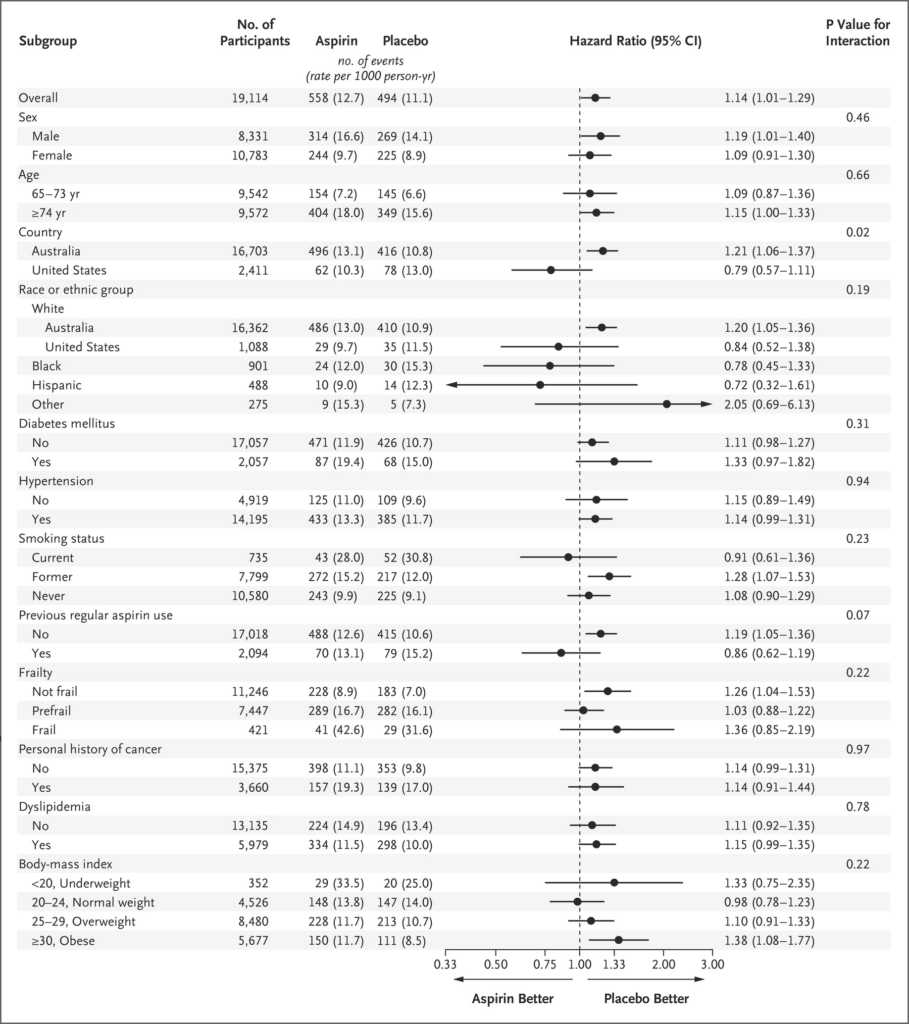
This table breaks the composite test group into sub-groups according to various criteria. Dots to the right of the line mean “aspirin was worse”, and to the left mean “aspirin was better”. Among the subgroup in the US, aspirin was better. Among people who had never taken aspirin before, aspirin was better. Among people within fairly wide limits of a “normal” weight range, aspirin was better.
Why are we seeing this?
Scientists are only human, and their environment, their preconceptions, and their incentives shape the way that statistics are handled. In my experience, it is not difficult to make a small effect look like a (p<0.05) effect by making consistent choices in the way the data are treated, none of which are suspect or dishonest. If the group had come up with the conventional and accepted conclusion based on such a small study, there would have been no prominent publication, no headlines, probably no follow-on grant. So they had every incentive to perform the analysis in a way that makes the results appear more interesting than they are.
Here’s a more complete analysis of the available studies, by James Lyons-Weiler, 2026 Link
Discussion
14 reader comments
Imported threads are marked Archive. New comments are welcome and moderated for spam.
I stopped taking low dose Aspirin not because of the headline but because of taking Turmeric supplements. I also drink two cups of tea made from Turmeric roots.
Taking both Aspirin and Turmeric might be overkill.
Any thoughts?
On an unrelated topic, but an important one, from the gift that just keeps on giving it would appear in a human trial that rapamycin significantly reduces cns lesions inMS by acting as an immune modulator. This was the case even in doses generally considered to be quite high at 2 mg/ day for six months. The side effects were minimal and inconsequential.https://www.sciencedirect.com/science/article/pii/S2211034818302761
This really begs the question that I have been grappling with for a long time. Do we have any idea how to optimally dose this drug in people?
I’m starting to believe that we are grossly underdosing it out of concerns regarding side effects that may be overblown and unwarranted.
This may be a seriously effective drug for many reasons if we can start to fully figure out how to use it.
Yes we just don't know. I feel very tired and get mouth ulcers if I dose 'too high', but it might be that such symptoms would pass. Still it's all I've got to go on for the moment.
Josh,
If the goal is to reduce inflammation, wouldn't a ketogenic diet be a better option than asprin? I switched a year ago, and my labs this july showed a CRP of 0.34mg/L. (CRP was 1.7mg/L in 2017). Asprin couldn't come close to touching that kind of a reduction.
Thomas
Excellent article, Josh! Very helpful!
The fact so many older folks are interested and concerned about this story proves how large a market there is or would be for any more obviously effective treatment that helps you stay healthy into old age. I've also noted however, that the people of a certain age have an unwavering belief in the advice of their often non-committal, ultra conservative Doctors. So it's going to take some pretty strong evidence before your family doctor starts recommending rapamycin, NMN, senolytics, etc.
Hi Mark
You know, ASA has been around forever, and people have an enormous comfort level with it as a result. I’ve seen many GI bleeds in my time from ulcers, varices, and gastritis from NSAID’s like Motrin, but very few from aspirin usage.
I’m pretty convinced that 5 years of steady use leads to a reduction in GI malignancies. There was even a study demonstrating that Asa can prevent the malignant transformation of Barret’s Esophagus, and the higher the dose the better.
It’s worth it to prevent very deadly GI cancers.
Of course, so much depends on dose, frequency, age, other meds, and genetic predispositions. I really wish that we knew more about rapamycin in regards to those variables as well
Hi Mark:
IMO, doctors are likely fearful of prescribing meds that live outside the normal "standard of care", due to law suits.
There likely are many doctors who take nutrients and off label anti-aging drugs, but do not suggest that their patients use them due to the law suit factor.
As for Acetylsalicylic acid (ASA), I think one way to know that it may cause excessive bleeding in combination with a specific person's unique biochemistry, liver health, and other drug usage, would be the bleeding factor.
For example, if on ASA, alone, does the person bleed profusely when cut, or does the blood clot fairly quickly.
There is also a test: The A partial thromboplastin time (PTT) test.
Then there are people who are told to by their doctor to take an 81 mg baby aspirin per day and they get it in their craw that if 81mgs is helpful, then maybe 500 mgs daily would be even better.
When side effects ensue, they often do not tell the doctor that the raised the dose to 500 mgs per day.
For people carrying the Leiden factor 5 gene mutation (like I do), daily low dose aspirin can potentially lower the risk for a stroke.
Very timely article, Josh. I've had a dozen people ask me about, so I'm glad to get your opinion. Thanks.
Indeed, one must read the articles involved.
Recently everyone cried aloud: every use of alcohol is bad, based on large scale epidemiological research. I looked in the article at my age group of 75 and above. Drinking 150gr alcohol a week results in about one month loss in life expectancy for that group. Medium life expectancy for this age is about 86(men). Who cares with still about 11 years to go about that loss? That however was not in the press.
Probably the article was meant for countries where half of the men pass away before 55?
I'm really glad to see you release this information. I read the study a couple of days ago and wondered why in the world this study was different than everything else I have read.
I am 63 years old, in excellent health, and have been taking a low dose aspirin Daily 4 more than 10 years. I will continue to do so.
Josh, great topic. However, I don't understand why you are calling this a "small study". They randomized 19,000 people did they not? That is huge for an RCT. I do agree that an important aspect of this study is that they enrolled people who had little or no cardiovascular disease by age 70. Maybe the big benefit of aspirin comes from the anti-clotting and reduced systemic inflammation among people who has some level of atherosclerosis.
High starch blue zone diet addresses the root causes of all of the conditions mentioned. In the quest for longevity, it seems illogical to ignore rhe diets of the longest lived human populations on earth..