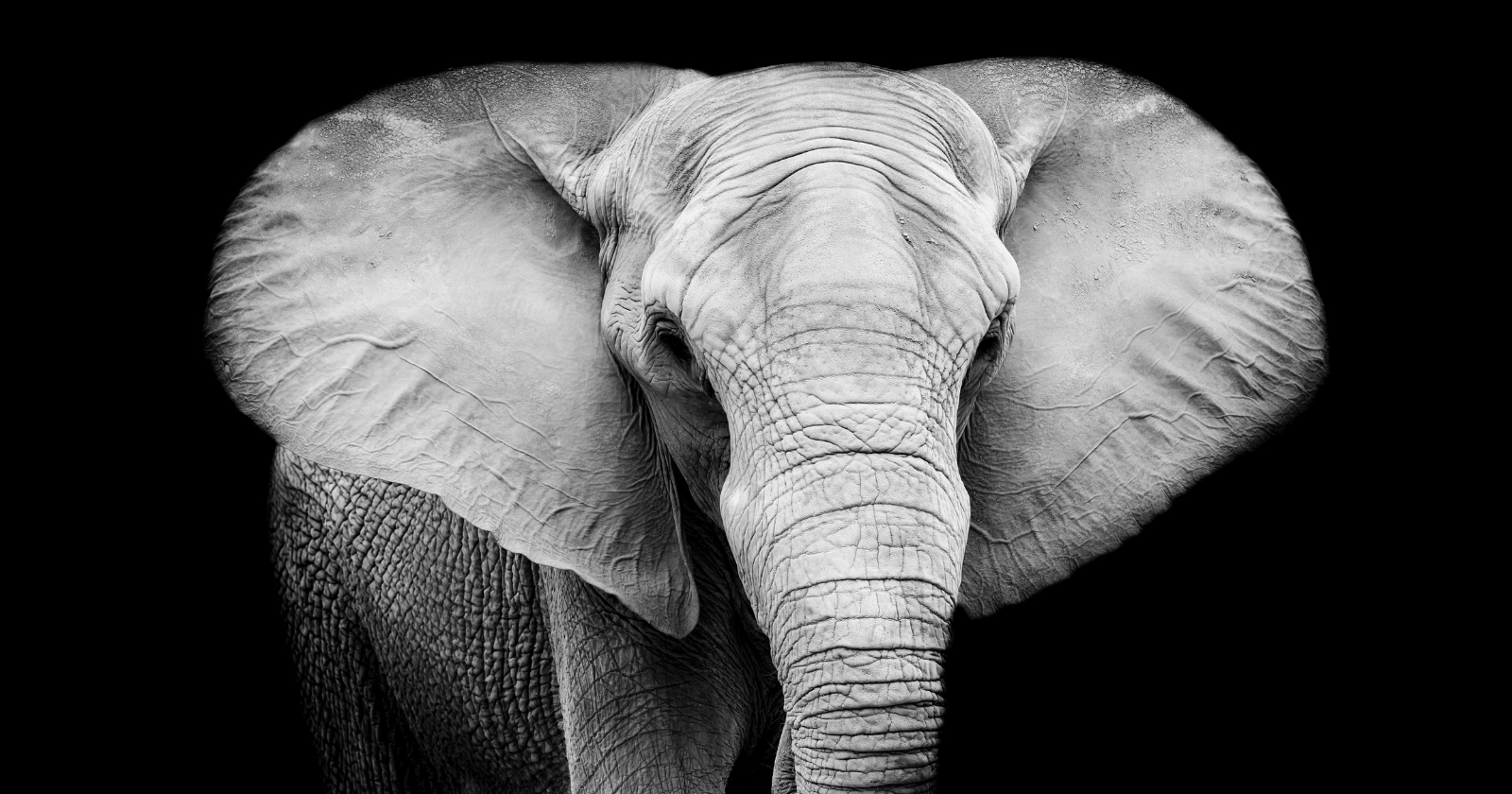
The full list, on the current experimental record, is short enough to fit in a single sentence. Chimpanzees, bonobos, orangutans, and some gorillas. Bottlenose dolphins. Asian elephants. Eurasian magpies. And, on some more recent and disputed evidence, a small tropical fish called the cleaner wrasse. That is the entire roster of non-human species that have demonstrated, under controlled conditions, an understanding that the animal in the mirror is themselves.
Everything else on Earth, when it walks up to a mirror, appears to see a stranger.
The test that produced this list is called the mirror self-recognition test, and it was designed by an American psychologist named Gordon Gallup Jr. in 1970, working with young chimpanzees. What Gallup wanted to know was whether an animal, given time to examine its own reflection, would eventually work out that the reflection was a projection of itself rather than another individual. His method for finding out was to mark the animal, on a part of its body it could not see directly, with a coloured spot. If the animal, on catching sight of the mark in the mirror, reached up and touched the mark on its own body, then it had, on Gallup’s argument, understood the relationship between the reflection and the animal producing it. It had passed what has since become known as the mark test.
The elephant that passed
The specific reason elephants belong on the list has an unusually well-documented origin. According to a 2006 study published in Proceedings of the National Academy of Sciences by Joshua Plotnik at Emory University, Frans de Waal at Yerkes National Primate Research Center, and Diana Reiss at Columbia University, a team of researchers installed a jumbo-sized mirror, two and a half metres square and reinforced against elephant-scale interaction, in the yard of three adult female Asian elephants at the Bronx Zoo. The three elephants were named Happy, Maxine, and Patty. All three had been born in captivity in the 1970s, all three were roughly thirty-four to thirty-five years old at the time of the study, and none of them, on the researchers’ careful checks, had had extended exposure to a full-sized mirror before.
All three animals moved through the first three stages Gallup’s original framework predicts. They approached the mirror socially, treating the reflected elephant as another individual. They inspected the physical structure of the mirror, some of them walking around behind it to look for the other animal. They then began the specific pattern of repetitive testing behaviour that indicates an animal is starting to work out the relationship between its own movements and what the mirror is showing. They swayed. They opened their mouths. They performed body movements while watching the mirror to see whether the reflection followed.
Then the researchers applied the marks. Each elephant was painted with a visible X in white on one side of the head, and an invisible sham mark on the other side, in a substance that felt and smelled identical but produced no visual mark. This let the researchers distinguish between an elephant genuinely responding to the visible mark and an elephant just touching its head for other reasons.
Only one of the three elephants passed. Happy stood in front of the mirror, examined herself, and used the sensitive tip of her trunk to touch and probe the visible white X on her head. She ignored the invisible sham mark entirely. She was the first known individual of any elephant species to have demonstrated mirror self-recognition under controlled experimental conditions, and, on the peer-reviewed evidence, she remains one of only a small number of individual elephants who have ever done so. Maxine and Patty, watching the same mirror, in the same yard, on the same days, did not.
Watch here: The Invisible Wall Only Elephants Can See.
Then a fish passed the same test
For most of the last four decades, the small and philosophically loaded list of species that could pass the mark test was treated by researchers as a rough guide to which parts of the animal kingdom had achieved something like self-awareness. Then, in early 2019, a group of researchers led by Dr Masanori Kohda at Osaka City University in Japan reported that they had run the same test on a species of small tropical reef fish, and the fish had passed.
According to the 2019 paper by Kohda and colleagues in PLoS Biology, titled “If a fish can pass the mark test, what are the implications for consciousness and self-awareness testing in animals?”, the cleaner wrasse, Labroides dimidiatus, showed all four stages of the classic mirror self-recognition sequence. They socialised with the reflection. They physically investigated the mirror. They began repetitive contingency testing. And when the researchers painted a brown coloured mark on the animals’ throats, in a location the fish could only see in the mirror, most of them swam to the mirror, examined the mark, and then scraped their throats against the substrate of the tank in the specific way cleaner wrasse scrape at parasites.
The result caused an immediate crisis in the field. Cleaner wrasse are not particularly close to any of the other species that had ever passed the test. They are separated from great apes by around 450 million years of independent evolutionary development. If a small reef fish can pass the same test that has been used for half a century as the indicator of higher self-awareness, then either the fish is dramatically more cognitively sophisticated than the animal cognition literature has assumed, or the test has been measuring something other than what it claims to have been measuring.
The scientist who had co-authored the original Bronx Zoo elephant study, Frans de Waal, responded to the Kohda paper in the same journal with a companion piece titled “Fish, mirrors, and a gradualist perspective on self-awareness”. His argument, in condensed form, was that the mirror mark test had encouraged a binary understanding of self-awareness that evolution itself does not support. Species do not, on the accumulated evidence of thirty years of comparative cognition research, cleanly divide into those that possess self-awareness and those that do not. Self-awareness, whatever it is, appears to exist on a gradient. The cleaner wrasse results are best understood not as evidence that a fish is as self-aware as a chimpanzee, but as evidence that the specific line the mark test claims to draw is not really the line it thinks it is drawing.
A follow-up study by Kohda’s team in 2022, using 18 cleaner wrasse rather than 4, found that 17 of the 18 fish, or 94 per cent, passed the mark test when the mark was designed to resemble the kind of parasite the fish is evolutionarily attuned to notice. The fish did not respond to green or blue marks, only to brown ones that looked like the specific ectoparasites the cleaner wrasse’s whole ecological role is built around identifying and removing.
Which is where the picture the mark test has been quietly building for the last five decades starts to shift into something more interesting than a list. What the test appears to have been detecting, on the current best reading, is not a single unified property called self-awareness that is either present or absent in a given species. It is a bundle of related cognitive and perceptual capacities, some of which are exceptionally well developed in a chimpanzee, some of which are exceptionally well developed in an elephant, some of which are exceptionally well developed in a small tropical reef fish that spends its life picking parasites off other animals, and some of which show up in different combinations across different parts of the animal kingdom.
The picture that emerges from this, on the current experimental record, is one in which the strangeness of the original short list is not that it contains six tonnes of elephant and half a kilo of magpie and three grams of reef fish. It is that a test built to draw a bright line has, in the process of being applied carefully across enough species, ended up quietly demonstrating that the line was never really there.
Kiran Athar is not a biologist or an animal-cognition researcher. She writes about biology, animal behaviour, and the ordinary corners of the natural world where the two intersect, drawing on peer-reviewed research and primary-source scholarship.