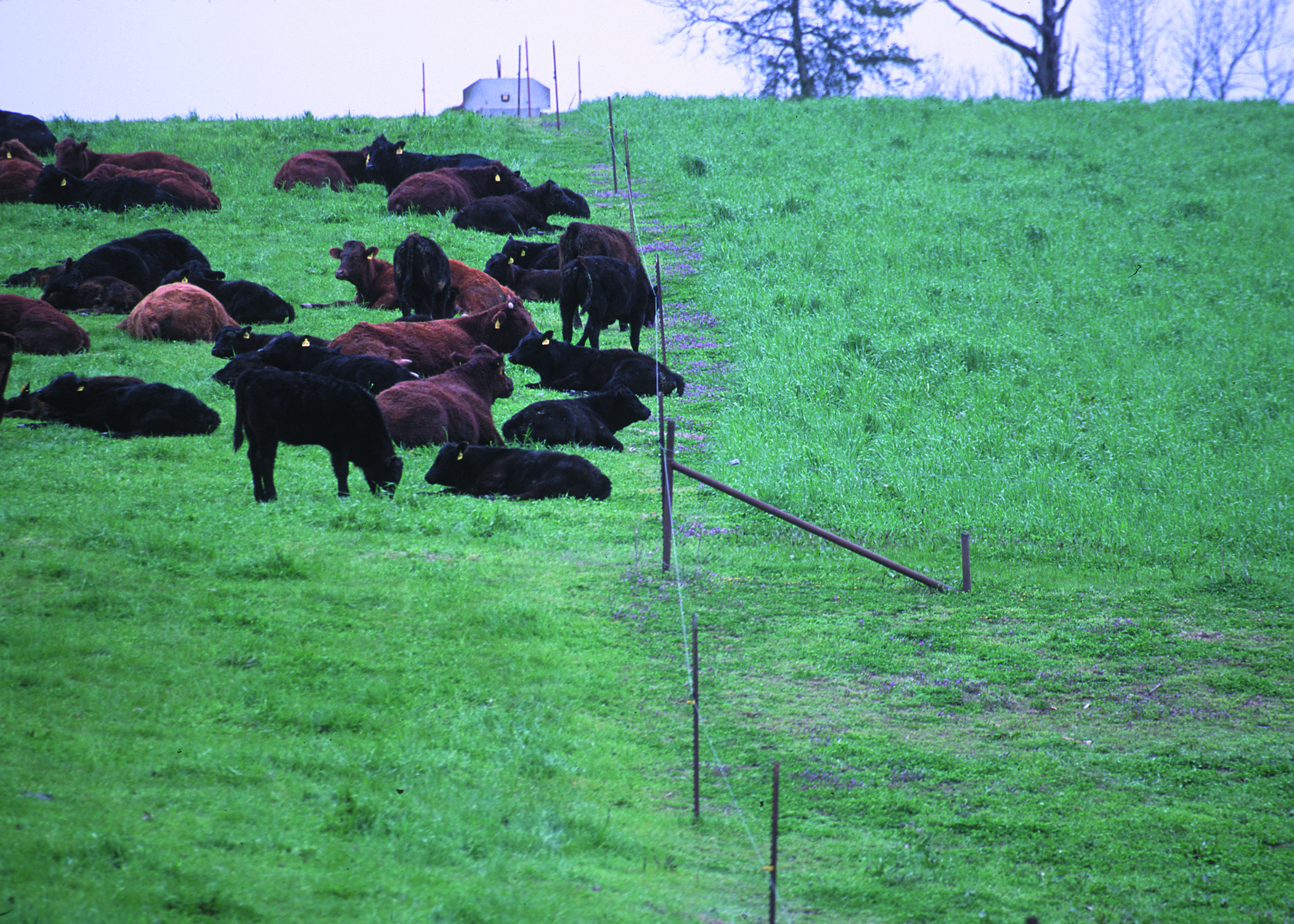
Ranches in north Texas that moved cattle quickly through many small paddocks held 3.61 per cent soil organic matter, against about 2.4 per cent on neighbouring ranches under heavy continuous grazing, according to a 2011 study led by Richard Teague, a professor emeritus at the Texas A&M AgriLife Research and Extension Center at Vernon.
A 2026 systematic review of 70 grazing studies, led by Jonathan Sanderman, vice president of science at the Woodwell Climate Research Center, found no change in soil carbon across the 10 studies that met all of its quality criteria. The review appeared in Communications Earth & Environment on 9 July 2026.
Teague’s study was published in Agriculture, Ecosystems and Environment in 2011. The two papers answer slightly different questions. One compared nine working ranches at a single point in time. The other pooled published studies and sorted them by how well each could support a cause-and-effect claim.
Whether rapid rotation adds carbon to rangeland soil is still not known.
At stake is how to read that gap. Ranchers who rotate cattle quickly through many small paddocks say their land comes back, and Teague’s ranch-by-ranch comparisons have stood for 15 years as the scientific backbone of that claim, so which kind of evidence carries the argument decides whether regenerative grazing is treated as a land-repair tool, a climate tool, or neither.
In an email on 9 October 2026, Sanderman said: “One thing I am confident about is the amount of sequestration that ranchers can expect is likely lower than many people are saying or hoping.”
Multi-paddock grazing splits a ranch into many fenced paddocks and moves cattle through them in turn. On Teague’s ranches the herd stayed one to three days in each paddock, and ranches had 10 to 41 paddocks. Grass rested for about 40 days in fast growth and 80 days in slow growth before cattle returned.
Heavy continuous grazing leaves cattle in one large pasture all season at a high stocking rate. The multi-paddock and heavy continuous ranches in Teague’s study carried the same stocking rate, 27 animal units per 100 hectares.
The study compared three neighbouring ranches in each of Cooke, Parker and Jack counties, where management had been constant for at least nine years. Multi-paddock ranches had 1 per cent bare ground against 30 per cent under heavy continuous grazing. Tall grasses made up 45 per cent of plant biomass against 7 per cent.
Standing crop was 4,680 kilograms per hectare against 2,696. Sediment loss was four grams per square metre against 18. The ratio of fungi to bacteria in the soil was 3.1 against 1.2, which the paper says indicates better water holding and nutrient retention.
Soil organic matter was measured by loss on ignition, which weighs a soil sample before and after burning off its organic material. The method measures organic matter. It does not measure organic carbon directly. The difference between grazing systems was significant only in the top 300 millimetres of soil, where multi-paddock soils ran 5.72 per cent against 3.76 per cent in the top 15 centimetres.
Sanderman’s review searched the literature to June 2023 and found 70 studies with direct soil carbon measurements comparing continuous or season-long grazing with an alternative. Forty-seven failed more than one quality criterion. The most common failure was a control site that could not be shown to represent the management on the treatment site before the switch.
The 10 primary studies, with 27 observations, showed a sequestration rate of 0.03 tonnes of carbon per hectare per year, with a p value of 0.90. A secondary group of 13 studies with 25 observations showed gains. When all retained data were pooled, the mean rate was 0.29 tonnes, with a p value of 0.08.
The review’s own data sheet graded Teague’s 2011 study as secondary. Pairings of neighbouring ranches could not show that the continuously grazed control represented what the multi-paddock land had been before. The review did not re-measure his ranches. The Environmental Defense Fund funded the review, and one co-author works at the fund.
The paper gives an example of the problem from another study in its set. One alternative grazing site had been converted from cropland 29 years before sampling, while its continuous grazing control had been converted 17 years before. The difference in carbon stocks in that pairing may simply be due to the extra 12 years under perennial pasture, the paper says.
A five-year experiment in Colorado ran the comparison as a randomised trial at ranch scale. David Augustine, an ecologist with the USDA Agricultural Research Service in Fort Collins, Colorado, and colleagues paired 20 pastures of 130 hectares each into 10 blocks at the Central Plains Experimental Range in northeastern Colorado. Pastures in each pair were matched on soil, plants, terrain and past management.
One pasture in each pair was assigned at random to adaptive multi-paddock rotation. The other stayed under season-long continuous grazing. From 2014 to 2018 the team found little evidence of any effect on the abundance or production of perennial cool-season grasses, in wet years or dry. Cattle in the rotational pastures gained 12 to 16 per cent less total weight each year.
The Colorado study appeared in Rangeland Ecology & Management in 2020. It did not measure soil carbon.
Each line of evidence has holes of its own. Teague’s comparison had no before-and-after baseline and did not record cattle weight gain or profit. The Colorado trial measured no soil carbon. The review’s primary set held only 27 observations, and sorting them by study design, grazing style, aridity or grassland type showed no pattern.
Sanderman said the absence of a signal in those 10 studies “doesn’t mean that sequestration isn’t happening with adoption of regenerative grazing.” The larger problem, he said, is that “the research community hasn’t done a good job studying this question.” “It is really hard to do research at the scale of commercial grazing enterprises,” he added.
Asked about reports that land visibly improves under rotation, Sanderman said: “I’m not sure what land visibly improving means.” Trends above ground do not always match trends below ground, he said, because not all feedbacks are positive. Many ranchers who adopt regenerative practices “increase herd size which ends up removing more biomass even if the forage is becoming more productive,” he said.
The review’s literature search closed in June 2023, so grazing studies published after that date are not in its dataset.