

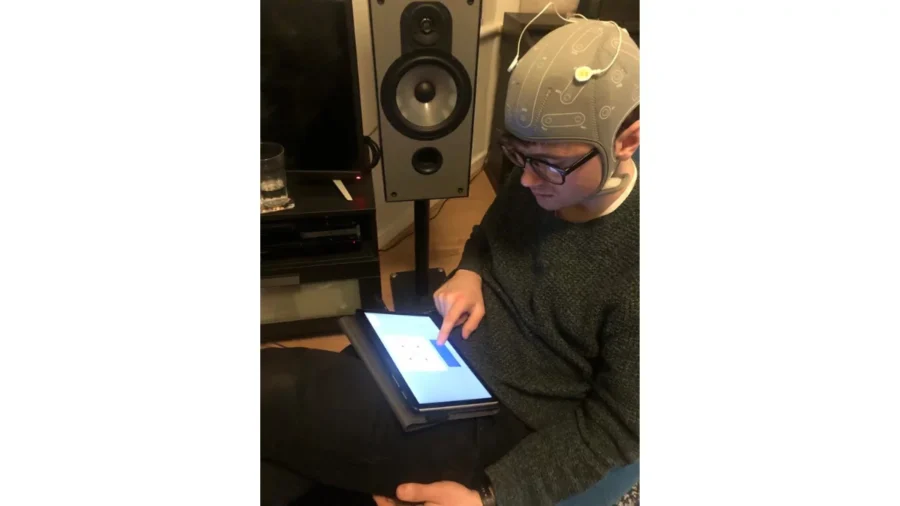
Researchers have developed a wearable brain stimulation system that can be used at home and tailored by artificial intelligence to improve focus, especially in people with low baseline attention.
The non-invasive device delivers personalized electrical pulses to the brain using transcranial random noise stimulation (tRNS), and adjusts intensity based on head size and attention levels. In a double-blind study, participants receiving the AI-guided stimulation significantly outperformed those given placebo or one-size-fits-all settings. The results suggest AI-powered neurostimulation could become a scalable, low-cost tool for enhancing sustained attention in daily life.
AI Meets Neurotech in a Headband
The system, developed by scientists at the University of Surrey, University of Oxford, and Cognitive Neurotechnology Ltd, is designed for home use. It combines tRNS—a gentle, non-painful form of electrical brain stimulation—with an adaptive algorithm that learns each user’s optimal stimulation level. This eliminates the need for costly MRI scans often required for personalization.
“We have shown it is possible to safely and effectively enhance cognitive performance using a personalised system that people can use independently at home,” said Professor Roi Cohen Kadosh, lead author and head of psychology at the University of Surrey. He added that the technology opens up new options for cognitive enhancement that are “accessible, adaptive, and scalable.”
How the Brain Boosting Works
In the study, 103 participants aged 18 to 35 used the system during 290 home-based sessions. The AI learned from this data, training on a measure of performance called A′ (a signal-detection metric) and head circumference to fine-tune the stimulation dose.
Later, in a tightly controlled follow-up trial with 37 new participants, those receiving AI-guided stimulation showed stronger improvements in sustained attention than those using standard or placebo settings. The most dramatic gains were seen in people who initially had low attention scores.
- Participants with low baseline focus improved the most with personalized stimulation
- Those with high baseline attention saw no added benefit
- The system avoided over- or under-stimulation that could reduce performance
- No serious side effects were reported, and sensations matched those of the placebo
Real-World Attention, Real-World Benefits
Sustained attention—the ability to stay focused over time—is vital for everything from driving to studying to managing work tasks. Yet it’s also a fragile resource, especially in our distraction-filled environments. Failures in this cognitive function are linked to conditions like ADHD, depression, and long COVID.
By enabling brain training in the living room instead of a lab, this system solves two longstanding barriers in neurostimulation research: the need for expensive personalization and the artificiality of lab conditions. Users only needed a tablet, CE-certified headgear, and some quiet space. The AI did the rest.
Not Just Smarter, But Fairer
Interestingly, the people who benefited most were those who started out with lower cognitive performance. This finding could ease ethical concerns that neuroenhancement might widen cognitive disparities. Instead, the researchers suggest it could help close the gap by supporting those at a disadvantage due to biology or environment.
“Our work highlights the growing role of AI and wearable neurotechnology in enabling personalised, real-world cognitive enhancement,” said Cohen Kadosh. He added the tool has future applications in education, job training, and even clinical therapy.
What Comes Next?
The team sees potential to explore additional brain areas, investigate long-term effects, and apply the same system to clinical populations. They also stress the importance of data privacy and ethical access as such technologies become more mainstream.
This study marks a promising step toward accessible, adaptive cognitive enhancement—right from your desk or kitchen table. And if your attention just drifted, maybe you’re the kind of person this system could help most.
Published in npj Digital Medicine
DOI: 10.1038/s41746-025-01744-6