He Taught AI to Say “I Don’t Know”

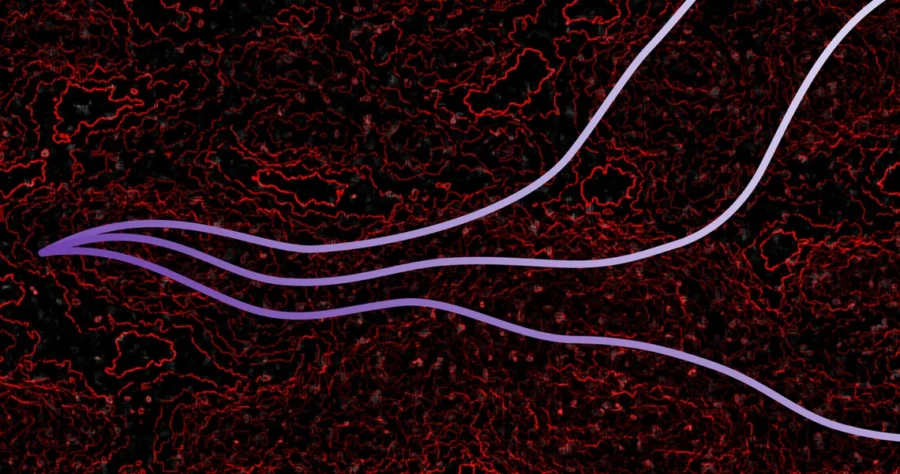
Light rays are propagating smoothly through a noisy, high-dimensional space in this artist’s impression. The new ray tracing algorithm improves on previous methods by better averaging information over trajectories, making it many orders of magnitude faster for quantifying uncertainties in large neural networks.

Artificial intelligence can diagnose disease, write essays, and generate art. But it often refuses to admit when it’s wrong. Now, a University of Arizona astronomer has found a way to change that. In a preprint posted to arXiv, Peter Behroozi introduces a new method for reducing hallucinations in large-scale AI models by making them aware … Read more
Human-AI Teams Make Better Medical Diagnoses

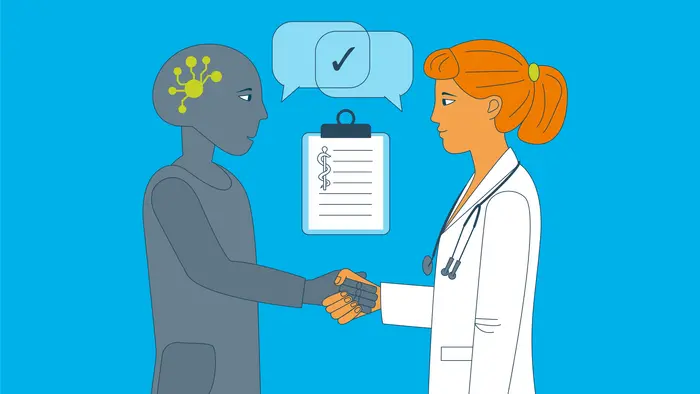
Robot and doctor shaking hands

Hybrid collectives consisting of humans and artificial intelligence make significantly more accurate medical diagnoses than either medical professionals or AI systems alone. New research analyzing over 40,000 diagnoses reveals that combining human expertise with AI models creates a powerful diagnostic partnership that outperforms traditional approaches. The study, published in Proceedings of the National Academy of … Read more

Video Deepfakes Now Pulse With Lifelike Heartbeats

Redheaded young woman

The arms race between deepfake creators and detectors has reached a critical turning point. Researchers have discovered that modern deepfakes can now replicate something previously thought impossible: a realistic human heartbeat. Scientists at Germany’s Fraunhofer Heinrich-Hertz-Institute and Humboldt University of Berlin found that current deepfake videos inadvertently mimic the subtle skin color fluctuations caused by … Read more

Brain decoder controls spinal cord stimulation

EEG Cap and walking man

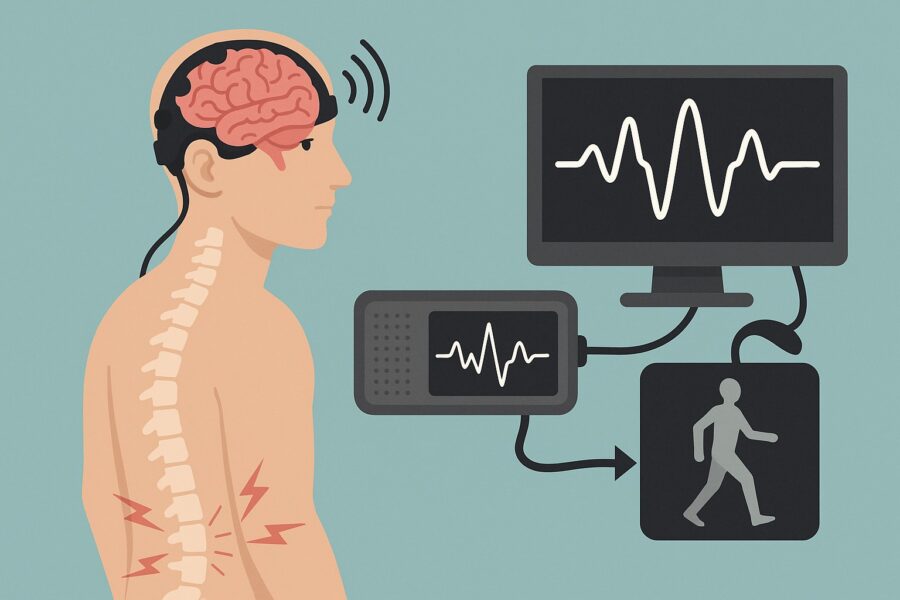
In a significant development for spinal cord injury treatment, researchers at Washington University in St. Louis have created a neural decoder that bridges the communication gap between brain and spine, potentially opening new avenues for rehabilitation. The research team, led by Ismael Seáñez, assistant professor of biomedical engineering at WashU, demonstrated that brain activity can … Read more

Small AI Models Match Giants With SIFT Algorithm

Researchers at ETH Zurich have developed a new algorithm that enhances large language models (LLMs), enabling them to generate more accurate and relevant answers. (Illustration: AI-generated / ETH Zurich)

In a development that could reshape AI efficiency, researchers at ETH Zurich have created an algorithm enabling smaller language models to match the performance of systems 40 times their size, potentially solving one of AI’s most persistent challenges. The method, called SIFT (Selecting Informative data for Fine-Tuning), targets the fundamental problem of uncertainty in large … Read more

AI Fails To Read Human Social Cues

A man covering his eyes in embarassment

Despite rapid advances in artificial intelligence, humans still maintain a significant edge when it comes to understanding social interactions, according to new research from Johns Hopkins University that reveals fundamental limitations in AI’s ability to interpret human behavior. The study, presented at the International Conference on Learning Representations, found that even the most sophisticated AI … Read more

AI Slashes Fluid Simulation Times Fifteenfold

Simulated waves

Osaka researchers have developed an AI model that performs complex fluid simulations in minutes instead of hours, potentially transforming offshore engineering while maintaining high accuracy. This advancement could accelerate development cycles for maritime technologies and enable real-time monitoring systems previously considered computationally impossible. Traditional particle-based fluid simulations, essential for predicting wave behavior in oceanic applications, … Read more