

The plural of “anecdote” is “data”. When Anatabloc was taken off the market two years ago, customers bemoaned the loss of the only product they had ever found that relieved their arthritic symptoms. One of them contacted me through this blog, and told me that before it disappeared, he stockpiled three years’ inventory, which he is still taking now.
Anatabine is a naturally-occurring chemical constituent of eggplant, tomatoes and (especially) tobacco. The chemical structure is similar to nicotine
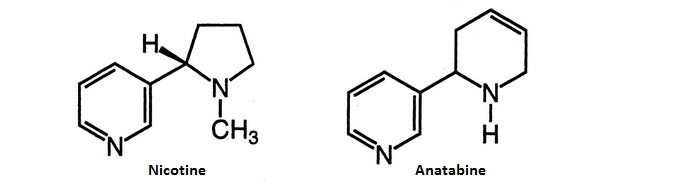
Anatabine is interesting because
- Inflammation is one of the primary means by which the body self-destructs as we get older.
- NFκB is the best-known pro-inflammatory hormone that increases with age, to our detriment.
- Anatabine is reported to block the action of NFκB.
Beginning more than 10 years ago, anatabine was promoted by Star Scientific Co as a nutraceutical under their trade name, Anatabloc. Impatient with the steady rise of sales, Johnnie Williams of Star Sci used political influence with Virginia’s Gov Bob McDonnell to get Medicaid to pay for anatabine as a drug. A scandal two years ago brought down Williams and McDonnell both. (Jon Stewart skewered the story at the time, and though his take on the politics may be well-grounded, his implication that any chemical found in tobacco must be poison is silly.) Anatabine was dragged down with the two, and now research on a promising chemical is foundering. Anatabine is no longer available for purchase in the America or Europe.
In the only published clinical study of anatabine, it was found useful for an obscure auto-immune syndrome of the thyroid. In the government web site ClinicalTrials.gov, there are three more completed trials for which I was unable to find publications as yet. The most interesting relates to the effect of anatabine on C-Reactive Protein in the blood, which is a well-established marker of inflammation. That study was conducted by . In , he reviews a mouse study suggesting anatabine might be useful for slowing progress of Alzheimer’s Disease. Psoriasis is another disease of inflammation gone awry for which it may be useful, and reportedly Rock Creek Pharmaceuticals is banking on psoriasis for their first clinical approval, from which they might leverage research on other applications. Smoking cessation is another promising early application. But in the long run, Rock Creek scientists have their sights set on Alzheimer’s Disease. (I’ve been unable to raise a response from Rock Creek’s principal scientists to find out more.)
What’s the evidence for blocking NFκB?
These three studies [1, 2, 3] all claim to observe that NFkB activity is lower in mice taking anatabine. The mechanism is to block phosphorylation of NFkB, which is an energizing stage in the biochemistry that initiates its activity. Dosages were injected, at 2mg/kg. These studies followed from cell studies in vitro observing the same chemistry.
All studies come from the same team of scientists, associated with RockCreek Pharma and the Rosskamp Inst, both in Tampa, FL. I wish there were independent groups replicating their findings, and I suspect that it is the political scandal that has driven them away.
I learned from Examine.com of two more herbs that block NFkB, to wit Boswellia (frankinicense) and Feverfew.
Dosage
Anatabloc contained a dosage of only 1mg per pill, but rodent studies suggest that the effective human dosage is likely to be at least 10 times higher than that.
Safety, and the Bottom Line
Reported side-effects of anatabine include headache and stomachache. Perhaps this is why the dosage in Anatabloc was kept so low. Rock Creek Pharma claims that a phase-1 trial of oral anatabine found no side effects, but anecdotal evidence suggests that some people have serious responses.
The best evidence we have may be from a user survey conducted by scientists affiliated with Rock Creek, and written up as a journal article.
Of the 78 respondents who stopped taking the supplement for some period of time for any reason, 83% experienced a noticeable return of their joint pain symptoms. Forty-four of 65 (68%) respondents indicated that their symptoms returned within 2–3 days or less, and 64 of 65 (98%) indicated that their symptoms returned within one week or less (Fig. 3). Almost all of the respondents (64 of 65, or 98%) who had stopped using anatabine and felt their joint pain symptoms return subsequently felt those symptoms decrease once they resumed using the supplement.
The survey indicates a lot of satisfied customers, but does not touch on the issues of dosage or side-effects.
Discussion
52 reader comments
Imported threads are marked Archive. New comments are welcome and moderated for spam.
Let's get china to produce for us just need a reputable company. If interested contact me sure we can brainstorm this one
Available from Britain:
https://www.predatornutrition.com/nootropic-supplements/hydrapharm/HYD1025%2F100.html
But Examine.com says you need dosage 30-50 times higher than they sell
https://examine.com/supplements/anatabine/#dosage-information
I had ~30 bottles on Anatabloc before all the sources dried up a few years ago. There was someone close to the inventory that was busted for selling it off on Ebay. That's where I got most of my bottles. The seller actually negotiated with me on lower prices than what he listed. I'm taking them now after a several year break. Took very good care to keep the bottles cool & dry. I believe they're still effective.
You can get Anatabine from this place.
https://www.predatornutrition.com/nootropic-supplements/hydrapharm/anatablok.html
"IMPORTANT: USERS OF ANATABLOK SHOULD NOTE THAT IT CONTAINS 2MG OF PURE ANATABINE PER CAPSULE. THIS IS EQUIVALENT TO 4.4MG OF ANATABINE CITRATE."
Don't know what that means but seems right to me. I'm currently taking 24mg/day of the original citrate version. I think the citrate form has a higher bioavailability.
If you do learn anything about this new "anatablok" please keep us posted. As I have said before, this in one of the best failed products ever.
Repost of Knuts4oe...
You did not mention that Anatabloc was currently available from pickvitamin.com, which seems to be located in California. According to the label it is formulated by "Professional High-Grade Lab", and a note which came with my recent purchase said "Anatabloc is same ingredient as the Hydrapharm: Anatablok that one is much better improvement".
(Note that these folks are "english language" challenged.)
The note also specified that these tablets contain "Pure Anatabine more potent than Anatabine Citrate". We still don't know if this Anatabloc contains any Anatabine...
I am still using the original Anatabloc from my “stash” and I had no problems so I think the old stuff is not only still safe but is also effective. I am also taking another version to stretch my supply of the original. This new version seems a bit sketchy. There is no identification information on the bottle to identify the manufacturer. And since I am also still taking some of the original, I am not in a position to verify efficacy. I am not at home right now or I would publish the source of the new stuff. The new stuff is tablets not lozenges. I much prefer the original lozenges.
Is there any new information on re-establishing manufacturing of Anatabloc & getting it back on market for purchase? In hopes of buying Anatabloc again I've followed Predator Nutrition and Hydrdrapharm for years and their Anatabloc is always out of stock so I assume the FDA used their long reach to shut them down. Most of us know this is a fraudulent shutdown of the product because it works way too well which threatens the established big pharma chemicals production profit base. Does anyone have any current information on Anatabloc? Thanks
Predator Nutrition in the UK has been selling HydraPharm AnataBloc, but it is currently (as of 11/20/2019) "out of stock" or "on back order." I have left my e-mail on the Predator UK web site and also sent an e-mail. As for HyraPharm, I have sent them an e-mail as well asking if it be offered over the internet again. I have one bottle of the original AnataBloc 300 doses. Is it safe to take now that it has long expired?
Here are several links discussing the fact that many drugs can be used far after their expiration date.
Apparently the army even kept stock piles in hot conditions to study expiration date, and the drugs were still usable, after many years.
Not sure about Antabine specifically.
Here is a link to wikipedia and and a portion of the article:
https://en.wikipedia.org/wiki/Prescription_drug
From the link: "A study conducted by the U.S. Food and Drug Administration covered over 100 drugs, prescription and over-the-counter. The results showed that about 90% of them were safe and effective far past their original expiration date. At least one drug worked 15 years after its expiration date. Joel Davis, a former FDA expiration-date compliance chief, said that with a handful of exceptions—notably nitroglycerin, insulin, some liquid antibiotics; outdated tetracyclines can cause Fanconi syndrome—most expired drugs are probably effective.
The American Medical Association (AMA) issued a report and statement on Pharmaceutical Expiration Dates. The Harvard Medical School Family Health Guide notes that, with rare exceptions, "it's true the effectiveness of a drug may decrease over time, but much of the original potency still remains even a decade after the expiration date"."
Also a Wall Street Journal article:
https://www.wsj.com/articles/SB954201508530067326
here's the current (02/08/2019) product link:
https://www.predatornutrition.com/nootropic-supplements/hydrapharm/HYD1025%2F100.html
Also currently on back-order as of the above date. :-( Bummer, I hope it gets back in stock soon, I've been without for a while & my chronic pain issues are starting to come back -- ARGH!
Been using this particular formulation for about a year. According the the ingredient list on the bottle I have in my hand at the moment, the formulation is not exactly the same as the old one; in particular it leaves out the nasty artificial sweetener sucralose (thank god!), and instead of saying anatabine citrate, it says pure anatabine -- whatever that means . . . also there is no flavoring of any kind.
I found the anatabloc product offered by predator nutrition to be effective. I really hope it comes back in stock soon!
Anatabloc is back, distributed by an Algerian company, but available only from a British neutraceutical company, Preditor Nutrition!
The jury is still out on whether this is 100% the Anatabloc we came to know and love!
https://www.predatornutrition.com/nootropic-supplements/hydrapharm/anatabloc.html
I have an email from Predator saying that it is the old Anatabloc. I think their exact phrasing was, "it is the same exact formula, in fact." I have tried to contact the Algerian firm Hydrapharm via Facebook but it looks like they did not even read my post or my PM. I have contacted George Miller the K attorney and received correspondence from his counsel, Linda Rickenderfer, who seemed very interested in anatabine and any connection to Archer Pharma, Roskpamp, Predator, Hyrdrapharm, and even a division of Wagreens which seems to have some type of equity agreement with Hydrapharm only in one area of Africa. Some of the users of the original A-bloc have said on another board that they are using the new product in combination with some original they've stocked. so it is hard to tell ye if the new product is working. I am always interested in more feedback, opinions and results from others. And if anyone is so inclined, send a PM to Predator on Facebook to confirm that they are selling the "exact same" formula. I'd like to see if they will continue to maintain that/
Can someone please add me to the contact list of shareholders there are options. Try and buy the IP. Get it synthesised in china India, sell it under pet supplements banner. To be honest the company was run by a bunch of dreamers they kept diluting the death out of the company that's what killed it. They had no idea how to run a profitable company. They ignored the international market by charging rediculous freight rates. They could of said it was for pets only. They could of produced it in a less regulated juristruction. They even had patents for safe tobacco. I would be interested to pick up the IP as a collective before some big pharmaceutical company shelves it.
BRING IT BACK!!!!!!
I took anatabloc for about one year and obtained almost 100% relief from psoriasis in the toenail, the only effective treatment I have ever found for a painful condition. Forcing Anatabloc off the market is just one tiny example of the overreach of the many federal government bureaucracies growing like cancer into every aspect of our daily lives. Think about that the next time you vote for either a Republican or a Democrat. Ron Paul and the Libertarian party are almost the only voices of reason advocating that we be allowed to simply decide these things for ourselves.