

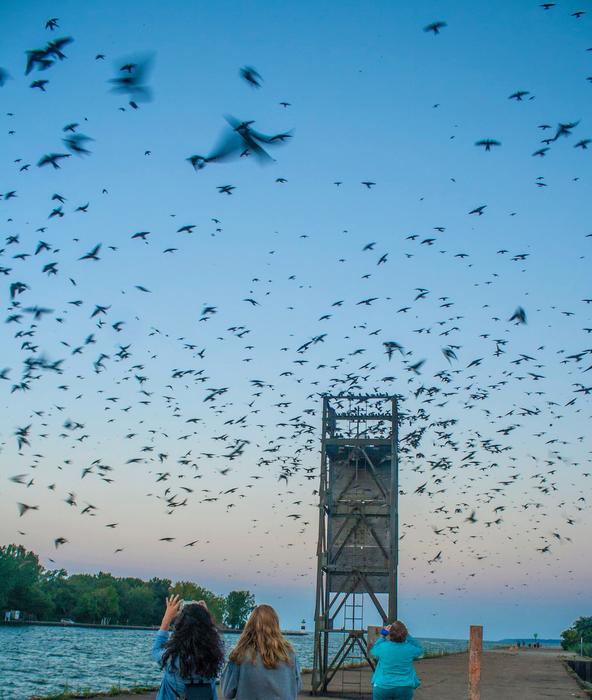
In the backyard birdhouses of Texas and Louisiana, purple martins arrive every February like a kind of promise. They come from the Amazon basin, navigating several thousand kilometres on instinct and timing refined over generations, and the people who put up houses for them, the landlords as they’re known in martin circles, look forward to that return each year with something close to ritual anticipation. So when the birds started dying in February 2021, the phones started ringing.
Winter Storms Uri and Viola had locked the Gulf Coast in subzero temperatures for nine days, a cold snap so anomalous that, at some sites, precipitation rose 18 standard deviations above the February mean. The birds kept coming in from South America, landing into an environment they had probably never encountered in their lifetimes, and they died in their hundreds.
“People in the Gulf States put up houses for the purple martins and look forward to their return every year,” says Maria Stager, assistant professor of biology at the University of Massachusetts Amherst and the study’s lead author. “When they saw the returning birds dying, they reached out to the PMCA asking what to do.” The PMCA (the Purple Martin Conservation Association) turned the disaster into something no biologist could have planned. Members collected 292 carcasses from 30 sites spanning nearly seven degrees of latitude. Louisiana State University’s Museum of Natural Sciences prepared them as study skins. And Stager’s team, working with a 27-year citizen science dataset and whole-genome sequencing, began asking questions that went well beyond counting the dead.
What they found is published today in Nature Ecology & Evolution.
The birds had been killed by cold, not hunger. Carcasses averaged just under 35 grams, roughly 34% lighter than breeding individuals caught at the same sites in May, but body composition analysis using quantitative magnetic resonance revealed that they still had substantial fat reserves: on average about 15% of body mass, well above the depletion threshold. House sparrows, it turns out, can only mobilise fat effectively down to around 21°C; below that, birds die from an inability to thermoregulate rather than an absence of fuel. For purple martins, birds that winter in the tropics and breed in a region that rarely sees frost, temperatures that bottomed out at nearly -20°C were almost certainly beyond any prior experience.
The mortality was not random, though you might expect it to be. Males arrive three days earlier than females on average, and so they were overrepresented among the dead: 191 males to 101 females in the collected carcasses. All were adults. Subadults, which delay their breeding-ground return until they’re older, hadn’t yet arrived when the storms hit. That age-based timing quirk, seemingly incidental, would matter enormously for what came next.
“The purple martin may be one of the most beloved and closely monitored backyard birds,” says Joe Siegrist, president and CEO of the PMCA and one of the paper’s co-authors. “Folks saddened by the loss of their birds were eager to turn this disaster into a contribution for the greater good of the species.” That army of citizen scientists, who monitor arrival dates at their nest sites each spring, provided the before-and-after data needed to estimate population impact. By comparing first-arrival timing between 2021 and 2022 against 24-year historical means, the team estimated that early-arriving martins had probably died at 52% of Texas sites and 53% of Louisiana sites: not a known number, but a troubling inference from the gaps.
The evidence of selection didn’t stop at phenotypes. Whole-genome resequencing of 66 individuals (29 victims and 37 survivors) from the same Texas sites revealed 218 genomic windows showing elevated differentiation between the two cohorts, harbouring around 90 protein-coding genes. Several were associated with seasonality, heat stress response and egg-laying. More striking still: the surviving population had shifted genomically in the direction of northern populations, as though the storm had, in a single winter, pulled the genetics of a southern breeding colony a little towards its counterparts breeding further up the continent.
The ripple effects ran forward in time. Average first egg dates in 2021 were 12 days later than the long-term mean in Texas, 10 days later in Louisiana. Reproductive success that year was the lowest ever recorded in the 25-year dataset. In 2022, the proportion of first-time subadult breeders in Texas fell to its smallest value on record; the cohort of offspring that should have been produced in 2021 simply wasn’t there. Arrival timing in 2022 also shifted markedly, by 14 days in Texas and 11 in Louisiana, with reduced variance suggesting selection had trimmed the earliest end of the distribution. By 2024, though, those timing signals had faded back towards historical averages, presumably as maturing subadults (who were never caught in the storm) accelerated their own arrival schedules across successive years.
Recovery, that is, is happening. But demographic modelling suggests it could take 6 years even under optimistic assumptions about adult survival, and potentially decades if storm mortality was as severe as the worst estimates suggest. A second comparable event within that window would, the models indicate, roughly double the time needed to return to pre-storm numbers. Were such events to occur more than once per decade, the population might never recover without outside help.
And here is the rock and the hard place. The same long-term dataset showing recovery from cold snaps also shows that warmer spring temperatures have been advancing the optimal breeding window in Texas and Louisiana, favouring earlier and earlier arrival. Martins haven’t been responding: arrival dates in both states have actually trended later since 1998, not earlier, contrary to what a warming climate alone would predict. The cold storms, rare but catastrophic when they hit, seem to be counteracting selection for early arrival just as warming conditions demand it. The population is being pulled in opposite directions by the same climate becoming simultaneously less predictable and more extreme.
“People always ask me, ‘if you’re interested in climate change, why are you studying the cold?'” says Stager. “But if birds are going to have a future, we need to know more about how they survive newly unpredictable conditions, which can include surprisingly cold temperatures.” From 2012 to 2022, purple martins declined in the Texas–Louisiana region more steeply than anywhere else in their range. Whether the birds can adapt fast enough, or whether the storms will keep arriving before the population catches up, is a question the birdhouses of the Gulf States will keep answering, one spring at a time.
Study link: https://www.nature.com/articles/s41559-026-03005-5