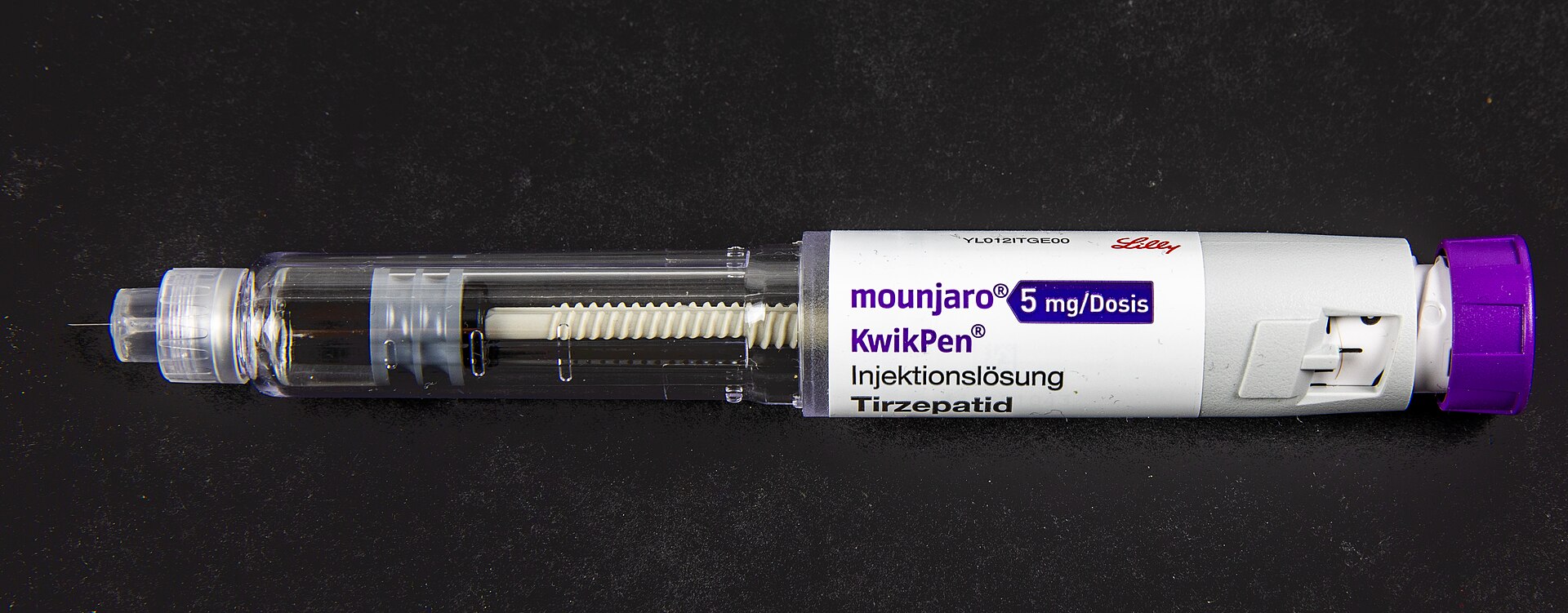
People who carry rare damaging variants in the gene for the GLP-1 receptor lost far less weight on semaglutide than matched patients without them, but lost close to the usual amount on tirzepatide, according to a genetic study of 13,725 treated adults published in Nature Metabolism on 11 November.
Semaglutide carriers lost 2.4 per cent of their body weight over six to 12 months, against 8.8 per cent for matched non-carriers. Tirzepatide carriers lost 13.3 per cent, against 15.2 per cent. The study was led by Matthew Levy and Elizabeth Cirulli of the genomics company Helix, with co-authors from health systems in a research network that spans 13 North American health systems.
Two drugs, two receptors
Semaglutide, sold as Wegovy and Ozempic, works only through the GLP-1 receptor. Tirzepatide, sold as Zepbound and Mounjaro, acts on that receptor and on a second one, the receptor for the gut hormone GIP. The authors reasoned that a faulty GLP-1 receptor might blunt the first drug while the second could partly work around it.
In the main trials both drugs produced average weight losses of 10 to 21 per cent over 68 to 72 weeks, the paper says, citing the STEP 1 and SURMOUNT-1 trials among others. Individual results vary widely, and the genetic causes of that variation are not fully known, the authors write.
The rare variants in question are uncommon. Damaging versions of the gene were found in about 0.2 per cent of treated people in the study.
How the study worked
The team used the Helix Research Network, which links clinical-grade exome sequencing to electronic health records and insurance claims for 351,818 people. From it they drew adults with a body mass index of 25 or more who started semaglutide or tirzepatide injections in routine care and had at least six months of weight records on treatment.
Of the 13,725 people treated, 33 carried a qualifying rare variant in GLP1R, the gene for the receptor. Six had variants expected to knock out the gene and 27 had changes to single amino acids that prediction software or lab tests flag as damaging or possibly damaging. Each carrier was matched to up to 10 non-carriers on drug, dose, sex, diabetes status, earlier use of these drugs, genetic background, starting BMI and length of follow-up.
Across both drugs, carriers lost 8.2 per cent of body weight against 12.5 per cent for their matches. The split by drug was the main result. Among the 17 carriers on semaglutide, 15 lost less weight than their matched group. Among the 19 on tirzepatide, 11 did. A formal test for a difference between the two drugs was statistically significant.
In a check, the authors looked at the second receptor. Rare variants in GIPR, the gene for tirzepatide’s other target, showed no consistent pattern with either drug, and a small overall dip did not hold up when the authors adjusted for genetic ancestry.
Tested twice more
The authors sought to repeat the result in two other groups. In the US National Institutes of Health’s All of Us Research Program, eight rare-variant carriers on semaglutide lost 2.6 per cent of body weight against 5.7 per cent for matched non-carriers. The direction matched, but the gap was not statistically significant.
In a separate, non-overlapping group from the same health systems, with records to 31 March 2026, seven semaglutide carriers lost 4.1 per cent against 7.5 per cent, a significant gap. Eleven tirzepatide carriers showed no shortfall.
The work builds on a study by Su and colleagues in Nature this year, which linked a common variant in the same gene, known as P7L, to modestly greater weight loss on these drugs. The new paper confirms that link in its own data and puts the rare-variant effect at about 12 times its size for semaglutide.
The authors write that carriers “may be preferentially suited to tirzepatide or other agents engaging non-GLP-1R pathways”. They also cite an analysis of cardiovascular outcome trials that tied each kilogram of weight lost on GLP-1 drugs to an approximately 7 per cent lower risk of major atherosclerotic cardiovascular events, and suggest the smaller losses in carriers could have long-term health effects.
What the study cannot show
The study cannot say whether testing patients for these variants before prescribing would improve their health or save money. No one was assigned a drug based on their genes, and the paper does not test that.
It is observational. Patients were not randomised to either drug, and the authors acknowledge that “residual confounding is possible”, though matching balanced the groups closely. Records of whether people took their injections and of their weight were, in the authors’ words, “imperfectly recorded”.
The numbers are small. The headline comparison rests on 17 carriers on semaglutide and 19 on tirzepatide, and the authors say this limits conclusions about individual variants. Nearly all carriers were of European genetic ancestry.
Tirzepatide was not fully immune. Carriers of the most severe variants showed a trend towards a smaller response on tirzepatide too, which the authors call a “hypothesis-generating observation” in a small subgroup. Many variants were classed as harmful by software that the authors say can be less reliable for receptors of this kind, and lab tests of each variant remain to be done.
Eight of the 21 authors, including both lead analysts, are Helix employees. The paper reports no specific funding. The analysis code is public, though the patient data are not.