

Cell biologists are within striking distance of “partial reprogramming”. Already, technology has arrived to turn an old cell into a young cell in a Petri dish, and researchers (Turn.bio) are looking intensely for ways to safely rejuvenate cells within a living body. Is this the breakthrough that we in the human rejuvenation movement have been waiting for, or is it a sideshow?
Partial Reprogramming
In nature, aging is part of a one-way street. A germ cell becomes a stem cell becomes a differentiated cell, and then the differentiated cell grows old.
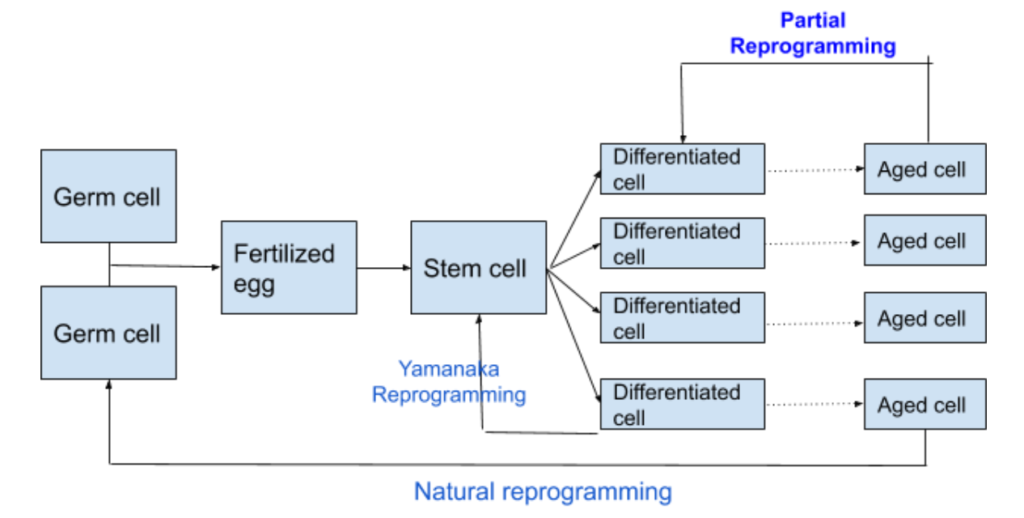 In the course of nature, cells change their epigenetic state from left to right. Nature must have a mechanism for resetting the cellular aging clock, going all the way back to the left. If this didn’t exist, then all cells would be on a one-way path to extinction. At some point in the life cycle, nature needs to take a mature cell and turn it into a germ cell (sperm or egg). But, in the process, epigenetic programming is wiped clean. Two things happen simultaneously: memory of the cell’s functional differentiation is lost, so it becomes again a pluripotent stem cell; and the age of the cell is reset to zero.
It never happens in nature that the cell’s epigenetic age is reset to zero, without also erasing the cell’s functional identity. Nature has no need for this process. But for cellular rejuvenation, this is what we would like to be able to do. If all the cells in your bones became young again, you might lose the calcification and brittleness of old bones and regain the springy resilience of a 10-year-old. But if all the cells in your bones became stem cells, your bones would lose their structural integrity and your body would collapse like a mass of jelly.
In theory, we might learn enough about hundreds of epigenetic changes that take place with age, and use CRISPR or analogous process to reset each one of them individually. This would be cellular rejuvenation “by hand”. If we are really, really lucky, then this Herculean biochemical task might be avoided by some accidental pathway by which the cell resets these hundreds of epigenetic markers on command. But we have no reason to expect that a mechanism exists to do this, because in the normal course of a life cycle, nature has no need for it.
Thirteen years ago, Yamanaka [2006] found that differentiated cells (specifically skin cells) could be induced to revert to stem cells by exposing them to just 4 proteins, which have come to be known by their initials as OSKM, the Yamanaka Factors. This was akin to what nature does, resetting the cellular age and erasing the cell’s function. Then, three years ago, a study from Juan Carlos Belmonte at the Salk Institute gave us hope that de-aging a cell might be possible without loss of its identity. They used the same OSKM, but exposed the cells for just a few days, then turned off the exposure. They reported that the cells were made younger without erasing their function. Mice with the rejuvenated cells lived longer. This was a proof of principle, but there were big caveats. First, they worked with progeria mice, genetically programmed to age unnaturally fast. Second, the mice were genetically prepared with OSKM grafted into their DNA, and pre-coded with a chemical switch so that OSKM could be turned on and off at will by injecting the mice with doxycycline. For mice that are not genetically modified before birth (or for normal people), delivery of OSKM to individual cells and timing that delivery poses a substantial challenge.
Then, in a preprint posted to BioRxiv just this spring, Vittorio Sebastiano and his Stanford group took another step forward. They added two more ingredients to the Yamanaka recipe (OSKMLN) and succeeded in rejuvenating human fibroblasts in cell culture, as reported by the methylation age of the cells. This experiment had neither of the two limitations of the Belmonte group, and it was human cells rather than mouse — three steps forward. But it was done in vitro only — one big step backward.
Turn.bio is a biotech startup that is seeking to develop and capitalize on the technology. Steve Hill of the Life Extension Advocacy Foundation (LEAF) interviewed Sebastiano about his discovery and the path forward. Hill provides more background in this article. Over at FightAging!, Reason reviewed the subject.
Is epigenetic reprogramming a driver of aging, or a response to cellular damage?
Hill asked Sebastiano this question, and he hedged in his response:
My personal opinion is that I can’t really decide whether the epigenetic changes are the cause or the consequence. I cannot decide what theory is right in the sense that some people suggest it’s a developmental program of aging and some people say it’s a consequence of damage accumulating. What I really care about, at the end of the day, is that, regardless, epigenetic changes explain aging. The epigenetic changes are what, at the nuclear level, triggers this dysfunctionality of the cell.
— Vittorio Sebastiano
The logic in this answer is incoherent. I suspect that Sebastiano is not confused, but he knows what he has to say to keep his funding flowing, and to keep from being distracted by philosophical arguments. There is a prejudice in the field that he has chosen to skirt, rather than confront it head-on. Look at his last sentence, “The epigenetic changes are what, at the nuclear level, triggers this dysfunctionality of the cell.” He recognizes that altering the epigenetic program is going to make the cell younger, but he avoids saying that the body has arranged the epigenetics to make the cell older.
Aging as an epigenetic program
The core truth here is that alteration of gene expression is the way the body functions. Gene expression is different from cell to cell, from tissue to tissue. The way the body changes its strategies from minute to minute and also from decade to decade–also gene expression. Epigenetics = gene expression is the heart of the way the body’s metabolism and the core of the developmental program by which we grow arms and legs and bones and muscles. It is also the core of the aging program, but you can run afoul of funders, decision-makers, journal editors and other gatekeepers if you say so. Better not to say so.
We know the cells of nearly every tissue are epigenetically reprogrammed as we get older. Is the purpose of this reprogramming to resist the damage, which is the primary cause of aging? (standard theory) Or are the epigenetic changes implemented as a self-destructive program for the express purpose of weakening and then killing the body? (programmed aging theory, to which I subscribe)
This is no abstract question for theorists–it has fundamental implications for practical anti-aging research. If the epigenetic changes are there to resist aging as best the body knows how, then we shouldn’t be tampering with them. But if the epigenetic changes exist only to create damage and stymie the cell’s repair mechanisms, then restoring the epigenetic program of the cell to a younger state looks like a promising anti-aging strategy.
Reason on Cancer
The response at FightAging! to Sebastiano’s experiments with cellular rejuvenation starts with a presumption that this kind of intervention must raise the risk of cancer. Where does this presumption come from? His thinking is based on general principles of evolutionary theory. Theory says that the body is trying to live as long as possible, and if the body has made the decision to permit cells to senesce, it must be from a self-interested calculation that it is better to allow certain but slow death in the guise of cellular senescence than it is to risk the possibility of near-term death from cancer.
I believe the evolutionary theory is wrong, and if so, there is no a priori reason to think that cellular rejuvenation will increase cancer risk. In fact, we might hope that cancer risk decreases, as the body’s immune system is restored to a younger state and systemic inflammation is quelled. (Of course, we will still want to experiment with animals and then humans to assure ourselves that the treatment does not increase cancer risk.)
I have staked my professional career on the theory that aging is programmed self-destruction, that the body is not trying to live as long as possible, but rather is aiming for a predictable lifespan, and if we thwart that program, we won’t have hell to pay.*
Clear logic of programmed aging
Aging is an epigenetic program, honed by natural selection for the sake of the community over the individual. The one-line proof is that genes regulating aging have been preserved in the genome since we were descended from single-celled ancestors 1 billion years ago. A longer version is in this blog five years ago, and the 300-page version is in my book.
Once you accept that aging is programmed, it follows that aging must be coordinated system-wide. We can look for one or several clock mechanisms, and for signals that transmit the age-state of the body through (almost certainly) the blood plasma. The quickest path to rejuvenation technology is not “repair of damage” — a daunting challenge of bioengineering — but only a modification of the signaling environment, or, perhaps, direct manipulation of the body’s aging clocks.
Cellular Rejuvenation: The Path Ahead
When the treatment matures, what will be our strategy for the body as a whole? Is there a central clock (perhaps in the hypothalamus, a neuroendocrine region of the brain) where the treatment must be targeted, after which the rejuvenation signal will be transmitted to the body without further intervention? Or would we have to reprogram every cell in the body?
What about inflammation? Presumably, systemic inflammation is controlled by signal molecules that will revert to youthful levels after reprogramming.
What about arterial plaques? Will they be cleared up by a rejuvenated metabolism? Same question for beta amyloid in the brain?
What about oxidative damage? Would the body know how to pick up the ball that it dropped when we were much younger? What about cross-linking? Accumulation of lipfuscin?
At times like these, I’m shaken awake to realize how little I really know about the aging metabolism, and the signal transduction that drives it.
————-
Perspective
For me, this is a case where the technology has gotten ahead of the science.
The big picture is that from the 1950s, evolutionary biologists have handed the medical researcher a mistaken framework. Medical researchers have done their best to ignore the theory and forge ahead with a practical program that addresses the changes that are observed to take place with aging. This agnosticism is a lot better than sticking dogmatically to a flawed theory.
But we could do so much better — we will do so much better — when we embrace the correct theory. A clear theoretical framework will be extremely helpful in guiding lab experiments toward the most important questions.
Here’s what I mean, specifically: Evolutionary theory offers the clear message: the body cannot have organized programs of self-destruction. This implies that aging is a disorganized process. It must be damage. It must be random and it must be local. It makes sense to learn about the cellular biology of aging, and develop ways to heal the aging cell. Aging will be remediated from the bottom up.
But the theory is wrong. In fact, aging is coordinated systemically. It is a top-down process, directed by signal molecule in the blood. The most efficient way to remediate aging is to study the signaling mechanism, to understand it well enough that we can alter the signaling environment, telling the body that it is young. We don’t have to repair damage in every damn cell in the body. All we have to do is to re-adjust the levels of hormones and transcription factors that circulate in the blood to youthful levels.
Once we think this way, it is obvious where the focus of our research ought to be.
- We need to understand how the system is coordinated. It is not yet known whether the clock that controls aging is in a specific location, probably the hypothalamus deep in the center of the brain, or whether the clock operates as a consensus among many distributed sites (e.g., telomere lengths and methylation states in many tissues). In this latter picture, the transcription factors that circulate in the blood and dictate epigenetic state are generated throughout the body, contributed by every cell in every tissue.
- Even more important, we need to catalog the thousands of signal molecules in the blood, proportions of which change with age. It is likely that some of these are more important than others, and if these few are reset to youthful proportions, the rest will follow. How many? Is there a manageable list of signal molecules that can be re-balanced in the bloodstream, and it will reprogram all the rest? Or must we manipulate hundreds of separate hormone levels in order to turn back the aging clock? The answer is yet unknown. A related question: How long must the blood levels of these compounds be artificially maintained before the body is reprogrammed to a youthful state, and the intervention is no longer necessary? We might imagine people lined up for a once-every-decade trip to the rejuvenation clinic with an IV drip for two days. But if the treatment has to be sustained for months at a time, it will be prohibitively expensive, uncomfortable, and disruptive.
Here’s an example that comes from this kind of thinking — an experiment we might start with: Take a sample of blood plasma from an artery going into the brain of a young mouse (or human), and catalog the proteins and RNAs. Do the same with the blood plasma emerging from the brain. “Subtract” the two profiles with a computer comparison to see which elements are changed. Any significant differences might tentatively be imputed to the hypothetical hypothalamic clock. Repeat the two measurements and the differencing with an old mouse. The difference of the differences is a good first guess as to what molecules in the blood control aging.
Back to Cellular Rejuvenation and Partial Reprogramming
Cellular rejuvenation may turn out to be a crucial technology for us to master, or it may be something we don’t have to understand in detail, because the body does this by itself once we rebalance the signal molecules in the blood. Or — a third possibility — it may be that cellular rejuvenation in the hypothalamus is sufficient to reset the body’s global aging clock. We could be addressing these questions experimentally.
Discussion
151 reader comments
Imported threads are marked Archive. New comments are welcome and moderated for spam.
Small study on reversing epigenetic aging:
https://www.nature.com/articles/d41586-019-02638-w
I cannot find the original article in Aging Cell.
If somebody can, please drop a link.
Looks like a case of growth hormone waking up quiescent stem cells to me. Which may not be a good thing in the long run. Assuming I'm right about what epigenetic age is basically measuring.
I have found this interesting paper from 2013
Proliferation Rate of Somatic Cells Affects Reprogramming
Efficiency*
THE JOURNAL OF BIOLOGICAL CHEMISTRY
They claim that OSK is more effective in IPSC generation then OSKM,, and cMyc is only needed to turbocharge already transforming IPSC colonies.
If this largely sidelined research is true, then cMyc a known oncogene should not be used in in vivo reprogramming experiments thus the treatment window might be widened or the dose increased without risk of malignant transformation.
I have come to this paper by speculating that instead of the slow mouse experiments, researchers should use serum starved confluent monolayers for rejuvenation studies. They could grow the primary cell culture from old donor cells, then stop serum and start interval OSK treatment followed by functional assays (like profiferative capacity, beta galactosidase, lipofuscin, telomeres, mDNA age etc) .
That could save time and money.
This is all interesting work. But in my opinion we can relax - in Vivo reprogramming with all its risks simply is not required. IPSCs can be made from any somatic cells, expanded in culture (telomerase already present) and injected via IV to the patient. No terratomas are formed this way and the tiny cells can go anywhere in the body they are required to effect repairs.
https://www.ncbi.nlm.nih.gov/m/pubmed/30662568/
So looks like we have a real rejuvenation therapy on our hands. Anyone know a good stem cell clinic that will do it?
well I am not convinced based on the scarce research available at this timepoint that interval OSKM really works in wild type organisms and really is anything more than turbocharging a wound healing mechanism.
also I have some doubts about injecting manufactured solid tissue cells. from what I have read these cells usually end up in the lungs and die in a few days..
so I think we should understand the biology of rejuvenation and then go for small molecules approach
or the ex vivo culturing of stem/progenitor cells you mentioned coupled with senolytics and blocking scar formaton this one could be a better solution but I dont see it coming in the next 20 years
Why would it not come in the next 20 years? Both senolytics and iPSCs via IV are available now! I don't believe that the problems with MSCs occur with iPSCs due to their much smaller size and pluripotency. Also, they don't last long in the body because the body's own signalling causes them to quickly differentiate as required (which is what they want). IPSCs are the best cell to add to the human body because we don't have any (after the embryo-fetal transition) and they are right at the top of the chain, renewing and refreshing all cells beneath them. It is the perfect combination with senolytics. Better even that telomerase therapy, which can potentially keep some cells that would be better off replaced, alive.
IV can't really be done with small animals though, so this is a straight to human trial.
From the abstract of the paper I posted
'Intravenously administered iPSCs were therapeutic with a dose as low as 5×10^6/kg and some iPSCs differentiated into somatic cells in injured organs. Disseminated iPSCs trafficked into injured tissue and survived significantly longer in injured than uninjured organs. In disease-free animals, no intravenously administered cell differentiated into an unwanted long-lasting cell or survived as a quiescent stem cell.'
Very promising indeed.
That wasn't my interpretation of the results at all - but I will re-read the paper to be sure of my facts.
It seems highly unlikely that iPSCs would form scars - this is what less plastic cells do in the absence of the requisite stem cells. The whole point of iPSCs is that the signalling of the environment they find themselves in decides what they differentiate into (and only form terratomas if their own signalling becomes dominant - which is easily prevented if they are diffuse.)
In theory, with the right signalling iPSCs can replace any type of cell, including neurons. This obviates the need to reprogram old cells back to health - simply allow them to be gradually replaced.
Even more excitingly, iPSCs could with the right signals regrow limbs and give humans fully regenerative abilities.
Where has your sudden pessimism come from Gabor?
Well this paper only came out in Jan 2019, let's hope others take up the baton.
I agree that the pace of research into aging is way too slow. It should be treated as a Manhattan Project or Apollo Moonshot, but sadly not all people think as we do.
This is the explanation I wrote for epigenetic aging back in March 2018 on one of Josh's other posts. It still seems true to me.
https://scienceblog.com/joshmitteldorf/2018/03/19/telomerase-update-and-downgrade/#comment-391343
What if epigenetic age is just a measure of time since a somatic cell line was spawned from it’s stem cell progenitor (which by definition will be younger epigenetically)? That means older people would naturally have an older epigenetic age because their stem cells are less active and somatic cells are replaced less often. It also means an individual with sightly more telomerase (and longer telomeres) would naturally have longer lasting somatic cells, so at any given time their tissues would be older epigenetically because they are also replaced less often. If this is true it means there are two separate but easily confused correlations: older people having less often replaced somatic cells due to tired stem cells, and people who have longer telomeres needing replacement less often (but probably with better preserved stem cells as a result).
I have a perspective based on genetics and evolutionary history that makes me dubious that this is what's going on.
There's also the fact that Horvath has designed a "multi-tissue methylation clock", that gives the same reading for blood cells (very recently spawned) and kidney cells (much older) and heart cells (probably as old as the body itself).
But I'll ask you: suppose we were to design an experiment to test whether what you say is true. What would the experiment look like?
The first part of the experiment is simple - see if telomerase activators cause an increase in epigenetic methylation age in leukocytes (or buccal cells, for example). Even if the telomerase activator is only moderately effective, it should reduce how often the somatic line is replenished from the underlying stem cell niche.
The actual chronological age of somatic cells (blood vs kidney for example), may not matter - as it is likely the underlying progenitor cell pool (the stage between stem and final somatic cells) that ages.
I would go with steve horvath's hypothesis in his 2013 paper that this is an epigenetic maintenance system
Let us for a moment assume the aging mechanism and the growth mechanism are separate circuits in the cell, then is it possible that these mechanisms are targeting common genes through histone modification in an antagonistic fashion, with the growth mechanism having precedence. The cell divides and functions optimally during the growth phase, but as the growth impulse is suppressed due to a maturity milestone having reached, the aging mechanism starts to dominate and progressively makes the cell dysfunctional.
This study 'Epigenetic ageing is distinct from senescence-mediated ageing and is not prevented by telomerase expression'
https://www.ncbi.nlm.nih.gov/pmc/articles/PMC6224244/
This study is about Link Between Epigenetic Clocks for Aging and Senescence.
'On epigenetic level, replicative senescence and aging evoke characteristic modifications in the DNA methylation (DNAm) pattern, but at different sites in the genome'
https://www.frontiersin.org/articles/10.3389/fgene.2019.00303/full
This study https://www.nature.com/articles/s41598-019-39919-3
'Synchrony and asynchrony between an epigenetic clock and developmental timing'
it is about the relationship between the epigenetic and the developmental clock and a snippet from the study 'Taken together, these results suggest that even though the DNAm aging clock and the developmental stage typically correlate with the gestational age, these clocks can be decoupled in some cases and likely represent two independent timing mechanisms.'
That's a very interesting study Kunal. Thank you for sharing.
I was recently reviewing some of S. Horvath talks and he mentioned he believed his clock was tracking development. This study would imply that the processes are somewhat separable.
I suspect there is a bit of both, as it is likely that many of the sites chosen by the algorithm also track development and growth by association. As Gabor commented above, there are many possible sites that can be selected, but one thing to keep in mind is that the original Horvath clock is multi-tissue, so many of the signs of cell differentiation would not be selected.
One possible interpretation of the studies so far is that the clock is driven by metabolism and proliferation. As cells multiply and function a set of sites vary their methylation as they progress from a young state to an equivalent old one. This process starts from conception and throughout life and results in a particular average methlylation state of the tissue. The higher the proliferation and metabolic rate the faster it ticks. So all tissues would have some percentage of old and young-methlylated cells.
Another take is that the process is more tightly controlled across the same tissue and most cells have the same methylation state correlated to their proliferation and metabolic rate history.
The way I understand the DNAm clock to work it would not differentiate between the two possibilities. In practical biological terms, they may not make a bit difference either. Both resulting in predictable outcomes as a result of average gene expression.
There's also the question of whether individual sites are more likely to vary at a particular point in the aging of the cell, which would correlate more with a controlled 'ageing' mechanism. The studies that utilize one or very few sites are clocks seem to imply this.
A snippet from the study
' comparisons of the epigenetic clock from different regions of the retina revealed no major differences; different parts of the retina followed the same trend as the whole retina and maintained their epigenetic age, even though central retina is developmentally accelerated compared to peripheral retinal regions . This result suggests that the developmental clock and the epigenetic clock might be controlled independently.
Maybe that is why young blood plasma rejuvenates the aged body, it basically rejuvenates the cell without reversing the aging clock using a different growth mechanism
Google “MicroRNA“ - and you will see that the aging program is implemented through MicroRNA.
More information would be helpful. This doesn't give us much to go on.
About the study in Aging cell, an observation
From the study
DNAm age of donor blood is not influenced by the environment of the recipient’s body even if the recipient is 1 year old, this trait persisted even 17 years after the transfer to the recipient and the DNAm age continues to increase after transfer to the recipient’s body as if the donor cells were still in the donor’s body and effectively the blood cells remembered the age of the donor.
suppose the 1 year old recipient received blood from a 50 year old recipient, and after 17 years, the recipient's blood age is roughly 68 yrs.
The Dnam clock shows that epigenetic age rises exponentially when we are growing, but in the case of the transplant to a 1 year old, the dnam cock advances at a rate, as when the body has already matured.
So is advancing at an exponential rate just an illusion due to a very high rate of growth or is it advancing at the same rate, as when the body has already matured.
what effectively is happening
neither the Dnam age has any effect on growth of the blood cells in the recipient,
nor the growth of the recipient has any effect on the Dnam age of the donated blood cells
this is pure speculation
suppose aging is a separate process from growth, then there could be a separate growth clock because the Dnam clock is looking at complete lifespan, and the growth clock stops at maturity.
but then how does growth stop if aging is a separate process, another speculation, there could be growth maturity clock which maybe starts at puberty.
I repeat this is pure speculation
I believe that it does work in animals and humans.
Here is my case:
Looking into how Turn Bio is reversing the cells aging.
The article
An Interview with Prof. Vittorio Sebastiano of Turn.Bio
says that
"You are using Oct4, Sox2, Klf4, and c-Myc (OSKM) but also LIN28 and Nanog to make OSKMLN"
I am going with Oct4 is it appears to be critical to the process.
So how do we turn on OCT4?
The study:
Tryptophan derivatives regulate the transcription of Oct4 in stem-like cancer cells
states:
"Reduction of endogenous ITE levels in cancer cells by tryptophan deprivation or hypoxia leads to Oct4 elevation."
So now we have 2 ways to turn on OCT4
Low tryptophan
or
Low Oxygen levels.
So the question is, does low oxygen levels in nature promote longevity?
The article:
Naked mole rats can survive 18 minutes without oxygen. Here’s how they do it
states
"The animals can survive more than 18 minutes without oxygen."
Article:
Dead zones enhance key fisheries species by providing predation refuge.
states
"only the harvested quahog clam (Mercenaria mercenaria) thrived in hypoxic areas"
Both the quahog clam(500+ years) and the naked mole rat (20+ years) live in low oxygen conditions.
So what about us humans?
(the following is for information only, I am not promoting either)
The article:
Effect of moderate alcohol intake on nocturnal sleep respiratory parameters in healthy middle-aged men
states:
"drinking alcohol before retiring resulted in lower arterial blood oxygen saturation (SpO2) during the early half of sleep"
also
The article:
Cigarette smoking decreases tissue oxygen.
states:
"smoker experiences tissue hypoxia during a significant portion of each day."
So what I would expect is that we would see that smoking and/or moderate
drinking associated with longer life.
In your recent article on the new clocks noted that heavy smoking is better than
2nd hand smoke for longevity.
This might be explained by the increase in Oct4 levels(low oxygen).
We have all heard limited alcohol drinking seems to have health benifits.
and
in various studies of the 100+ crowd, that many smoke(low oxygen), drink(low oxygen) or are vegitarians(low Tryptophan)
The following is just my personal experience.
My wifes great great Grandma lived to 104 years, while her 2 sister only lived
into there 70s.
We know that before bed each night she drank a glass of sherry(low Oxygen).
We visited her just before she passed away, looking at her I would not have
thought her more that 50 or 60 years old.
Her own doctor remarked while she was in her 90s that she had the heart of a 50 year old.
Young blood cocktail stops Alzheimer's decline, early clinical trial reports
https://newatlas.com/alkahest-young-blood-plasma-alzheimers-cognitive-decline/60927/?fbclid=IwAR3_Tk3HS9ovTzvQlELXztsb1FcRdAtZcJDl9Jxhhb2D7wRE_0g7uYYUn_E