
On the morning of September 2, 1859, telegraph operators working the line between Boston and Portland, Maine, unplugged their batteries and kept sending anyway. The wire was carrying a current the sky was pushing through it. In Washington, an operator’s forehead was grazed by an arc that leapt from his equipment. Telegraph paper caught fire in Pittsburgh. Accounts gathered afterwards describe a storm that shocked operators and set fires in telegraph offices across two continents.
The storm was named for Richard Carrington, a 33-year-old English amateur astronomer who happened to be sketching sunspots when a brilliant white flash erupted across the group he was drawing. He noted the time: 11:18 in the morning, September 1. Roughly seventeen hours later, Earth’s magnetic instruments went into revolt.
It remains the most intense geomagnetic storm on the instrumental record.
What Carrington saw through his telescope
Carrington was working from a private observatory at Redhill, south of London. He was projecting the Sun’s image onto a screen when two patches of intensely bright light appeared on top of a large sunspot group. They lasted about five minutes. He ran to fetch a witness. By the time he returned, most of the brightness was gone. Richard Hodgson, observing separately in England, saw the same thing.
What Carrington had watched was a solar flare, though the word did not yet exist in the sense it now carries. The flash was electromagnetic radiation reaching Earth at the speed of light, arriving in eight minutes. What came behind it was slower and heavier: a coronal mass ejection, a cloud of magnetised plasma launched from the Sun’s atmosphere. That cloud carried the punch.
Science Blog has previously looked at how the fastest coronal mass ejections cross the 150 million kilometres between Sun and Earth in under 18 hours. The 1859 cloud did it in about 17. That is extraordinary. Typical transit times run two to four days.
The aurora as far south as it has ever been recorded
Auroras are usually a high-latitude phenomenon. Charged particles from the Sun spiral down along Earth’s magnetic field lines and dump their energy into the upper atmosphere near the poles, where oxygen and nitrogen glow green, red, and violet.
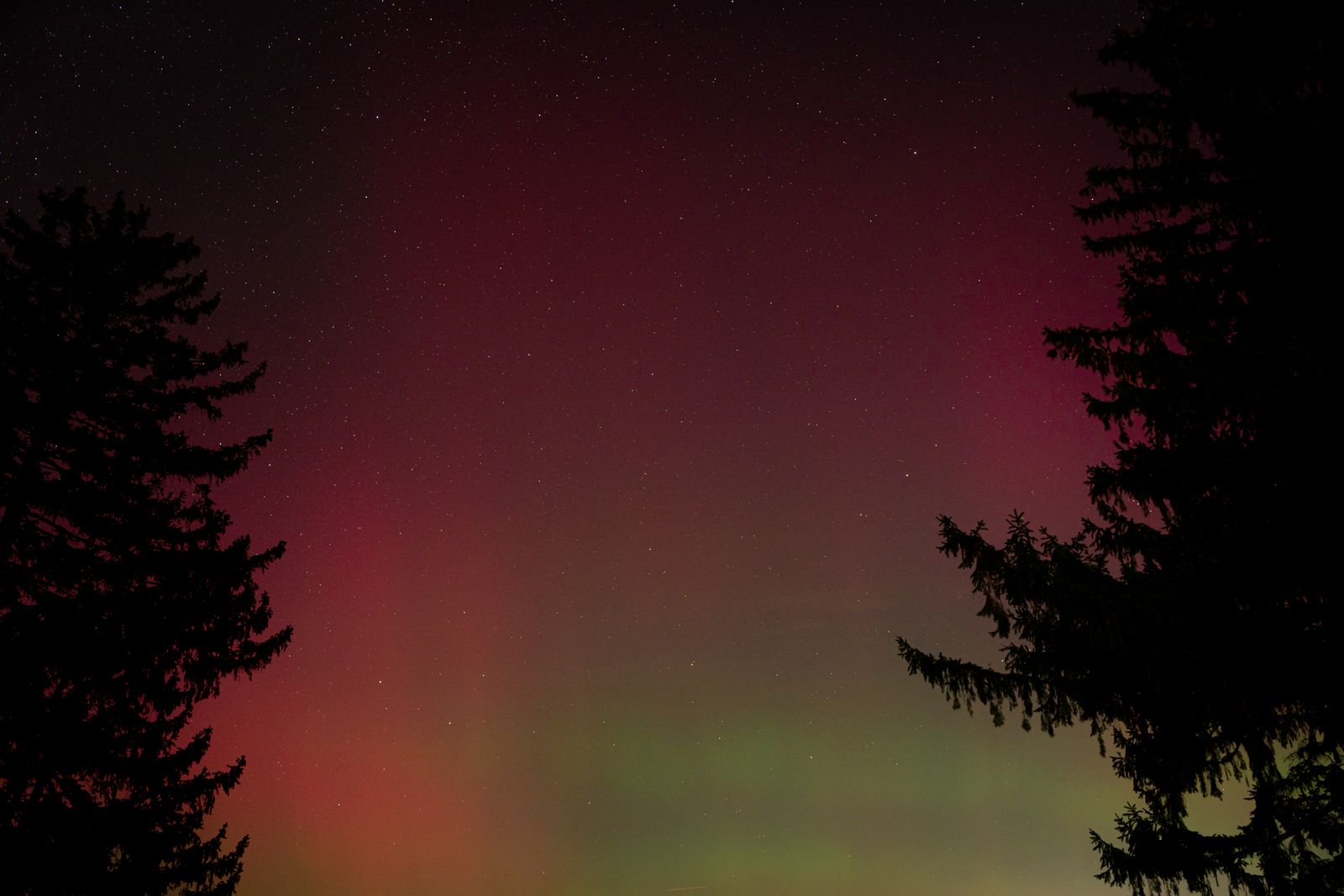
The Carrington storm pushed the auroral oval so far toward the equator that the northern lights were seen from Cuba and from Honolulu, while the southern lights were reported as far north as Santiago. In the Rocky Mountains, gold miners woke around one in the morning and started making breakfast, convinced dawn had arrived. From North America down to Panama, people reported reading newspapers outdoors by aurora light alone.
Putting a number on that is harder than it sounds, and the work is still going on. A 2020 reconstruction in Earth, Planets and Space, led by Hisashi Hayakawa of Nagoya University, put the equatorward boundary of the auroral oval at about 25 degrees invariant latitude in the Southern Hemisphere, using Chilean newspaper reports and a naval log from the brigantine Dart in the Pacific. Northern Hemisphere estimates from the same body of work sit further poleward, between roughly 28 and 31 degrees. Science Blog has also covered the same group’s reconstruction of the February 1872 storm, which they place alongside Carrington as one of only three superstorms in the last two centuries.
Telegraphs that ran on nothing
The telegraph network of 1859 was small by modern standards, wire strung between wooden poles across North America and Europe. But it was the first continent-scale electrical infrastructure humans had ever built, and it acted like an enormous antenna.
When Earth’s magnetic field twists violently, it induces electric currents in any long conductor sitting inside it. The longer the wire, the more current. Telegraph offices across the United States and Europe found their equipment behaving strangely. Some stations caught fire. Operators were shocked. Papers ignited.
The most quoted exchange comes from two operators, one in Boston and one in Portland, Maine, who realised around 8 a.m. on September 2 that their batteries were doing more harm than good. They disconnected them. And then, for about two hours, they kept sending messages back and forth using only the current the storm itself was driving through the line. The two-hour conversation between Maine and Boston, conducted with the power disconnected, was reprinted in contemporary newspapers and later gathered into the scientific literature. It remains one of the strangest documents in the history of communications.
Why a repeat today would be worse, and not in the ways people assume
The wiring has multiplied. Long high-voltage transmission lines, pipelines, undersea cables, and railway signals are all vulnerable to the same physics that shocked the telegraph operators. The concern is not that a laptop on a desk would fry. It is that the transformers at the heart of the electrical grid, some of them custom-built and years to replace, could be damaged in numbers that would take a very long time to fix.
Science Blog has reported on the specific risks a Carrington-class storm poses to grids, satellites, and navigation today, and the equally specific things it would not do. It would not switch off every electronic device. It would not end civilisation. It would put enormous stress on continent-scale infrastructure that has never been tested against a storm of that size.
David Wallace, an electrical engineer at Mississippi State University, laid out the mechanism in a 2022 piece republished by Civil Beat: geomagnetically induced currents that can exceed 100 amperes flow into transformers, relays and sensors and cause internal damage, which is how you get large-scale outages. One hundred amperes is roughly the electrical service running into a house. Replacement transformers of that size are not sitting in warehouses. They are built to order.
The forecasting problem
The Carrington cloud took roughly 17 hours to reach Earth. The satellite fleet that watches the Sun today, including the ESA–NASA SOHO observatory and NOAA’s DSCOVR spacecraft at the L1 Lagrange point, sits about 1.5 million kilometres upstream. When a coronal mass ejection crosses that point, the measurements it yields translate into somewhere between 15 and 60 minutes of warning about what the cloud is carrying and how bad the geomagnetic