

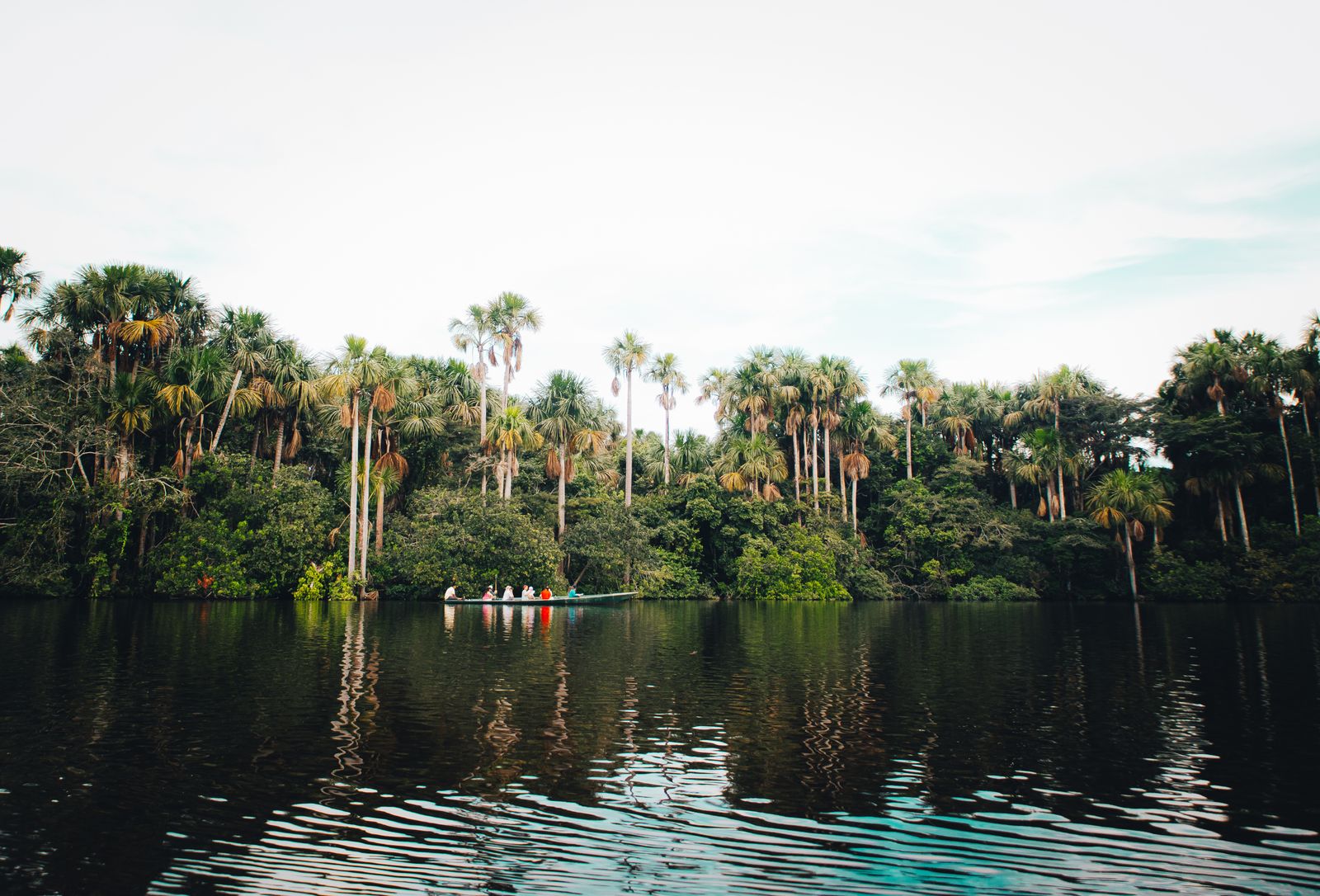
In the Peruvian Amazon, about four hours by rough road from Pucallpa, a river runs at an average of 86 degrees Celsius, roughly 187 degrees Fahrenheit, along a stretch that measures somewhere between four and six miles depending on how you count the tributaries. That is not hot-tub warm. That is teapot-off-the-stove warm. Frogs and small mammals that fall in are cooked, their eyes clouding almost immediately in a way the geothermal scientist Andrés Ruzo has described in his field notes on the Boiling River, also called the Shanay-timpishka.
Correction, 16 September 2026: An earlier summary said scientists had no geological explanation for the river’s heat. It has been corrected to reflect the leading explanation described in the article: a non-volcanic hydrothermal system in which groundwater returns through faults and fractures.
The oddity is not that a river can be that hot. Yellowstone has hotter water. The oddity is where this one is. The nearest active volcano sits more than 700 kilometres away.
Thermal rivers of this scale are almost always children of magma. This one appears to have no volcanic parent at all.
What the water actually does
The Shanay-timpishka begins as a cold, ordinary Amazon stream. Then, along a stretch in the Mayantuyacu region of central Peru, it changes character. Ruzo, who first measured it in November 2011 and has returned across six field seasons, recorded an average water temperature of 86 degrees Celsius, with some pockets pushing above 90. He estimates the full river system runs about 5.5 miles, and in places widens to more than 80 feet across, though the water there is shallow.
Steam rolls off the surface in thick white sheets. Ruzo has told interviewers, including National Geographic’s Overheard podcast, that the sound of it from a nearby ridge resembles a slow, constant ocean surge. Ivory-colored stones line the banks. The water itself is a startling turquoise, clear enough that you want to step in, until you remember what it would do to a foot.
Why the missing volcano matters
When Ruzo was a graduate student at Southern Methodist University, working on Peru’s geothermal maps, he asked around about a large boiling river in the Amazon. The answer, from mining companies, oil and gas firms, and geological surveys, was consistent. It could not exist. Thermal rivers of any real size sit near volcanic or magmatic systems, and no such system was known to run under this part of the jungle.
One senior geologist, Ruzo has recalled, told him to stop asking. It was, professionally speaking, a stupid question.
The question turned out not to be stupid. It was just answered wrong.
Ruzo tested three hypotheses on his return trips. Was the river volcanic? Geochemical fingerprinting of the water said no. Was it an oil-drilling accident, the industrial equivalent of a scald? He found an oil well more than a mile away, checked the operator’s records, and cross-referenced with historical archives that mentioned a thermal river in the area long before any petroleum work. That left the third option, and it is the one that now seems to hold.
A very large hydrothermal system without a volcano
The current best explanation is that the Shanay-timpishka is a non-volcanic hydrothermal feature on an unusually large scale. Rainwater and Andean meltwater seep deep into the earth, are heated by the geothermal gradient at depth, and then find their way back up through a network of faults that act like plumbing.
Maria Richards, who coordinates the Geothermal Lab at Southern Methodist University, has explained the mechanism in these terms: the crust is stitched with small fault segments, water percolates down, heats, builds pressure, and is pushed back up along those faults. The greater the volume, the more forceful the return. Hot springs work this way all over the world. Arkansas has them. So does most of continental Europe.
What makes the Peruvian river different is scale. Richards has said she has personally never seen a non-volcanic hydrothermal system anything like it.
The heat, in other words, is not coming from a magma chamber. It is coming from the ordinary warmth of the deep crust, focused and delivered by an accidentally excellent piece of underground geometry.
What has been published, and what has not
It is worth being plain about the state of the evidence here. Ruzo’s original temperature and geochemical measurements have been described in his book and in interviews. He has said he plans further publication. The most substantive peer-reviewed work to come out of the site so far is not about the plumbing at all. It is about the forest.
In October 2024, Alyssa Kullberg, then a postdoctoral researcher at EPFL in Lausanne, and Riley Fortier, a PhD candidate at the University of Miami, published a paper using the Boiling River as a natural experiment for climate change. Their team placed 13 temperature loggers along the river for a year. Average annual air temperatures ranged from 24 to 25 degrees Celsius in the cooler forest to 28 to 29 degrees in the hottest bands. Maximum air temperatures near the steamiest patches approached 45 degrees Celsius.
Where the river ran hottest, understory vegetation thinned. Large evergreens like Guarea grandifolia struggled. Heat-tolerant species dominated. And this shift happened over remarkably short distances, sometimes across a couple of hundred metres, along a study area of less than two kilometres.
The BBC piece includes a small but important correction at the foot: an earlier version implied the water reached 45 degrees Celsius. The water reaches 86.
Why the forest around it looks scrubby
Fortier, quoted by the BBC, said the change in the forest was visible from the moment the team stepped into the affected zone. Fewer large trees. Drier leaf litter. Crunch underfoot in a place that should feel spongy.
Rodolfo Nóbrega at the University of Bristol has offered a plausible reading: even with water nearby, higher temperatures can push plants past their photosynthetic ceiling. They shut down not because they are thirsty, but because they are cooked.
Kullberg has been careful about generalising. The Boiling River is a strange place. Its air is unusually steamy. Its heat is delivered from below, not by the sun or by shifting weather systems. It cannot stand in for the whole Amazon’s climate future. It is one small window, in one small valley, with its own peculiar physics.
Chris Boulton at the University of Exeter, who has co-authored work on Amazon tipping points, has called the natural-experiment framing clever, while noting it is a snapshot, not a forecast.
The legend that turned out to be partly right
Ruzo’s grandfather told him a story about Paitití, an Incan version of El Dorado, and about the horrors Spanish conquistadores reported when they went looking for it: spiders that ate birds, anacondas that swallowed men, shamans with spells, and a river that boiled. The spiders exist. So do the anacondas. And so, it turns out, does the river.
Local Asháninka and Shipibo-Conibo communities in the Mayantuyacu region have known about the Shanay-timpishka for generations. Shamans use its waters in medicine and rituals. Ruzo secured permission from the local shaman before conducting his measurements, and continues to work under that arrangement. The name Shanay-timpishka is often translated to mean the river is heated by the sun, though the sun has nothing to do with it.
The story that had to travel furthest was not the river’s existence. It was the geological explanation. As we have written before about the way bodies contain hidden histories, landscapes can too. A boiling river without a volcano looked, for decades, like a category error. It was just an unusual solution to a plumbing problem.

Where the science goes next
Ruzo’s field seasons have moved toward dating the water itself, trying to work out how long it has been underground before it re-emerges scalding. That number would tell geologists a great deal about the depth of the circulation loop and the size of the fault network feeding it. Kullberg and Fortier’s forest work continues, adding groundwater measurements that the first paper did not include.
The river remains under pressure from deforestation along its watershed, and Ruzo has advocated for national monument status to protect both the geothermal feature and the surrounding forest. The retreat of tropical glaciers in the Andes, which likely feed part of the deep circulation, is one of several slow variables that could change the river’s behaviour over decades.

For now, the fact stands. Along a four to six mile stretch of rainforest in central Peru, water flows out of the ground at temperatures that would sterilise a surgical instrument. There is no volcano within a distance you could drive in a full day. A frog that misjudges the bank does not swim out. The steam rises through the canopy in white sheets, and from a ridge above the valley, if you stand very still, you can hear it moving, like something breathing.