

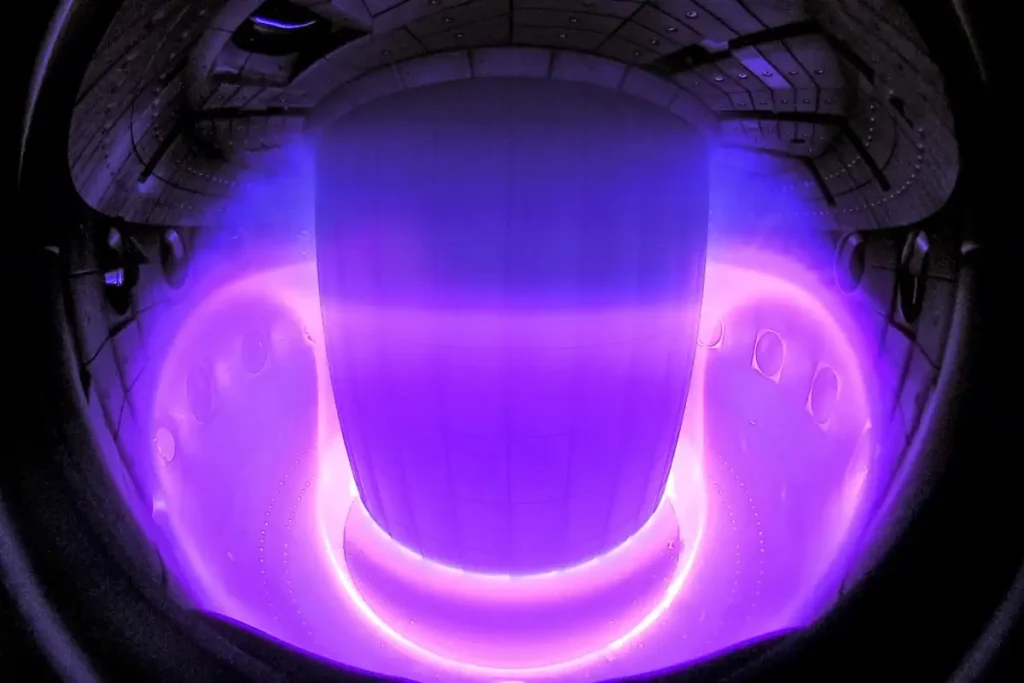
Fusion plasmas have been hitting the same density wall for 40 years. Push the fuel concentration too high and the reactor fails within seconds, ending the shot in a cascade of instability. That empirical limit, known as the Greenwald density, has been one of fusion’s most frustrating constraints, because the denser the plasma, the more power it produces. Scientists at China’s EAST tokamak just ran stable plasmas at 1.6 times that supposedly hard ceiling.
The results, published in Science Advances, suggest the barrier isn’t fixed physics but a condition that can be sidestepped if you control how the plasma forms from the first microsecond. The EAST team, led by researchers at Huazhong University of Science and Technology and the Chinese Academy of Sciences, used microwave heating during startup and higher initial gas pressure to fundamentally alter how fuel interacts with the reactor’s tungsten walls. Line-averaged electron densities reached 1.3 to 1.65 times the Greenwald limit while remaining stable—densities that would normally trigger immediate collapse.
The technique matters because fusion power scales with density squared. At 150-million-degree temperatures, doubling fuel concentration can quadruple energy output. But tokamaks have been trapped below the Greenwald limit since it was identified in the 1980s. Breaking through changes the economics and engineering of future reactors significantly.
Why the Wall Matters More Than Expected
Plasma-wall interactions are a primary source of contamination. When energetic particles strike the metal surface, they knock off heavy atoms that radiate away energy, cooling the core and triggering instability. The EAST approach reduced edge temperatures deliberately, limiting this sputtering process. Cooler edges meant cleaner fuel, which allowed density to climb without the usual penalty.
This aligns with plasma-wall self-organization theory, which predicts two operating regimes. Most tokamaks have operated in the “density-limit basin,” where higher density leads predictably to disruption. EAST’s results demonstrate entry into the “density-free basin,” a state where that relationship breaks down and density can rise freely.
“These experimental achievements provide new physical insights into breaking through the long-standing density limit in tokamak operation in pursuit of fusion ignition,” Jiaxing Liu explains.
The tungsten walls were essential. Previous attempts on carbon-lined tokamaks remained stuck in the conventional regime. Metallic surfaces, combined with startup conditioning, created the conditions for self-organization between plasma and wall that theory predicted but experiments had not clearly demonstrated until now.
What This Changes About the Path Forward
The work doesn’t solve all three variables needed for ignition—density, temperature, and confinement time—but it loosens the most restrictive constraint. Operating at 1.6 times the previous ceiling means reactors could potentially generate far more power without growing larger. It’s a scalable approach that doesn’t require continuous pellet injection or other complex fueling systems.
Associate Professor Yan Ning says the team plans to apply the method during high-confinement operation, the most demanding plasma conditions EAST can produce. Whether the density-free regime can be sustained under those circumstances will determine how broadly this technique applies to future burning plasma devices.
The results change assumptions about what tokamaks can achieve. The density limit appeared to be fundamental—a cliff edge built into the physics. EAST’s experiments suggest it’s more like a basin that can be avoided if you start in the right place. That shift in understanding may matter as much as the density record itself.