

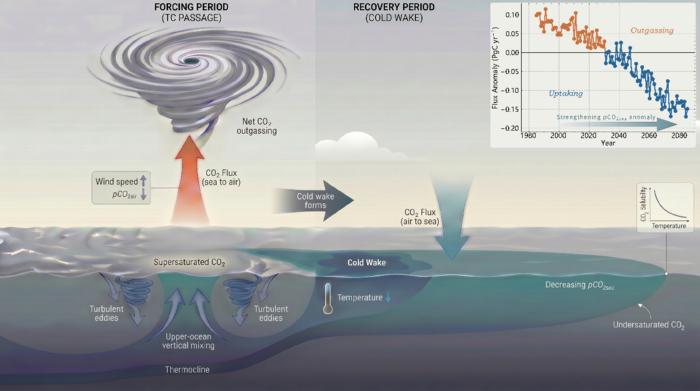
Every year, roughly 90 tropical cyclones spin up across the world’s oceans, each one dragging carbon dioxide out of the sea and flinging it into the air. That, at least, is what most scientists assumed. The problem was that nobody had managed to measure the whole thing properly. Ships don’t sail into hurricanes. Moored sensors go dark when the storms pass over. The few readings that existed were snapshots from different basins, taken under different conditions, and they disagreed wildly with each other; estimates of cyclone-driven CO2 release ranged across more than an order of magnitude. For decades, the contribution of tropical cyclones to the global carbon cycle remained, as one researcher put it, “obscure.”
A new study in Nature Geoscience has closed that gap, and what it found is considerably stranger than expected.
The team, drawn from institutions in China, the United States, and Germany, built a daily global dataset of air-sea carbon flux going back to 1993, the first of its kind at that resolution. Instead of trying to send instruments into storms, they reconstructed what the ocean was doing chemically during and after each cyclone, pulling together satellite sea-surface temperatures, reanalysis wind fields, and painstaking interpolations of the ocean’s dissolved carbon chemistry across more than 2,500 individual cyclone cases. The result was a picture of the carbon cycle at hurricane-scale for the first time.
What that picture shows is a system in transition. And the direction of change is not straightforwardly good or bad; it depends entirely on how much carbon humans keep putting into the atmosphere.
A Storm in Two Acts
The physics works in two phases. While a cyclone is actually overhead, the maths is fairly simple: ferocious winds act like an enormous gas transfer pump, churning the surface and driving CO2 from the ocean into the air. This is the forcing period, lasting a few days around the storm’s passage, and it has been fairly well understood. What had been systematically underestimated was what happens next. A cyclone doesn’t just churn the surface; it mixes colder water up from depth, leaving a “cold wake” that can persist for weeks to over a month after the storm moves on. Cold water absorbs more CO2 than warm water, so this wake quietly pulls carbon back in from the atmosphere during the recovery period, partially undoing what the storm did. The two effects nearly cancel. But not quite: outgassing still wins, on average.
Or it did. The study documents a dramatic shift. In the early 1990s, tropical cyclones accounted for roughly 16 percent of the annual carbon flux in the tropics and subtropics. By the late 2010s that figure had fallen to around 4.5 percent. The total annual outgassing attributable to cyclones dropped by nearly half over that period.
“The role of tropical cyclone in the global carbon cycle has long been obscure, owing to sparse observations during and after tropical cyclones,” said Zhanhong Ma of the National University of Defense Technology, a co-author of the study. “This work provides a sophisticated global air-sea carbon flux dataset, enabling exploration of the tropical cyclone contribution in the context of global warming.”
The mechanism behind the decline is, in a way, a portrait of what warming is doing to the ocean’s interior. As the surface heats up faster than deeper layers, the temperature contrast between surface and subsurface is sharpening; the upper ocean is stratifying. That steeper gradient means that when a storm stirs things up, the cold water it drags to the surface is colder still, relative to what was there before. Colder surface water means more carbon uptake during the recovery phase. So the same storm, at the same intensity, leaves a deeper carbon sink in its wake than it would have thirty years ago. The cyclones themselves haven’t changed much; it’s the ocean they’re stirring that has.
The regional numbers are worth pausing on. In the Bay of Bengal, tropical cyclones have historically been responsible for a remarkable share of local CO2 release, accounting for something approaching half of the basin’s annual efflux in some estimates. In the South China Sea and western North Pacific the fractions are similarly large. These weren’t marginal contributions.
Which Way the Storm Blows
Where this is heading depends on the emissions trajectory. Under a high-emissions scenario, the cold wakes get progressively more intense as stratification strengthens, to the point where the models project cyclones flipping from net carbon sources to net carbon sinks sometime around 2035. That might sound reassuring, one more feedback nudging the climate system in a helpful direction. It isn’t, quite. An ocean that absorbs more CO2 is an ocean that acidifies faster. And ocean acidification is already compressing the habitable range for species that build shells or skeletons out of calcium carbonate. Cyclone cold wakes becoming carbon sinks would accelerate that process without slowing atmospheric warming in any meaningful way; the amounts involved are too small relative to total human emissions. Under a low-emissions scenario, the trend is projected to reverse in the 2040s and return to something like today’s levels by the end of the century.
The authors are careful to flag what remains uncertain. Future cyclone frequency is genuinely contested; different modelling approaches give different answers, and the analysis relies on assumptions about how storm activity will change. The cold wake mechanism is well understood, but the interplay between biology, chemistry, and circulation during recovery periods is complicated in ways that daily satellite data can’t fully resolve. Still, the broad pattern is robust across multiple datasets and sensitivity tests. Tropical cyclones are already behaving differently in terms of their carbon accounting, and the gap between scenarios is not subtle.
There is something disorienting about the finding. Hurricanes have generally been understood as hazards to be tracked and, where possible, survived, not as participants in the global carbon budget who might switch sides. The idea that warming could turn these storms from a modest carbon source into a carbon sink, while simultaneously making the ocean more hostile to marine life, captures something about the climate system that is hard to sit with: the feedbacks don’t always point the same direction, and “better” in one ledger often means worse in another.
https://doi.org/10.1038/s41561-026-01985-4
Frequently Asked Questions
Why would a hurricane actually release carbon dioxide from the ocean?
When a tropical cyclone passes over the ocean, its extreme winds act like a massive pump at the sea surface, dramatically accelerating the transfer of dissolved CO2 from the water into the air. This happens in part because high wind speeds physically enhance gas exchange, and in part because low atmospheric pressure associated with cyclones also shifts the equilibrium slightly toward outgassing. The effect is intense but short-lived, lasting roughly the few days the storm is overhead.
If cyclones are releasing less carbon than before, is that good news for the climate?
Not really, and this is where the story gets complicated. The reason cyclones are releasing less carbon is that global warming has sharpened the temperature contrast between the ocean’s surface and its deeper layers. That means the cold wakes storms leave behind are more intense, drawing more CO2 back into the ocean after each cyclone. Under high emissions, the models suggest cyclones could flip to net carbon uptake within a decade or so, but the amounts involved are too small to meaningfully slow warming, while the increased uptake would accelerate ocean acidification.
What is ocean acidification and why does it matter here?
When the ocean absorbs CO2, it forms carbonic acid, lowering the water’s pH. Ocean acidification is already affecting species that build calcium carbonate structures, including corals, oysters, and many planktonic organisms, by making it harder to maintain their shells and skeletons. If warming causes cyclone cold wakes to pull more CO2 into the sea, that additional uptake would intensify acidification in already-stressed tropical and subtropical regions, potentially shrinking viable habitat for a wide range of marine species.
How did researchers actually measure carbon fluxes during and after hurricanes?
They couldn’t measure directly, because ships don’t operate in hurricane conditions and sensors often fail when storms pass overhead. Instead, the team built a reconstruction: combining satellite sea-surface temperature data, reanalysis wind fields, and interpolated estimates of the ocean’s dissolved carbon chemistry to calculate daily air-sea CO2 fluxes for more than 2,500 cyclone events between 1993 and 2020. They then validated the reconstruction against the relatively rare cases where moored ocean buoys had survived storm passages with usable data.
Does this mean cutting emissions sooner would change what hurricanes do to the carbon cycle?
Yes, and the difference between scenarios is substantial. Under a low-emissions pathway, the current trend toward reduced cyclone-driven outgassing would reverse around the 2040s, with the balance returning to something close to today’s levels by the end of the century. Under high emissions, stratification keeps intensifying and cyclones flip to net carbon uptake by around 2035, with the oceanic sink effect growing stronger throughout the century and acidification worsening alongside it. The emissions trajectory essentially determines which version of the carbon cycle hurricanes are part of.