

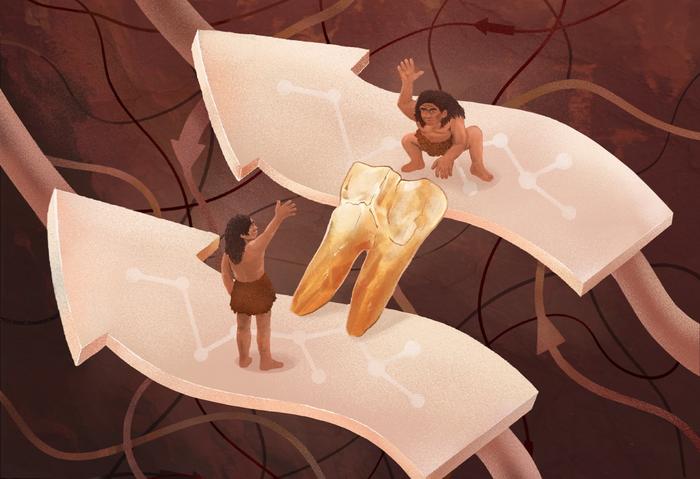
A single tooth sits under a microscope in a clean room in Beijing. It is 400,000 years old. The researchers working with it are not allowed to drill into it, grind it down, or section it for analysis. They know that if they damage the morphology, they will have destroyed something irreplaceable. So instead, they do something almost absurdly delicate: they place a drop of acid, roughly the volume of a large raindrop, against a small section of the tooth’s enamel surface. Two minutes later, they collect the liquid. That liquid, it turns out, contains molecular information about human evolution that has eluded scientists for a century.
The teeth belong to Homo erectus, the hominin species that was, as far as we know, the first member of our own genus to walk out of Africa. They came from three archaeological sites in China, and in May 2026, a team led by Fu Qiaomei at the Institute of Vertebrate Paleontology and Paleoanthropology in Beijing published results in Nature that nobody had managed before: the first meaningful molecular data ever extracted from East Asian H. erectus fossils.
What made this possible was not brute force but chemistry. Tooth enamel is the hardest substance in the human body, and it turns out to be a remarkable molecular time capsule. Unlike bone and dentine, which degrade relatively quickly at geological timescales, the dense crystalline structure of enamel can preserve proteins for millions of years. By applying a micro-destructive acid-etching technique, modifying a process originally developed for sex determination in ancient human remains, Fu’s team extracted enamel proteins from six H. erectus specimens, five male and one female, from the Zhoukoudian, Hexian, and Sunjiadong sites. All six specimens date to roughly 0.4 million years ago, making them broadly contemporary despite spanning both northern and southern China. The tooth surface was returned, visually intact, to the museum collection. The science left the building in a microcentrifuge tube.
Previous molecular analysis of H. erectus had yielded almost nothing. A 2020 study had extracted peptides from a 1.77-million-year-old H. erectus tooth from Dmanisi in Georgia, but those sequences lacked any single amino acid differences that could tell H. erectus apart from other human lineages. The species remained, molecularly speaking, a blank.
The Beijing team ran every sample through mass spectrometry at two independent laboratories, Capital Medical University and Fudan University, and cross-validated the data through three separate software pipelines. What they found, shared across all six specimens regardless of site or geography, were two mutations in a protein called ameloblastin, which is involved in forming enamel itself. The first mutation, designated AMBN-A253G, had never been seen before in any human lineage or indeed in any primate. No Neanderthal carried it. No Denisovan. No modern human. The earlier H. erectus specimens from Dmanisi in Georgia and Atapuerca in Spain lacked it. Every mammal in the comparative database carried the ancestral version at that position (well, almost every one; a few horses and pigs had something different, but nothing matching the G variant). This particular mutation, it seems, belongs exclusively to these Middle Pleistocene East Asian populations.
A Molecular Signature of Peking Man
The finding clears up a long-running argument. The Hexian fossils, discovered in Anhui Province in the 1980s, had always looked slightly different from the Zhoukoudian specimens most people know as Peking Man. Some researchers had proposed, based on cranial morphology alone, that the Hexian individuals might be more closely related to Denisovans than to H. erectus. The protein data says otherwise: the Hexian teeth carry AMBN-A253G just as clearly as the specimens from Zhoukoudian and Sunjiadong, placing them firmly within H. erectus. Morphological diversity within a single population, it turns out, can be genuinely misleading.
The second mutation is more complicated, and arguably more significant. AMBN-M273V was previously known only from Denisovans, the enigmatic archaic humans identified just a decade and a half ago from a finger bone in a Siberian cave. The variant shows up in their genome at relatively high frequency and was thought to be one of their molecular hallmarks. But now it turns out that Middle Pleistocene H. erectus in China was carrying it, probably some hundreds of thousands of years before the Denisovan lineage even existed. Denisovans and Neanderthals are thought to have diverged from each other around 380,000 to 470,000 years ago, which means that at roughly 400,000 years old, these H. erectus specimens were alive at more or less the same time the Denisovan line was just branching off. The geography overlapped too: known Denisovan territory included Siberia, the Tibetan Plateau, and Harbin in northeast China, while the H. erectus sites span both northern and southern China.
The implication is that H. erectus passed the AMBN-M273V variant to an ancestral Denisovan population through interbreeding, probably multiple contacts over time. The evidence for the direction of flow comes from an odd detail in the Denisovan genomic data: two of the earliest known Denisovans, the Harbin individual and one called Denisova 25, are heterozygous for the M273V variant, meaning they carry one copy of each version. Later Denisovans are homozygous, carrying two copies of the derived variant. That pattern is consistent with a variant that entered the population from outside and was only gradually fixed, rather than one that originated within the Denisovan lineage itself.
A Ghost in the Modern Genome
Genomicists have long known that Denisovans received somewhere between half a percent and 8% of their genome from a mystery lineage, sometimes called super-archaic, whose ancestors diverged from the common ancestor of Neanderthals, Denisovans, and modern humans more than a million years ago. H. erectus is the obvious candidate for this ghost population. The new protein data provides the first direct molecular evidence connecting these two lineages, not just circumstantially but through a specific, traceable variant. And because Denisovans later introgressed DNA into modern human populations, roughly 15% of those super-archaic genomic regions eventually made it into living people across Southeast Asia and Oceania. The M273V variant itself appears today at a frequency of around 21% in the Philippines, about 1% in India, and less than 1% in Papua New Guinea, with barely a trace elsewhere.
The method itself may matter as much as the findings. Paleoproteomics, the analysis of ancient proteins, has been expanding rapidly as a way to reach further back in time than ancient DNA allows. DNA degrades in most environments after about half a million years; proteins, locked inside enamel, can survive much longer. The same team developed a new sex determination tool, called protSexInferer, capable of classifying biological sex from ancient enamel based on the ratio of peptides from a Y-chromosome-linked protein. Five of the six H. erectus individuals analyzed here were male, one was female, and the method cross-validated cleanly against every reference specimen with known sex in the dataset.
What remains elusive is the full picture of H. erectus molecular diversity. The six teeth analyzed here represent a brief window, around 400,000 years ago, from three sites in central and eastern China. H. erectus occupied vast swathes of Asia and parts of Africa and Europe for nearly two million years. Whether the AMBN-A253G variant extends across all East Asian populations, or represents something more regional, is not yet known. Whether populations in Indonesia carried the same markers, or something quite different, is anyone’s guess. The Denisovan side of the interaction also remains opaque: how often did these meetings occur, across how wide a geographic range, and with what demographic consequences for both populations?
Zhoukoudian’s original fossils, the first Peking Man specimens, were lost during the Second World War while being transported for safekeeping. They were never recovered. The tooth studied here came from excavations conducted between 1949 and 1951, after the war. It survived. Its enamel held on to something that even now, after 400,000 years and a world war, is just beginning to be read.
https://doi.org/10.1038/s41586-026-10478-8
Frequently Asked Questions
Does this mean Peking Man is a direct ancestor of people alive today?
Not quite directly, but there is now molecular evidence for a genetic connection. The study shows that East Asian H. erectus populations shared a protein variant with Denisovans, who later introgressed DNA into modern humans across Southeast Asia and Oceania. That variant is still detectable in living people in the Philippines and elsewhere, which suggests a real, traceable thread of inheritance running from these 400,000-year-old individuals to the present day, though through the Denisovans as intermediaries rather than in a straight line.
How do you get DNA or proteins out of a fossil without destroying it?
In this case, the team used an acid-etching technique that touches only a tiny area of the enamel surface, using roughly a drop of 5% hydrochloric acid for about 15 minutes in total, then collecting the dissolved protein-containing liquid. The tooth’s physical shape and morphology are preserved; only a microscopic layer of surface enamel is consumed. It is about as non-invasive as ancient fossil analysis gets, though the team first spent months testing animal teeth from the same sites to confirm the method worked before touching the human specimens.
Why does enamel preserve proteins when bone does not?
Enamel is almost entirely mineral, roughly 96% hydroxyapatite crystals, which form an extremely dense matrix that physically shields the proteins trapped inside from microbial attack, water infiltration, and chemical degradation. Dentine and bone are far more porous and organic-rich, which means their proteins and DNA get broken down much faster. The proteins in enamel also tend to be short, tightly folded, and chemically robust, which helps them survive geological time. This is why paleoproteomics increasingly focuses on teeth rather than bones when working with very ancient material.
Is the Denisovan connection in modern DNA really from H. erectus specifically?
The new protein evidence makes H. erectus the leading candidate for the source of what geneticists call super-archaic DNA in Denisovan genomes, but it remains a hypothesis rather than a confirmed fact. Genomic studies had already estimated that Denisovans received a few percent of their genome from a lineage that diverged from the Neanderthal-Denisovan-modern human ancestor more than a million years ago, which is consistent with H. erectus. The AMBN-M273V variant is now the most direct molecular link, but the full scope of the interaction, how often it happened and across which populations, still needs to be worked out through further analysis.
Could ancient protein analysis eventually replace ancient DNA for studying human evolution?
It probably will not replace it, but it is filling an enormous gap. Ancient DNA is far more informative when it survives, carrying millions of base pairs compared to the handful of protein variants that paleoproteomics can typically recover. The problem is that DNA rarely survives beyond about half a million years in most climates, while enamel proteins can last several million years and hold up in warm environments where DNA has no chance. For species like H. erectus and potentially even older hominins, ancient proteins may be the only molecular window we get, which makes the continued development of methods like the one used in this study genuinely important.