Cancer-Seeking Nanomotors Use Light to Unleash a Triple Chemical Attack on Tumors

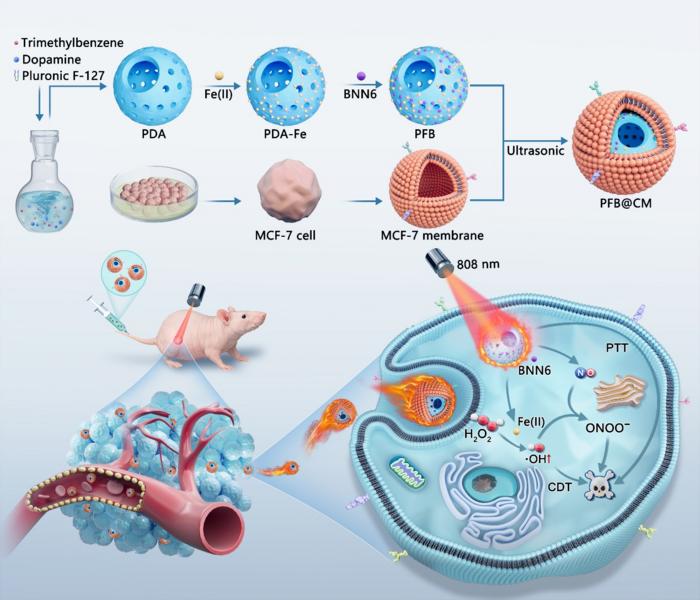
Researchers built tiny particles called PFB@CM nanomotors by coating a drug-loaded core with a shell made from cancer cell membranes. The cancer cell coating helps the particles blend in with tumors and avoid being rejected by the body. When exposed to near-infrared light, the particles heat up. That heat does three things at once: it propels the particles into cancer cells, triggers the release of nitric oxide (NO), and frees up iron ions. The iron reacts with hydrogen peroxide already present in the tumor to produce a toxic molecule called hydroxyl radical (·OH). That radical then combines with the nitric oxide to form peroxynitrite (ONOO⁻), which kills cancer cells. The upshot: light turns these particles into self-guided, multi-pronged cancer killers.

A bowl-shaped particle, roughly a quarter of a micrometre across, drifts through the bloodstream. It’s wearing a disguise: a fragment of membrane stripped from a breast cancer cell, studded with the same proteins that cancer cells use to recognise each other. The immune system ignores it. The particle reaches a tumour, docks, and waits. Then … Read more

How Scientists Learned to Read Information Encoded in Darkness Inside Light

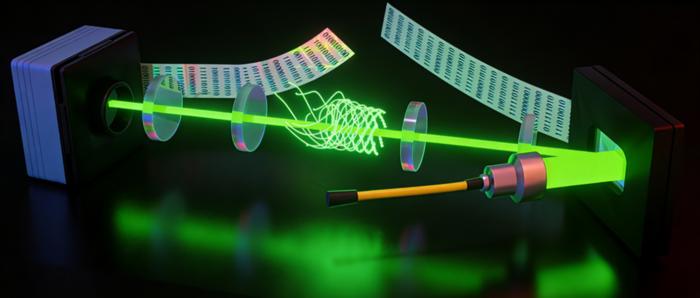
Schematic and working principles of the LightELF system.​ LightELF is a neuromorphic high-throughput optical data transmission prototype that uses the topological invariants of optical singularity evolution as the information medium.

Inside a beam of light, there are places where the light simply isn’t. Not dim, not scattered, not absorbed. Absent, a void of zero intensity threading through the beam like a knotted vein of darkness. These are phase singularities: points where the electromagnetic phase becomes undefined, where the wave collapses into nothing. They dart through … Read more

Bat-Inspired Gripper Lets Drones Perch Like Birds and Switch Off Their Motors

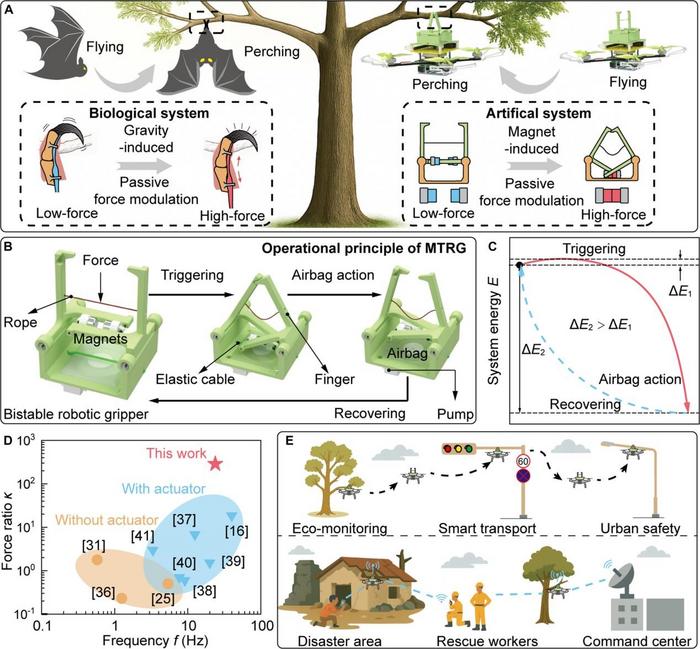
Perching behavior of biological and artificial systems.

A bat hanging from a cave ceiling is doing something that looks effortless but is, mechanically speaking, genuinely strange. It isn’t gripping. Not actively, anyway. When a bat lands inverted, its body weight pulls down on tendons running through the legs, and those tendons tighten the toes around whatever surface the animal has landed on. … Read more

Sixty Years After Its Discovery in a Meteorite, Scientists Make Hexagonal Diamond in Bulk

A diamond ring

When the Canyon Diablo meteorite punched through the Arizona desert some 50,000 years ago, it carried with it a strange passenger. Locked inside fragments of the impactor, crystallographers in the 1960s found what appeared to be a new form of carbon, structurally distinct from ordinary diamond, its atoms stacked in a different geometric pattern. They … Read more

Three AI Superpowers Are Developing Incompatible Technologies That May Never Converge

The AI triad: divergent technological pathways and their global implications

Somewhere in a Guangzhou laboratory, a team of researchers has just finished mapping something that looks, from a distance, like a geopolitical fault line — except it runs through lines of code rather than continental crust. The fracture they’ve been tracing separates three distinct technological civilisations: American, Chinese and European. And according to their analysis, … Read more