

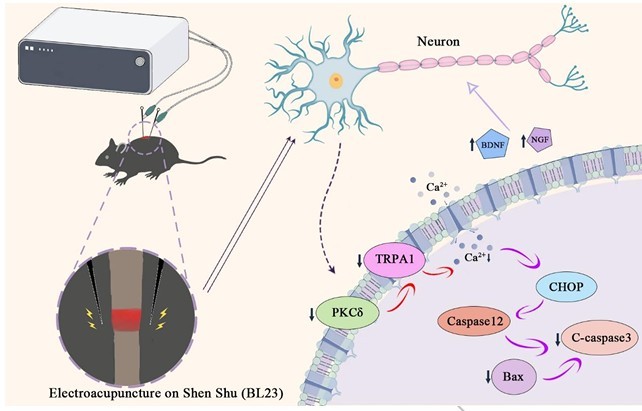
The needle goes in at a point called Shenshu, 5 millimetres to the side of the second lumbar vertebra, roughly at the small of the back. It is a stainless steel disposable, thinner than a syringe needle, and once the electrode clips are attached and the current set to pulse at 4 hertz and then 10, something begins to change inside the damaged spinal cord, not at the needle itself but several segments away, in neurons that are slowly killing themselves with their own chemistry.
Spinal cord injury does its worst damage in two waves. The first is mechanical: the collision, the fracture, the cord compressed or severed in a moment. That part, medicine can do relatively little about. The second wave is slower, stretching across days and weeks, and it is in some ways more destructive precisely because it unfolds in slow motion. Neurons that survived the initial impact begin to die anyway. The question researchers have been asking for years is why, and whether that process can be interrupted.
A study published in Burns & Trauma by a team at Wenzhou Medical University has turned up a fairly specific answer. Injury to the spinal cord triggers a molecular cascade involving two proteins, PKCδ and TRPA1, that together function as an abnormal gate for calcium. Under healthy conditions calcium flows in and out of neurons in controlled amounts, carrying signals, supporting metabolism, doing the thousand small jobs that keep cells alive. After severe injury, the inflammatory environment that follows flips this gate wide open, flooding neurons with calcium at concentrations the cell simply cannot manage. The excess calcium overwhelms the endoplasmic reticulum, the structure inside the cell that normally serves as a calcium buffer, and this sets off another chain reaction: ER stress, the activation of proteins called CHOP and caspase-12, and ultimately the systematic dismantling of the neuron from within.
It is an unpleasant feedback loop. The calcium overload stresses the ER; the ER stress amplifies TRPA1 sensitivity; amplified TRPA1 admits more calcium. Round and round, with more neurons dying at each cycle.
Zhouguang Wang, Xiaokun Li, and Yihui Zhang’s team at Wenzhou tested whether electroacupuncture could interrupt this loop in mice with experimentally induced spinal cord injuries. The injuries were severe, standardised, replicated across three groups of thirty animals each: a sham surgery group, an untreated SCI group, and a group that received daily 15-minute sessions of electroacupuncture at the Shenshu acupoint, beginning the day after injury and continuing for two weeks.
“Secondary injury after spinal cord trauma is driven by molecular stress responses that are difficult to control,” the researchers wrote. Their findings, they argued, show that “electroacupuncture does more than relieve symptoms”; it directly targets a calcium-dependent pathway driving neuronal death.
The functional results were, to put it plainly, striking. Using DeepLabCut software to track the precise movements of individually marked joints, the team observed treated mice lifting their knees, ankles, and toes clear of the ground as they walked, a motion the untreated animals couldn’t manage. Hip height increased, muscle tone recovered, movement cycles lengthened. Electromyography showed electrical signals propagating more strongly from above the injury to the gastrocnemius muscle below. Standardised locomotor scores climbed throughout the 30-day observation period, with treated animals consistently outperforming untreated ones at every time point. Whether any of this translates directly to human patients isn’t yet clear, since mice and people have different injury geometries, different immune responses, different nervous systems; but the effect was reproducible and consistent.
At the molecular level, the mechanism is now fairly well characterised. Electroacupuncture suppressed PKCδ and TRPA1 protein expression, reduced the downstream phosphorylation marker that signals calcium overload, and lowered the levels of ER-stress proteins. It also shifted the immune environment around the injury site: microglia (the brain and spinal cord’s resident immune cells) moved from a pro-inflammatory phenotype, marked by CD86, toward a repair-promoting one, marked by Arg-1 and CD206. Fewer neurons showed signs of active cell death.
What makes the Wenzhou work more than a replication of earlier studies is the repair side of the picture. Beyond protecting neurons, electroacupuncture actively stimulated growth. Neurotrophic factor levels, specifically BDNF and NGF, rose in treated animals; new neurons appeared at the boundaries of the injury site; tracer experiments showed regenerating axons extending into regions downstream of the lesion that had been effectively disconnected. The team also found evidence that electroacupuncture stabilises the microtubules inside regenerating axons, the scaffolding that growing nerve fibres rely on for structural support. This part is somewhat less understood mechanistically than the calcium story, though it aligns with earlier observations in other injury models.
The study has real limits. It used a mouse model, and the researchers are explicit that clinical validation is still needed. The paper does not address how long the effects persist after stimulation stops, or whether earlier or later treatment windows would produce different outcomes. And while identifying PKCδ-TRPA1 as a specific target is useful, developing a drug or device that replicates electroacupuncture’s effects on that axis in human patients is a considerably harder problem than demonstrating the pathway in rodents.
Current spinal cord injury treatment leans heavily on surgical decompression and corticosteroids, approaches designed to manage the immediate crisis rather than the weeks of secondary damage that follow. The clinical evidence for electroacupuncture is encouraging in places (earlier trials at governor vessel acupoints reported 15 to 20 percent improvements in lower limb motor function compared with conventional rehabilitation), though the evidence base remains thinner than for pharmacological approaches, and trial designs vary considerably.
What the Wenzhou study contributes is a plausible, testable molecular account of how the intervention might actually work. For a practice that has been used clinically for decades without a clear mechanistic explanation, that’s a useful thing to have. If PKCδ-TRPA1 inhibition is indeed the operative mechanism, it opens the possibility of pairing physical stimulation with targeted drug therapy, attacking the calcium flood through two different channels simultaneously. Whether that combination is better than either alone is, for now, an unanswered question worth asking.
DOI / Source: https://doi.org/10.1093/burnst/tkaf066
Frequently Asked Questions
The primary mechanical trauma is only the beginning. In the days and weeks that follow, a series of chemical chain reactions unfolds inside surviving neurons, including abnormal calcium influx, inflammation, and a stress response in the cell’s internal protein-folding machinery. This “secondary injury” phase is thought to account for much of the permanent functional loss, and it is the target most modern neuroprotective research is trying to address.
PKCδ is an enzyme activated by inflammation; TRPA1 is a calcium-permeable ion channel that PKCδ makes hypersensitive to stimulation. Together, after spinal cord injury, they act as a runaway gate, flooding neurons with calcium at levels that overwhelm the cell’s stress-buffering systems and trigger programmed cell death. The Wenzhou study is the first to identify this specific axis as a driver of secondary neuronal death in spinal cord injury, making it a potential drug target in its own right.
Not yet on current evidence, though the case is building. Earlier clinical trials reported meaningful improvements in lower limb motor function when electroacupuncture was added to rehabilitation, and the new molecular data provide a plausible mechanism for those results. What’s still missing is rigorous randomised trial data showing consistent benefit in human SCI patients, along with clearer guidance on timing, frequency, and which patients are most likely to respond.
This is a reasonable concern in principle, since calcium is central to normal neuronal function. The study found no evidence of harm in treated animals, and the acupoint stimulation appears to restore balance rather than suppress calcium pathways wholesale. But the question of long-term effects on healthy neural signalling, particularly in circuits above the injury, wasn’t directly addressed by the research and would need to be examined in future work.
- New ‘Molecular Glue’ Pushes Perovskite Solar Cells Closer to Commercial Reality
- Scientists Turn Immune Cells Into Light-Controlled Robots
- Solar Windows Get a Second Life With New Recyclable Glass
- A Persistent Hum Might Help Clear Alzheimer’s Plaques—For Weeks
- The Fungus Munching Through Mountains Of Toxic Waste