

Key Takeaways
- Solid oxide cells can generate electricity or produce hydrogen, offering versatility for clean energy transitions.
- A new review links solid oxide fuel cells and electrolysis cells, emphasizing a unified approach in research and application.
- Key challenges include high operating temperatures and material degradation, which hinder commercialization and reliability.
- Innovative solutions like high-entropy materials and machine learning are accelerating advancements in this field.
- Solid oxide cells and batteries complement each other: cells provide long-duration storage, while batteries handle short-term demand changes.
Somewhere in a Japanese port, a shipping container hums. Inside it, a stack of ceramic wafers, each thinner than a credit card, is converting natural gas directly into electricity without combustion, without turbines, without the thermodynamic waste that haunts conventional power plants. The device is a solid oxide fuel cell, and at roughly 55 per cent efficiency (some configurations push higher), it outperforms most of the energy infrastructure built over the past century. But here is the part that makes materials scientists lose sleep: run the same device in reverse, feed it electricity and steam, and it will split water into hydrogen and oxygen. Same ceramic. Same electrodes. Two completely different jobs.
This reversibility is what makes solid oxide cells perhaps the most quietly consequential technology in the clean energy transition. A single unit that generates power when the grid needs it, then stores surplus renewable electricity as hydrogen fuel when it doesn’t. The concept has been around for decades. Getting it to work reliably, at scale, at a price anyone would pay, has proved considerably harder.
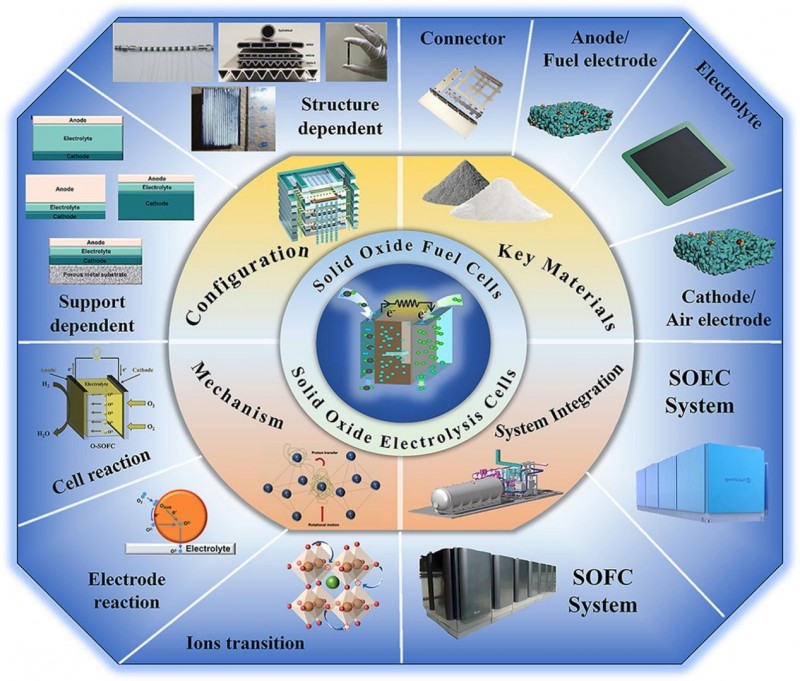
A sweeping new review published in eScience by researchers at Northwestern Polytechnical University and Fuzhou University attempts something that hasn’t really been done before: pulling together the scattered threads of solid oxide research, from the atomic behaviour of oxygen ions migrating through crystal lattices all the way up to the plumbing and thermal engineering of industrial-scale systems, into one coherent framework. The paper tracks developments in both solid oxide fuel cells (SOFCs) and solid oxide electrolysis cells (SOECs), treating them not as separate technologies but as two operating modes of the same fundamental device. It is, in a way, an argument that the field has been thinking about the problem in pieces when it should have been thinking in wholes.
They solve a different problem than batteries. Lithium-ion batteries excel at short-duration storage, responding to demand shifts over minutes or hours. Solid oxide cells are better suited to longer-duration storage because they convert electricity into hydrogen, which can be stored indefinitely and converted back when needed. The two technologies are more likely to complement each other than compete, with batteries handling rapid fluctuations and solid oxide systems managing seasonal or multi-day surpluses.
The ceramic electrolyte materials only conduct ions efficiently at high temperatures, typically above 600 degrees Celsius. Below that threshold, oxygen ions don’t have enough thermal energy to hop between vacancies in the crystal lattice, and the cell’s internal resistance climbs steeply. Researchers are working to lower operating temperatures through new electrolyte compositions and nano-scale engineering, but doing so without sacrificing efficiency remains one of the field’s central challenges.
Durability and cost are the main barriers. The high operating temperatures cause materials to degrade over time through a tangle of interacting mechanisms, including electrode poisoning, thermal expansion mismatch, and chemical reactions between cell components. Manufacturing these multi-layer ceramic devices at scale, with consistent quality, also remains expensive compared to established technologies like proton exchange membrane electrolysers. Several companies have working systems, but bringing costs down enough for mass deployment is still an ongoing engineering effort.
By mixing five or more different elements into a single crystal structure, high-entropy doping increases the material’s configurational entropy, which thermodynamically stabilises the structure and makes it more resistant to the element segregation that degrades conventional materials. The diverse mix of cations also creates a wider variety of catalytic active sites, which can improve both ionic conductivity and reaction kinetics. Early results are promising, with some high-entropy compositions outperforming established materials on both performance and durability.
The core challenge is temperature. These cells operate between 600 and 1000 degrees Celsius, which is what gives them their remarkable efficiency but also what makes everything else so difficult. At those temperatures, materials expand, contract, corrode, poison each other, and slowly fall apart.
Consider the electrolyte, the dense ceramic layer sandwiched between the electrodes that shuttles ions from one side to the other. The workhorse material here is yttria-stabilized zirconia, or YSZ, a form of zirconium oxide doped with yttrium to create oxygen vacancies in the crystal lattice. Oxygen ions hop from vacancy to vacancy, driven by concentration gradients and thermal energy. At 1000 degrees Celsius, YSZ conducts oxygen ions well enough to sustain useful electrochemistry. Drop to 600 degrees and conductivity plummets. Researchers have spent years trying to solve this, and the solutions are getting inventive. One approach involves creating heterojunctions by incorporating zinc oxide into the YSZ layer, which boosts ionic conductivity at lower temperatures. Another adds trace copper oxide as a sintering aid to increase density and oxygen vacancy concentration. Scandium-stabilized zirconia offers three times the ionic conductivity of YSZ at the same temperature, though at substantially higher cost.
“Solid oxide technologies have long been studied in fragments, materials here, systems there,” the authors note. “What has been missing is a unified perspective that connects these elements into a coherent design logic.”
That fragmented approach has left real gaps. The electrodes, for instance, face a bewildering array of degradation pathways that interact with each other in ways researchers are only beginning to map: nickel-based anodes vaporize at high temperatures, loosening the electrode structure and reducing catalytic activity; strontium migrates to electrode surfaces and forms insulating oxide layers that block oxygen diffusion; chromium from stainless steel interconnects volatilizes and deposits at the triple phase boundary where gas, ion conductor, and electron conductor meet, poisoning the very sites where electrochemistry happens; silicon from glass sealants precipitates as silica on active catalytic surfaces; and carbon deposits accumulate when hydrocarbon fuels decompose, smothering the electrode’s reactive area. Each of these problems has generated its own sub-literature, its own candidate fixes, its own partial successes.
What the review argues, though, is that fixing materials one component at a time misses the bigger picture. Thermal expansion mismatch between electrode and electrolyte causes cracking and delamination at interfaces. A cathode material might have superb catalytic properties but expand at a rate that tears itself away from the electrolyte over thousands of hours of operation. The cobalt-based perovskites, for example, are excellent oxygen reduction catalysts but have thermal expansion coefficients nearly double those of common electrolytes. Substituting iron for some of the cobalt brings the expansion down but suppresses ionic conductivity. It’s a trade-off that can’t be optimised in isolation.
Some of the more promising developments involve high-entropy materials, ceramics doped with five or more different elements simultaneously. The idea borrows from high-entropy alloys in metallurgy: by mixing many elements in roughly equal proportions, you increase configurational entropy, which stabilizes the crystal structure and can suppress the kind of element segregation that degrades conventional electrode materials. One high-entropy perovskite electrolyte achieved a proton conductivity of 8.3 milliSiemens per centimetre at 600 degrees Celsius, outperforming established compositions. High-entropy cathodes have shown power densities 1.5 times those of their conventional counterparts, with the bonus of inhibiting strontium segregation (a chronic durability problem) by creating what the authors describe as a chaotic stress field around strontium atoms that restricts their movement.
Machine learning is starting to accelerate the search, too. Gradient boosting models have predicted hydration properties of thousands of candidate perovskite materials, while active learning protocols have identified champion catalysts for oxygen evolution from small experimental datasets. The field is, perhaps belatedly, beginning to adopt the data-driven materials discovery methods that have transformed battery and semiconductor research.
But none of this matters much if the system-level engineering can’t keep up. The review is unusual in dedicating substantial attention to what engineers call the balance of plant: the heat exchangers, steam generators, gas supply systems, and thermal management strategies that keep a solid oxide stack alive. Optimised gas channel geometries have cut temperature gradients by more than 40 per cent. Cascade control methods can regulate stack temperature with zero overshoot. Companies including Bloom Energy and Mitsubishi have already deployed systems ranging from microgrid backup to 1-megawatt shore power installations. The technology works. The question is whether the materials science, the electrochemistry, and the thermal engineering can converge quickly enough to make reversible solid oxide cells the flexible backbone of a renewables-dominated grid, storing wind and solar as hydrogen when supply exceeds demand, then burning that hydrogen back into electricity when it doesn’t. That convergence, the authors suggest, will require the field to stop working in fragments and start designing from the system down to the atom.
Source: Peng Feng et al., “A review of advanced SOFCs and SOECs: Materials, innovative synthesis, functional mechanisms, and system integration,” eScience (2026). DOI: 10.1016/j.esci.2025.100460