

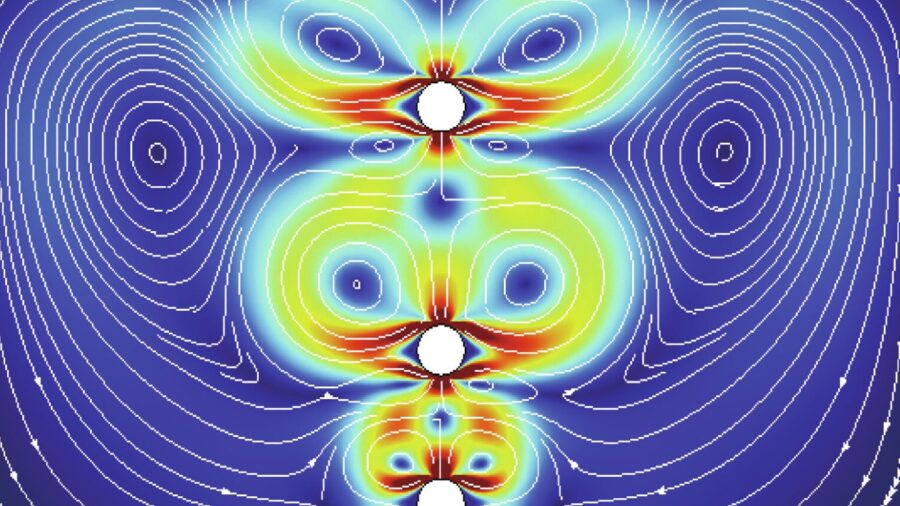
A single bubble, roughly the width of a human hair, rises through a column of thick fluid. It is doing two things at once. As it ascends, it drags surrounding liquid upward with it, pulling material across centimeters of space in a broad, slow convection loop. And simultaneously, because a piezoelectric transducer bolted to the container’s outer base is buzzing at 6,200 hertz, the bubble is also oscillating, spinning out tight vortices of fluid just micrometers wide at its equator. Two length scales, one tiny sphere. That combination, it turns out, is surprisingly useful.
Researchers at Beijing Institute of Technology have spent the last several years working out exactly how useful. The answer, published in Cyborg and Bionic Systems in March 2026, covers a somewhat improbable range of territory: mixing industrial lubricants, dissolving blood clots, and delivering genes into living cells.
The underlying problem is one of the more persistent headaches in chemical engineering. At the small scales where chemistry and biology actually happen, fluids behave differently from the way they behave in a bathtub. The technical term is low Reynolds number conditions, which essentially means that viscosity dominates over inertia, and turbulence, the usual workhorse of industrial mixing, simply fails to materialise. Stir a vat of high-viscosity polymer at the macro scale and you’ll get bulk agitation, sure, but the microscale transport that actually drives chemical reactions across interfaces barely budges. Microfluidic chips handle this elegantly, coaxing fluids into chaotic trajectories through clever channel geometries, but they process tiny volumes and do not scale up to anything useful for manufacturing. Chenhao Bai and colleagues at BIT reasoned there ought to be a way to get the best of both regimes at once.
Their solution began with a syringe pump, a glass capillary with a ten-micron interior, and a piezoelectric transducer. The pump forces air through the capillary at a controlled rate, releasing microbubbles averaging about 120 microns in diameter into whatever liquid is being processed. At that size, each bubble naturally rises under its own buoyancy. But because the transducer is running close to the bubble’s resonance frequency, each bubble also oscillates, pulsing in and out slightly as it climbs.
The size is actually the point. A rising bubble drags surrounding liquid upward with it through buoyancy, creating convection across the full height of the container. At the same time, acoustic excitation near the bubble’s resonance frequency generates tight spinning vortices right at its surface, breaking up the laminar boundaries where diffusion would otherwise be the only mixing mechanism. Together those two effects cover both large-scale and small-scale transport simultaneously, which is what conventional mixers struggle to do in viscous fluids.
In low-viscosity fluids like water, turbulence cascades energy down to tiny scales and keeps molecules in motion. In viscous fluids, that cascade is damped out, and at small length scales you end up with smooth, layered flow where different fluid parcels just slide past each other without actually mixing. The acoustic vortices generated around an oscillating bubble can disrupt those layers directly, which is why the technique is specifically advantageous in high-viscosity conditions where most industrial mixers start to struggle.
That’s roughly what the transfection experiments were testing. At lower driving voltages, the shear forces from the bubbles create temporary pores in cell membranes that allow molecules to enter without permanently damaging the cell. The team achieved around 68% gene delivery efficiency in HeLa cells while keeping more than 85% alive, without the chemical reagents or electrical fields that conventional transfection methods require. Whether that translates to therapeutic use in vivo is a longer-term question the current study doesn’t address, but the underlying principle is established at laboratory scale.
Scale, mainly. The experiments were done at the scale of hundreds of microliters, and the jump to industrial volumes requires working out how the acoustic field, bubble size distribution, and container geometry interact at much larger scales. The energy advantage over conventional mixers is already clear in laboratory comparisons, consuming around five watts against thousands for mechanical alternatives, but scale-up laws for this kind of acoustofluidic system haven’t been established yet.
That oscillation is the interesting part. When a bubble vibrates in a viscous fluid near resonance, it generates what physicists call acoustic microstreaming: a pattern of circulatory flows in the immediate vicinity, intense enough to shear apart laminar boundaries and pull fresh fluid into contact with the bubble’s surface. On its own, acoustic microstreaming is a fairly localised phenomenon, effective over perhaps a millimeter or two. But because this bubble is also rising, it carries those vortices with it across the full height of the fluid column, sweeping through a volume that pure acoustic microstreaming would never reach. The team’s measurements put the coverage area at more than 3.5 times larger than microstreaming alone, with flow velocities roughly twelve to fifteen times higher.
The glycerol mixing tests made the advantage concrete. Glycerol mixed with a dye-tagged aqueous solution is notoriously resistant to homogenisation at low energy input, a reasonable proxy for the kind of high-viscosity fluids encountered in pharmaceutical manufacturing and polymer processing. A single column of acoustically actuated rising bubbles reached a mixing index above 88 percent in twenty seconds, cutting mixing time by more than half compared with a passive control. Three columns running simultaneously hit nearly 93 percent in eight seconds, a doubling in efficiency compared with robot-assisted stirring. The system consumes about five watts.
That last figure is worth pausing on. Conventional industrial mixers draw anywhere from a few hundred watts for a laboratory magnetic stirrer to 7,500 watts for a large mechanical impeller. The acoustic bubble platform outperforms most of them, in high-viscosity conditions where their efficiency drops further, at roughly one-fiftieth of the energy.
Chemistry follows a similar pattern. In a gas-liquid precipitation reaction between carbon dioxide and calcium hydroxide, the bubbles increased the mass-transfer coefficient by a factor of about 3.2 and cut reaction time by 45 percent, in part by expanding the gas-liquid interfacial area and increasing CO2 solubility in solution. For triglyceride saponification, a reaction relevant to soap and biofuel production, the method drove the conversion rate to 93 percent in four minutes; controls needed six. The microstreaming vortices were not participating in these reactions chemically; they were simply making the reactants meet each other faster and more thoroughly, which is often all that is needed.
The biomedical applications are where the physics gets genuinely tunable, and where the researchers found the most room for finesse. The same shear forces that disrupt laminar layers in a glycerol column can also, at the right driving voltage, temporarily deform a cell membrane. Below roughly ten volts peak-to-peak, the pores formed in HeLa cell membranes are transient; they reseal. The window between “membrane temporarily permeable” and “cell dead” is narrow but real. Within it, the team achieved gene transfection efficiency of around 68 percent while keeping more than 85 percent of cells alive, without chemical transfection reagents or electroporation equipment.
Turn the voltage up past fifteen volts and the pores stop resealing. Red blood cells lyse rapidly, releasing hemoglobin in quantities detectable by the characteristic absorbance peak at 413 nanometers. Fibrin clots fracture mechanically under the microstreaming. Both results are potentially useful, though translating from a laboratory container to an in vivo blood vessel involves a rather long list of complications that the paper does not attempt to address. The team frames these as demonstrations of principle rather than clinical proposals.
What makes the platform more than a curiosity is the programmability. Because bubble generation and acoustic parameters can both be controlled independently, and because the robotic arm holding the capillary can be pre-programmed to follow trajectories through a fluid volume, the whole thing can be automated. The authors suggest it could eventually displace robotic stirring strategies for large-area mixing tasks, which is a fairly modest claim given the energy comparison. The more interesting territory, perhaps, lies in combining the two operating modes: using gentle voltages for targeted gene delivery in one region of a bioreactor while applying higher-voltage lysis conditions elsewhere, all within a single device.
The obstacles are real. Scaling up from two-hundred-microliter test volumes to anything approaching industrial capacity will require working out how bubble size distribution, acoustic field uniformity, and container geometry interact at larger scales, none of which the current study attempts. For now, the system operates in a regime where its energy advantage is already established, but its practical ceiling has not been tested. The bubble, rising, oscillating, shearing and stirring as it goes, is still mostly a laboratory object. Whether it stays that way probably depends on how badly the polymer and pharmaceutical industries want a mixing technology that works in the one regime where their existing tools don’t.
DOI / Source: https://doi.org/10.34133/cbsystems.0449