
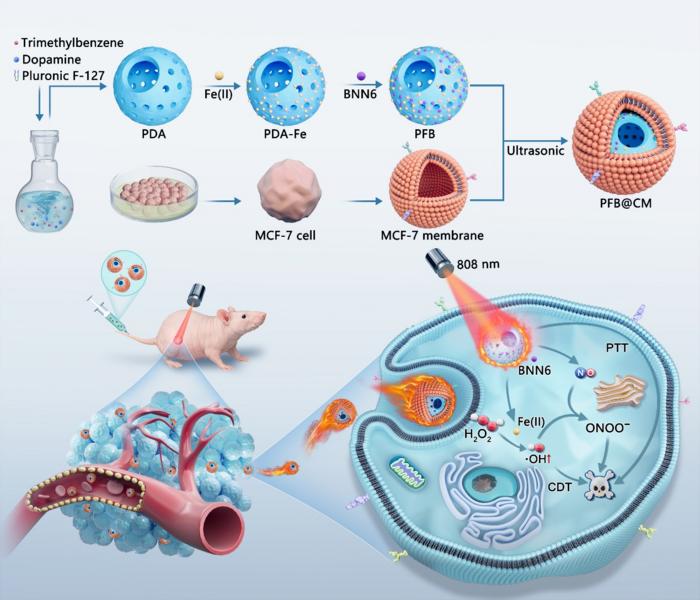
A bowl-shaped particle, roughly a quarter of a micrometre across, drifts through the bloodstream. It’s wearing a disguise: a fragment of membrane stripped from a breast cancer cell, studded with the same proteins that cancer cells use to recognise each other. The immune system ignores it. The particle reaches a tumour, docks, and waits. Then a surgeon flicks on a near-infrared laser, and the whole thing kicks into gear: the particle heats up, starts moving under its own power, drills into tumour tissue, and simultaneously unleashes three different killing mechanisms at once. In mice, the approach wiped out nearly 98 percent of tumour mass within two weeks.
The system, developed by Chengzhi Hu and colleagues at the Southern University of Science and Technology in Shenzhen, China, is perhaps one of the more elaborate cancer therapies to emerge from the nanomedicine field in recent years. It weaves together photothermal ablation, a chemical process that poisons cells with reactive oxygen species, and precisely controlled gas therapy into a single nanoparticle platform, each mode amplifying the others rather than operating in isolation.
The particle itself, called PFB@CM, is built in layers. The core is a mesoporous polydopamine bowl, a biocompatible carbon-based material with tiny pores running through its walls, into which two payloads are loaded: iron(II) ions acting as a Fenton catalyst, and a compound called BNN6 that releases nitric oxide (NO) when heated. The whole assembly is then coated in membrane fragments harvested from MCF-7 breast cancer cells. “This membrane camouflage does two things,” says Hu. “It helps the nanomotor evade immune clearance, and it provides homologous targeting; the membrane proteins recognize and bind specifically to the same type of cancer cells.”
Homologous targeting is the bit that’s rather clever. Cancer cells, broadly speaking, recognise cells of their own type through surface proteins; a nanoparticle wearing those same proteins can exploit that recognition to get taken up preferentially by tumour tissue. It’s borrowing the tumour’s own identification system as a delivery address.
Light-Activated Motion and the Triple Cascade
When a near-infrared laser at 808 nanometres is trained on the tumour site, the polydopamine core absorbs the light and converts it to heat. A suspension of the particles at a concentration of 100 parts per million heats up by roughly 22 degrees Celsius over ten minutes, reaching around 49 degrees, enough to begin killing cancer cells directly through thermal ablation. But the heating does something else, too: it creates a temperature gradient across the particle’s asymmetric surface that drives it to move. As laser power increases from 0.5 to 1.5 watts per square centimetre, particle speed climbs from about 3 to nearly 9 micrometres per second. That might sound negligible, but in the context of penetrating tumour tissue, directed motion matters enormously; passive nanoparticles rely almost entirely on random diffusion and the leakiness of tumour blood vessels to reach their targets, whereas these particles actively push through.
The heat simultaneously triggers two chemical cascades. “NO alone is potent, but its short half-life and narrow therapeutic window require spatiotemporal precision,” Hu explains. “Here, NO is released only inside the tumour and only when the laser is on.” That precision matters because nitric oxide is a deeply biphasic molecule: at concentrations below a micromolar or so, it can paradoxically promote tumour growth, whereas at high concentrations it breaks DNA strands, halts DNA repair, and triggers cell death. Getting the dose right, in the right place, is most of the challenge with NO-based cancer therapy.
The iron(II) ions, meanwhile, are liberated from the polydopamine matrix by the combination of heat and the tumour’s naturally acidic environment, both of which weaken the coordination bonds holding the iron in place. Once free, the iron reacts with hydrogen peroxide that tumour cells naturally overproduce, generating hydroxyl radicals through what’s called a Fenton-like reaction; these reactive oxygen species attack lipids and proteins, causing what amounts to a kind of accelerated cellular rust. Then comes the cascade’s final step: the hydroxyl radicals and the nitric oxide react with each other to produce peroxynitrite, a reactive nitrogen species considerably more toxic than either parent molecule. In effect, two moderately powerful weapons combine to produce a third, more powerful one. Experiments using fluorescent probes inside MCF-7 cells confirmed that peroxynitrite appeared only when both the laser and hydrogen peroxide were present, a nice bit of chemical logic.
Near-Total Tumour Clearance in Mice
In cell culture, PFB@CM alone (without laser activation) inhibited MCF-7 cancer cell growth by about 37 percent. Add the laser, and inhibition jumped to 87 percent. The membrane coating conferred genuine selectivity: when loaded with a fluorescent dye as a stand-in for a drug payload, the particles were taken up far more readily by MCF-7 cancer cells than by normal endothelial cells used as controls.
The in vivo results are where the numbers get striking. In tumour-bearing mice, two ten-minute laser sessions given six and 24 hours after intravenous injection drove tumour temperature to about 51 degrees at the tumour site. After 14 days, tumours in the treated group had shrunk to an average volume of 20.6 cubic millimetres, compared to roughly 1,000 cubic millimetres in untreated controls; tumour weight fell by 97.6 percent. Histological examination of the mice’s organs showed no structural damage, suggesting the treatment’s toxicity was reasonably well confined to the tumour.
Whether any of this translates to patients is a different matter. The 808-nanometre laser used penetrates tissue only to about 1 to 2 centimetres, which essentially limits the approach to superficial tumours. “We are exploring NIR-II windows and magnetothermal triggering to reach deeper lesions,” Hu says, referring to longer-wavelength infrared light and magnetically induced heating as possible alternatives. There is also the question of fine-tuning the chemistry: “while the cascade chemistry works, we need to optimise the NO/ROS ratio to avoid the pro-tumour effects that low NO concentrations can sometimes cause.” That concentration-dependent flip between pro- and anti-tumour activity in nitric oxide biology has bedevilled the field for years, and solving it in a living system, with variable laser power and variable tumour microenvironments, is not straightforward.
The more interesting implication, perhaps, is the design logic. “This design philosophy, integrating active motility, homologous targeting, and multimodality in one nanoparticle, could be adapted for other cancers and other therapeutic agents,” Hu says. Swap out the breast cancer cell membrane coating for one derived from, say, pancreatic or ovarian cancer cells, load the pores with a different NO donor or a different metal catalyst, and the same framework might in principle target a completely different tumour type. How far that modularity holds up in practice will depend on trials that are still quite some way off; but as proofs of concept go, a light-activated particle that disguises itself as cancer, homes to tumours, and then detonates a three-part chemical cascade is, at minimum, a novel kind of argument about what a nanoparticle might eventually be asked to do.
https://doi.org/10.34133/cbsystems.0495
Frequently Asked Questions
Why can’t cancer drugs just target tumours on their own without this kind of complexity?
Most cancer drugs circulate throughout the body and hit healthy tissue as well as tumours, which is what causes side effects. Passive nanoparticles improve things somewhat by exploiting the leaky blood vessels that tumours tend to develop, but they still rely on random diffusion to reach their targets. The PFB@CM nanomotors add two extra layers of precision: a biological disguise borrowed from cancer cells themselves that helps them dock with matching tumour tissue, and light-activated propulsion that lets them actively push through tumour barriers rather than waiting for chance encounters.
What does nitric oxide actually do to cancer cells, and why is controlling it so tricky?
Nitric oxide is a signalling molecule the body uses for all sorts of purposes, including regulating blood flow, and at high concentrations it becomes genuinely toxic to cancer cells by breaking DNA strands and triggering cell death pathways. The problem is that at low concentrations it can do the opposite and inadvertently help tumours grow, so delivering it without precision is risky. The nanomotors get around this by releasing NO only when the laser is on and only inside the tumour, keeping concentrations in the therapeutic range rather than the counterproductive one.
Could this work on cancers deeper inside the body, not just near the surface?
Not yet. The near-infrared laser used in this research penetrates tissue only about 1 to 2 centimetres, which restricts it to superficial tumours like certain breast cancers. Researchers are exploring longer-wavelength infrared light and magnetically induced heating as alternatives that could reach deeper tissue, but those approaches carry their own engineering challenges and are still at an early stage.
Is the idea of using cancer cell membranes as a disguise new?
The concept of coating nanoparticles with cell membranes, sometimes called biomimetic camouflage, has been explored for several years as a way to help nanoparticles evade immune clearance. What this study adds is the combination of that camouflage with active propulsion and a three-part therapeutic cascade, so the membrane coating is doing double duty: hiding the particle from the immune system and steering it specifically toward cancer cells that share the same surface proteins.
Discover more from SciChi
Subscribe to get the latest posts sent to your email.