
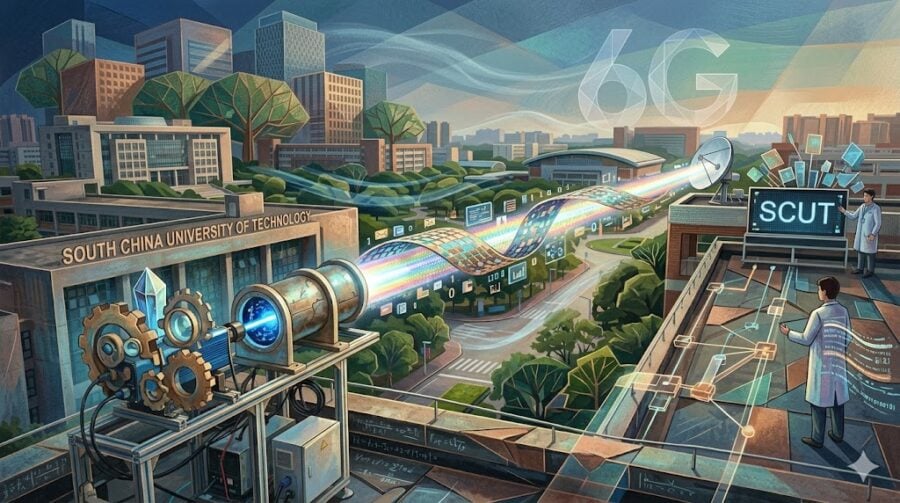
From the roof of a teaching building at South China University of Technology, a beam of white light crossed 1,200 metres of open air and arrived, intact, at a receiver on the other side of the campus. Not a laser line, not a narrow coherent beam of the kind that demands precise alignment and makes eye-safety officers nervous. White light, broad and diffuse, the kind that illuminates a room, carrying encoded data at 100 megabits per second. The letters “SCUT” blinked into existence on a screen on the far side, reproduced without a single bit error. Zhiguo Xia’s team had, in a fairly literal sense, turned a lightbulb into a radio tower.
The feat matters because visible light communication, or VLC, has spent years as a technology that almost works. LED-based systems can shuttle data across a few metres of a nicely lit room, which is fine for some applications and frustrating for most others. A kilometre is a different proposition entirely: it’s roughly the ceiling altitude for the drone delivery networks and autonomous aerial vehicles that cities are starting, cautiously, to take seriously.
A Material That Behaves Like Glass, Then Thinks Like a Crystal
The trick, described in the journal Matter this week, is in the material sitting inside the photonic engine. Xia’s team at SCUT wanted something that could take the punishment of a focused high-power laser, convert that energy into brilliant white light with minimal losses, and do it fast enough to encode data in the flickering. Conventional phosphors dissolved in silicone resin do the colour-conversion job reasonably well, but they conduct heat poorly (about 0.2 watts per metre-kelvin), which means they overheat, saturate, and drop efficiency the moment you push the laser power up. Transparent ceramics made by conventional sintering methods work better thermally, but they require extreme pressures and temperatures, can’t easily be made into complex shapes, and are expensive to produce at scale. Neither option gets you to a kilometre.
The solution the team landed on is, in essence, a way of making a ceramic that behaves like a glass during manufacture and like a crystal afterwards. They started with a mixture of oxides (silicon, aluminium, lutetium, magnesium, and crucially, calcium) and melted everything together at 1,720°C, and quenched it into an amorphous glass. Then, by heating this glass through a carefully staged sequence, they coaxed it to crystallise fully into a garnet structure. The calcium is the key: it loosens the glass network just enough to create channels through which ions can migrate during crystallisation, lowering the energy barrier and allowing the process to complete densely, without leaving pores or glassy residue between grains. Crystallinity reached 97.5%. The resulting discs are five centimetres across, shaped however the mould dictates (rings, which are ideal for the photonic engine geometry, are trivially easy to produce this way, and essentially impossible via conventional sintering).
What comes out of the process is a material with properties that are, by any reasonable measure, rather good. Thermal conductivity reaches 4.19 watts per metre-kelvin, roughly 20 times that of silicone resin and about twice the best values reported for comparable glass-ceramic composites. Internal quantum efficiency hits 97.8%. The hardness, at 26.3 gigapascals, beats commercial yttrium aluminium garnet ceramics by about 30%. And the fluorescence lifetime sits in the nanosecond range, which matters enormously for data transmission: a phosphor that takes microseconds to re-emit absorbed photons is useless for high-frequency modulation, because the slow decay smears out the signal.
“This is really a record with attractive performance beyond the traditional technology,” says Xia. The distance achieved, he notes, clears the 1,000-metre ceiling for low-altitude airspace by a comfortable margin.
The photonic engine built around the ceramic is essentially a laser (blue, 450 nanometres) directed at the ceramic ring, which absorbs the blue light and re-emits in yellow, combining with transmitted blue to produce white light at a luminous efficacy of 202 lumens per watt. The white light then propagates through open air to a detector. At intrinsic modulation, without any signal processing tricks, the system achieves a bandwidth of 7.4 megahertz and 10 megabits per second. Filter out the slow-decaying fluorescence components, and the bandwidth jumps to 71.8 megahertz, enabling the 100 Mbps peak rate. The team also ran interference tests: shining a flashlight at the beam, blasting it with a fan. And the transmission held. Over the test distance, 10,192 bytes sent, zero errors received.
Real Numbers, Real Limits
There are caveats worth stating plainly. The ceramic emits predominantly in the yellow-green region (500 to 650 nanometres) and lacks red components, which limits colour rendering quality. It’s nowhere near fibre-optic speeds; 100 Mbps is roughly 1,000 times slower than the data rates that optical fibres routinely achieve. Rain, fog, and cloud scatter light and would degrade or block the link, a practical limitation that the team acknowledges. The plan is to integrate the optical system with radio-frequency backup so that coverage continues during bad weather, a standard approach in hybrid optical-wireless design.
But the broader context here is 6G, and 6G is where the ambition gets large. Current 5G networks move information fast; 6G is meant to do something closer to sensing and thinking, incorporating data from satellites in low Earth orbit, from ground stations, from the objects the network is embedded in. Xia is candid that 6G has so far existed, in his phrase, “largely at the visionary level.” What his team has produced is something more concrete: a material platform and a communication architecture that delivers the right numbers over the right distances for at least some of the environments where 6G needs to work.
“This work also provides compelling experimental support for the application of laser lighting in scenarios such as drone logistics and low-altitude air travel,” says Xia. The economics matter too. The glass-to-ceramic route uses standard melting equipment, doesn’t require vacuum chambers or hydraulic presses, and can produce wafer-scale pieces in a single heat treatment. Whether that translates to genuinely cheap mass production remains to be seen, but the manufacturing logic is sound in a way that hot-isostatic-pressing simply isn’t.
Xia’s vision for where this goes next involves AI running the link itself: “AI-driven link adaptation can dynamically adjust data rate and optical power, ultimately supporting a future 6G network that is space-air-ground integrated, fully covered, and highly reliable.” The idea is a network that adjusts in real time to atmospheric conditions, available spectrum, and traffic demands, using light where it works, radio where it doesn’t, managed by software intelligent enough to know the difference. A ceramic disc, five centimetres across, communicating across a kilometre of open sky. The infrastructure of the future might be smaller, and brighter, than most people expect.
https://doi.org/10.1016/j.matt.2026.102822
Frequently Asked Questions
Why can’t ordinary LEDs do what this laser-ceramic system does?
LEDs struggle with a combination of problems at the power levels needed for long-range communication. Their light-emitting efficiency drops as they get hotter (a problem called “efficiency droop”), they have limited modulation bandwidth, and phosphor coatings on white LEDs use organic resins that conduct heat poorly. The result is a system that degrades quickly under the power loads needed to send a signal over hundreds of metres, let alone a kilometre. The laser-ceramic approach separates the high-power light source from the colour-conversion material, using a ceramic that handles heat roughly twenty times better than resin and responds fast enough to encode data at tens of megahertz.
Could this technology work indoors, or is it only useful over long outdoor distances?
The 1.2-kilometre demonstration was designed to validate the outdoor, long-range case, but the underlying photonic engine architecture is relevant for indoor environments too. Visible light communication systems using lower-power LEDs already operate in offices and aircraft cabins. A laser-ceramic engine would be over-specified for most indoor uses, but the manufacturing approach could lead to cheaper, better-performing colour-conversion materials that improve indoor VLC systems as well. The team mentions home interconnection platforms explicitly among the intended applications.
What happens to the signal in rain or fog?
Water droplets scatter and absorb visible light, so heavy rain or dense fog would degrade or sever the link entirely. This is a recognised limitation of all free-space optical communication, not a specific flaw of this system. The team’s plan is to integrate the optical link with conventional radio-frequency backup, so the network can switch between light and radio depending on conditions. This hybrid approach is standard in long-range free-space optical communications at infrared wavelengths, and adapting it to visible light is technically straightforward.
How does this connect to 6G specifically?
6G networks are designed to incorporate multiple types of wireless links (satellite, aerial, and ground-based) into a single intelligent system that can sense its environment as well as transmit data. Visible light communication over kilometre-scale distances would allow streetlamps, drones, or building-mounted transmitters to act as high-capacity nodes in that network, particularly in areas where radio-frequency spectrum is congested or unavailable. The 1,000-metre range demonstrated here matches the defined ceiling for low-altitude airspace, making the system directly relevant to drone and autonomous vehicle communication.
Discover more from SciChi
Subscribe to get the latest posts sent to your email.