

Starve yourself. Exercise until it hurts. Buy expensive supplements and stay away from the foods you love most. You may have the impression that living a long time is no fun at all.
But the good news is that the most powerful life extension strategies are things we want to do anyway. Live in a way that makes you happy. Connect deeply to friends and lovers. Spend time with your children. Enjoy sex more frequently. Take leadership in your community. Express yourself artistically.
The very reason that aging evolved is to stabilize death rates for the sake of the community. How can we be surprised to learn that the biggest factors affecting our life expectancy are not individual life style but social and communal connections?
Leadership
Human genetics were shaped in a history of competing small tribes. What I have long wondered about is that a well-functioning tribe needs a lot of loyal followers and one resolute and charismatic leader.
All animals living in a body, which defend themselves or attack their enemies in concert, must indeed be in some degree faithful to one another; and those that follow a leader must be in some degree obedient.
— Darwin, The Descent of Man
Somehow the leaders and followers had to come from the same gene pool. Selection is simultaneously for strong-willed leaders and compliant followers. And when we look today at the variety of personalities, we may observe the successful results: most people are indeed content to take their views and opinions from the community around them, to perform faithfully the task allotted to them, to raise few questions. And yet there are plenty of us—all of my readers, I’m sure—who question authority, think independently, and who are in the habit of pro-active assertion.
How nature has arranged this, I can only imagine. My guess is that there are infrequent combinations of genes that lead to independent-mindedness. But there must also be a great deal of phenotypic plasticity. That’s a five-dollar word describing a phenomenon biologists don’t understand very well. Each individual is born with the potential to develop in a number of different directions, and adapts epigenetically within a single lifetime to choose one destiny among many. Somehow, animals and people figure out when leadership is demanded of them, and respond accordingly, and they shut up and obey orders when appropriate, which for most people is most of the time.
The relevance of this to aging is that changes of leadership are disruptive and costly. Many a tribe must have fallen victim to neighboring tribes during times when old leadership has died or succumbed to senility, while new leadership is distracted by jostling for power. A beloved leader with a loyal following was and is a great asset to the community. It would have served the community well if evolution might have arranged for leaders to have a longer life span than followers from the same community, the same pool of genes.
The take-home message: Cooperative leadership is good for your health. Earn the love and respect of your neighbors for your contributions to community life.
Glass half empty / Glass half full
Depression is a big risk factor for every disease that has ever been studied, and depression takes years off a person’s life. The effect is hard to quantify because people who suffer from depression are more likely to have addictive dependencies, less likely to have healthy diets, less likely to exercise, less likely to have supportive social relationships. The indirect toll of depression makes it hard to measure the direct effect independently.
This study of telomere length in heart patients found that depression accounts for 2½ years of excess telomere attrition.
I think of depression as one side of a continuum, from a full capacity for awareness and open-hearted enjoyment at one end of the spectrum to loss of all vitality and incapacitating numbness at the other end. But the culture of Western medicine has led to a perspective from which depression is treated as a chemical imbalance in the brain that can be objectively diagnosed, present or absent with no “in between”.
In my view, this accounts for the fact that when psychologists study the health effects of a positive or negative outlook on life, they treat depression as an artifact that warrants separate treatment in their statistics, lest it bias their results. It is the more remarkable, then, that even after removing from their sample men who are clinically depressed, the authors of this study still find that dispositional temperament accounts for 9 years of life expectancy. Among a thousand men aged 64-84, those who leanded toward pessimism had more than twice the cardiovascular mortality rates of those who were disposed toward optimism.

9 years of added life is an effect that stands out head and shoulders among the effects that epidemiologists are wont to study. Points of comparison: If cancer were completely eliminated, it would add 4 years to life expectancy. Estimates vary for years lost to obesity in America, with a range of 3 to 8 years. Smoking is associated with 10 years of lost life, before subtracting a correction for indirect risk factors that correlate with smoking.
A speculation concerning depression and evolution
Why is depression such a common malady in our culture? If depression is so bad for us, why has evolution put up with it? My conjecture is that this is related to the need for phenotypic plasticity in the choice to become leaders or followers. The genes for leadership must be preserved in the community, and yet most people with genes for leadership must be convinced, nevertheless, to live their lives as loyal followers—else the community would be rent by dysfunctional power struggles. Depression is nature’s way of keeping too many people with leadership genes from disrupting the authoritarian structures of their community.
Social status
Frequently cited in this regard is a fertile long-term study of health and class in the British civil service system. The Whitehall Study began in 1967 and continues to this day.

Nearly half a million Brits participate in Her Majesty’s Service, and there are more than 20 grades and subgrades, in a clearly-defined hierarchy of who gives orders and who takes them. There is a close analogy to grades of military officers.
High-level officers are generally better paid and can afford a more comfortable life. But medical care in Great Britain is socialized, and disparities in standards of care are relatively small. There are also differences in family wealth that make the social service grade an independent measure of status, and not merely a surrogate for wealth.
The remarkable finding is that each grade of the service lives longer on average than all the grades underneath it. Social status is tightly correlated with longevity.
Education
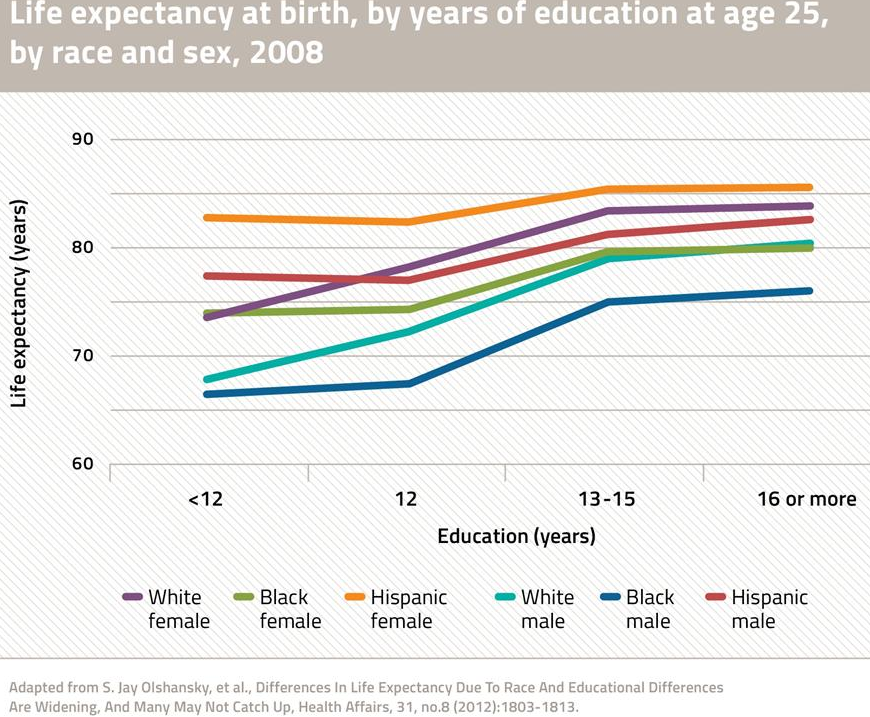
A college education is worth ten years of life to a black male, but only 3 years to a hispanic female. I don’t think it’s what they learn in school that makes the difference, but the career opportunities and the social connections that come with a college degree that account for the statistics. I would guess also that there is a good deal of filtering in the process: preferential selection of people with patience and discipline who are inclined to think about their future. This study attempts to separate the effect of education from filtering for iwhat the author calls “conscientiousness”. He concludes that both play a role in extending lifespan. And here is a more recent, drier and more thorough account of differences in life span by race and education, focusing on completion of high school. A high school diploma seems to be be associated with 5 extra years for a white male, but almost nothing for a black female.
The Bottom Line
To live in a way that is engaged and self-actualized is the best thing you can do for your longevity. Strong family ties, love, sex, power and money are all good for your longevity. (Some of these items aren’t in todays blog, but they will be in Part II next week.)
END of Part I
Discussion
10 reader comments
Imported threads are marked Archive. New comments are welcome and moderated for spam.
IQ is positively correlated with both longevity and social status at least as highly as anything else is. "a person with an IQ of 115 [+1s.d. at age 11 in 1932] was 21% more likely to be alive at age 76 than a person with an IQ of 100 (the average for the general population)" "The researchers found that statistically controlling for economic class and a measure of “deprivation” reflecting unemployment, overcrowding, and other adverse living conditions accounted for only about 30% of the IQ-mortality correlation." ( http://www.scientificamerican.com/article/research-confirms-a-link-between-intelligence-and-life-expectancy/ ) IQ is also relatively highly correlated with higher educational attainment, job performance, and earnings that result in status.
So IQ causes both longevity and social status. It is also likely a marker for low genetic load, given that is highly heritable and caused by many genes of small effect where uncommon alleles tend to have slight negative effects. (IIRC from Steve Hsu's infoproc blog)
The importance of cooperation has major implications for society, as well as for individuals. I’d write a book about it, if I could ever find a publisher. –http://bit.ly/Q3zdMU
Let me try out an alternative hypothesis to explain the 'social status' effect you see:
1) On average, people who are naturally predisposed to being robustly healthy are also more likely to live longer.
2) On average, people who are naturally predisposed to being robustly healthy are more likely to reach, and stay in, higher grades - due to less time off work needed, better ability to cope with longer hours, high stress situations, periods without adequate time for self-care and rest, etc.
It's hard to get to being, and stay, a CEO without being fully healthy. That doesn't mean being a CEO makes you healthier in of itself.
How would you distinguish experimentally between the two hypotheses?
Let me think about this. It must be do-able.
I have my doubts that supplements cannot have any relevance to life expectancy. I do acknowledge that they may never give extremely long life expectancy though. For instance vitamin B1, in some people has a genetic problem associated with it. It has a lot to do with the oxygen utilization of heart muscle. Even if they get the average amounts in their diet their heart is deprived of the full amount of oxygen it needs. Over time it is almost inevitable that they will have a heart attack. This can be prevented by them taking a supplement. Also if a supplement of any one of the B vitamins is taken over a long period of time, the full B vitamin complex should also be taken, to maintain balance, or other health problems can happen. Of-course this would only help people who had this B1/ genetic problem, but there are a lot of instances other nutrient/genetic problems. There is also quite a lot of just plain nutrient deficiency, in even rich countries, because of highly processed food and the way it is grown. Hardly any of this is acknowledged by mainstream medicine because big pharma rules. Thats where most of its money is made. So it is hard for me to see any longevity increase coming, if people were made genetically stronger and very healthy, with hardly any need for a drug. Big pharma would hardly make the same money. It will have to be open source medicine.
All important to a healthy and long life - but I thought we were interested in going beyond that?
Some of are Harold!
Hi Josh
Very iinteresting. You are starting to nibble at a subject I spent a lot of time researching but never wrote any papers on. And yes of course I have come up with a unified theory of personality traits and mental illnesses from an evolutionary perspective.
Don't want to be a spoiler, so will just give you a hint: look into handedness and associated mental illnesses /personality types etc!! Big hint- there are way more left handed leaders than there should be based on rate of LH in population!
And bipolar disorder is the key to the evolutionary purpose of mental illness/personality types
Have fun!
this 100% is in line with the Blue Zone studies of Dan Buettner - https://www.bluezones.com/speaking/dan-buettner/ - who talks about community and purpose as the foundation of his version of the pyramid