

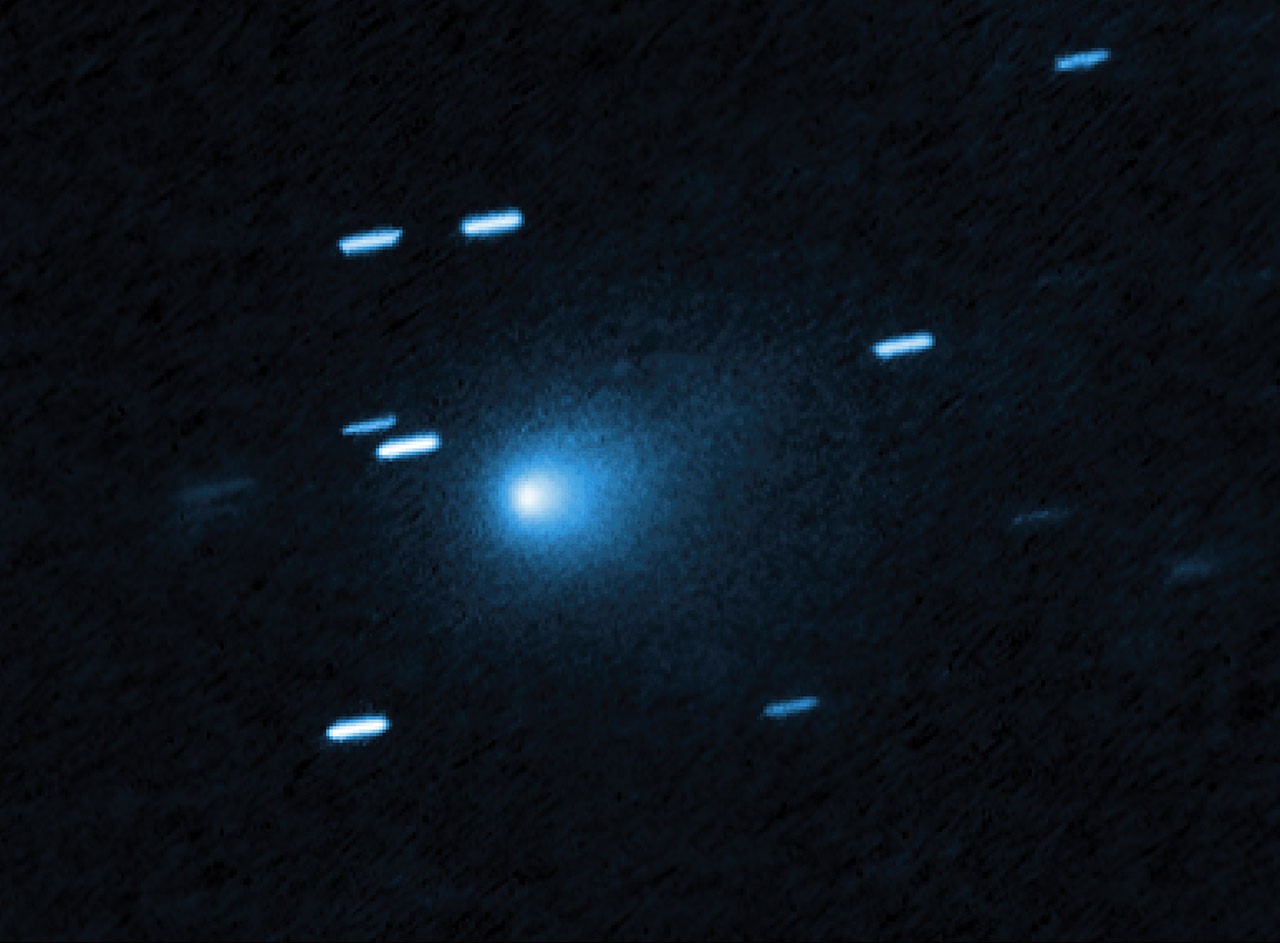
The visitor did not announce itself with a streak across the sky. It appeared as a faint moving point in four survey images, the kind of evidence that looks insignificant until its positions are fitted to an orbit.
ATLAS recorded those images from Río Hurtado in Chile on 1 July 2025. The NASA-funded Asteroid Terrestrial-impact Last Alert System exists to search wide areas of sky for objects that could threaten Earth. This object was safely remote, but its path was far stranger than that of an ordinary asteroid.
Within hours, the preliminary orbit was clearly hyperbolic. The object was moving too fast for the Sun to hold it. By the following day it had a formal identity: 3I/ATLAS, only the third confirmed interstellar object after 1I/ʻOumuamua and 2I/Borisov.
The story then seemed to accelerate with the comet. It passed the Sun, disappeared into solar glare, re-emerged on the outbound leg and swept past Jupiter’s neighbourhood. Around 20 March 2026, less than nine months after discovery, its distance from the Sun again exceeded Jupiter’s average orbital radius.
That crossing was not the end of the Solar System. It was, however, a clean marker in a one-way journey. 3I/ATLAS is not beginning a long ellipse that will bring it back in a century or a millennium. Its orbit is open.
Four dots became an orbit
The discovery sequence contained four exposures of a crowded field toward the Galactic centre. Between frames, one tiny point changed position. Astronomers measured those coordinates and sent the astrometry to the Minor Planet Center, the international clearing house for small-body observations.
One photograph cannot establish an interstellar origin. An orbit must be fitted to positions measured at different times. Follow-up observatories quickly lengthened the arc, while searches through existing survey data found the comet in images taken as early as 14 June 2025.
The extra dates tightened the solution. The path did not merely edge above the boundary between a closed ellipse and an open hyperbola. Its eccentricity was around 6.1, far above the value of one that separates returning and escaping orbits.
The University of Hawaiʻi’s account of 3I/ATLAS records the discovery at its Chilean ATLAS station and the rapid follow-up. The designation is compact bookkeeping: “3” for the third confirmed detection, “I” for interstellar and “ATLAS” for the survey that reported it.
July marked recognition, not arrival
On 1 July, the comet was already about 4.5 astronomical units from the Sun, roughly 670 million kilometres away. Jupiter’s average distance is about 5.2 astronomical units, so 3I/ATLAS had already moved inside Jupiter’s orbital radius before anyone knew it existed.
It was travelling at approximately 61 kilometres per second relative to the Sun, commonly converted to 137,000 miles per hour. That was its local speed while falling inward, not a fixed speed for the entire passage and not its speed relative to Earth.
ScienceBlog’s earlier examination of the discovery followed that measurement in detail. The central point for the outbound story is simpler: by the time a small interstellar body becomes bright enough to detect, much of its approach is already over.
The comet had travelled between stars for an unknown span before reaching the realm of the giant planets. “Arrival” is therefore a convenient human label. The telescope did not see it cross a border on 1 July. It recognised a traveller already deep inside the planetary system.
The turn around the Sun took four months
After discovery, 3I/ATLAS continued inward and brightened as sunlight heated volatile material in its nucleus. Gas escaped, carrying dust into a coma that made the object visibly cometary but concealed the solid body at its centre.
It passed about 0.19 astronomical units from Mars on 3 October 2025. Around 30 October it reached perihelion, the closest point to the Sun, at roughly 1.36 astronomical units. That placed it outside Earth’s orbit but inside the orbit of Mars.
The geometry kept Earth safe. NASA’s 3I/ATLAS facts and answers put its closest approach to Earth on 19 December at about 1.8 astronomical units, or around 270 million kilometres. The object never posed a collision risk.
Solar gravity bent the trajectory and accelerated the comet on the way in. After perihelion, the same gravity slowed it as it climbed outward. What the Sun could not do was remove enough energy to turn the hyperbola into an ellipse.
“Beyond Jupiter” is a distance, not a photograph
3I/ATLAS made its closest approach to Jupiter in mid-March 2026, passing the planet at roughly 0.36 astronomical units, about 54 million kilometres. That is close on a Solar System map and enormously distant by the scale of a spacecraft encounter.
A published ephemeris chronology places the comet’s outward crossing of Jupiter’s average orbital distance around 20 March. The date was about 262 days after 1 July 2025. “Barely a year” was in fact well under nine months.
The wording needs one geometric qualification. Jupiter moves along its orbit while the comet follows a different, steeply retrograde track. Crossing beyond 5.2 astronomical units from the Sun does not mean that 3I/ATLAS crossed Jupiter’s orbital line beside the planet at that instant.
Nor was there a telescope stationed at a boundary watching the comet leave. The crossing comes from an ephemeris, a calculation of the object’s changing position based on its measured orbit. In March, it was already faint and outbound; by late August it was much farther away.
Jupiter did not capture it
Jupiter is capable of dramatically changing comet orbits. Its gravity can redirect small bodies, shorten or lengthen their periods, eject formerly bound comets or, in suitable geometries, help capture objects into new paths.
That does not mean every passage near Jupiter is a gravitational reset. The result depends on distance, direction and relative speed. 3I/ATLAS entered the Solar System with a hyperbolic excess speed close to 58 kilometres per second, the speed that remains after the Sun’s gravitational contribution is removed.
The March encounter perturbed the trajectory, but the comet remained emphatically unbound. Jupiter did not take away enough orbital energy to leave it circling the Sun. Small non-gravitational forces from uneven outgassing also changed the best-fit path slightly without changing that conclusion.
“Never to return” is not a metaphysical promise about every possible event in the Galaxy. It is an orbital statement. Under the measured trajectory, and absent an extraordinary future encounter with another massive body, 3I/ATLAS will not loop around the Sun and revisit the planets.
Past Jupiter is not outside the Solar System
The planets do not sit inside a hard-edged bubble. Beyond Jupiter lie Saturn, Uranus and Neptune, the Kuiper Belt and a vast region still influenced by the Sun. The heliopause, where the solar wind gives way to the interstellar environment, lies far beyond the planets and changes with direction and solar activity.
By late August 2026, the comet was outbound beyond the realm of Jupiter and near the distances associated with Saturn’s orbit. The University of Hawaiʻi observing forecast expected it to become accessible again to telescopes from September 2026, when it would be beyond Saturn, through May 2027 as it moved towards the distance of Uranus.
Only much later will it traverse the outermost parts of the Sun’s domain. Even then, saying that it is going “back” to interstellar space should not imply a return to a known home. Its birth system has not been identified, and the stars themselves move through the Galaxy.
The comet is leaving the Sun, not retracing a marked road to its birthplace.
A short visit mobilised distant spacecraft
Discovery four months before perihelion created an unusually valuable warning interval. Observatories could plan around the comet’s changing distance and activity, while spacecraft already scattered through the Solar System could look from geometries unavailable to Earth.
NASA’s observation timeline includes Hubble, Webb, TESS, SPHEREx, Mars orbiters, solar missions and asteroid spacecraft. None intercepted the nucleus. Together they watched the coma develop across wavelengths and from different locations.
ESA’s Jupiter Icy Moons Explorer was another improvised observer. The Juice operations account describes how teams planned observations under tight thermal and pointing constraints, stored the data and later downlinked them over interplanetary distance.
A NASA mission study examined whether a spacecraft launched from Earth or Mars could have reached 3I/ATLAS. The trajectory analysis showed why prior preparation matters: the comet’s speed and late discovery made a conventional post-discovery intercept exceptionally demanding.
The comet left more than a trail
As 3I/ATLAS recedes, researchers retain spectra, images, astrometry and time series collected throughout the passage. Those records can be reprocessed as calibration improves and compared with new models long after the comet becomes too faint to observe.
The chemistry extended the visit beyond orbital mechanics. Webb and other instruments found a coma rich in carbon dioxide and measured water, carbon monoxide, methane and isotopic ratios carrying information about a cold formation environment. ScienceBlog has separately examined evidence that some of the comet’s water may predate the Sun.
Those interpretations will continue to be argued and refined. The immutable part is the encounter’s direction. The first frames caught an inbound point. Later observations followed an active comet around the Sun. The orbit now carries the same material outward, with no second observing season centuries from now.
The third detection is a beginning
The “third” in 3I/ATLAS counts confirmed discoveries, not all interstellar bodies that have crossed the Solar System. Planet formation should eject countless comets and asteroids into the Galaxy. Most are too small, dark or distant to be noticed during a passage near another star.
ʻOumuamua was recognised only after perihelion. Borisov arrived as an obviously active comet. 3I/ATLAS was found early enough on the inbound leg to organise a broad campaign. Three examples are far too few to define a typical interstellar object, but they already show the value of wider and faster sky surveys.
The apparent speed of the story comes from that rarity. On 1 July 2025, 3I/ATLAS was a moving dot awaiting an orbit. By the next day it had joined a class containing only two predecessors. On about 20 March 2026 it had already crossed beyond Jupiter’s orbital distance on the way out.
The comet will not return, but the observing system that found it will keep scanning. The next interstellar visitor may again arrive as a few quiet pixels. The difference will be that astronomers now have another complete passage from which to learn how quickly to recognise it, what to measure and how much can be accomplished before an open orbit carries it away.