

The first images did not look like the arrival of a messenger from another planetary system. They showed a faint point of light shifting through a dense field of stars, exactly the sort of modest clue on which much of observational astronomy depends.
That point was recorded by a telescope at Río Hurtado in Chile and reported on 1 July 2025. The telescope belonged to ATLAS, the Asteroid Terrestrial-impact Last Alert System, a NASA-funded network built to find objects that might threaten Earth. Instead, it had caught something on a one-way passage through the solar system.
The object became 3I/ATLAS: the third confirmed interstellar visitor, after 1I/ʻOumuamua in 2017 and 2I/Borisov in 2019. When astronomers found it, it was already inside Jupiter’s orbit, about 670 million kilometres from the Sun, and moving at roughly 137,000 miles per hour.
That speed was real, but it was not the most important number. The shape of the orbit was. 3I/ATLAS was moving too quickly for the Sun to hold it, which meant it had entered from interstellar space and would eventually return there.
The four discovery frames
The discovery sequence was assembled from four exposures taken by the Chilean ATLAS telescope. In each one, the object occupied a slightly different position. Against a quiet patch of sky this would be hard enough to notice. 3I/ATLAS appeared in the direction of the Galactic centre, where the background is crowded with stars.
The team submitted its astrometry, the careful measurement of an object’s position at a known time, to the Minor Planet Center. Other observatories followed up. Once a preliminary orbit existed, astronomers could work backwards and look for the same moving point in earlier survey images.
That process matters because an orbit is not read from one photograph. It is fitted from an arc of positions. The longer the time between the earliest and latest reliable measurement, the better astronomers can separate a merely unusual solar-system orbit from a genuinely unbound one.
The University of Hawaiʻi account of the discovery describes how difficult the field was and how rapidly the follow-up unfolded. By 2 July, the Minor Planet Center had announced the object. The designation included “I” for interstellar and “ATLAS” for the survey that found it.
What ATLAS was built to do
ATLAS sounds grander than its individual instruments look. Its telescopes are relatively small by modern research standards, but they have very wide fields of view. Their job is not to stare deeply at one galaxy. It is to scan large portions of the sky again and again, looking for points of light that change position.
NASA funds the system through its planetary-defence programme, and the University of Hawaiʻi operates it. The network expanded to four telescopes in 2022, with sites in Hawaiʻi, Chile and South Africa, giving it the ability to search the entire dark sky every 24 hours under suitable conditions. NASA’s description of that expansion captures the underlying philosophy: coverage and repetition can compensate for modest aperture.
The intended quarry is a near-Earth asteroid that may be approaching from a dangerous direction. ATLAS was involved, for example, in the discovery of asteroid 2024 YR4, the object whose small possibility of a 2032 lunar impact was later ruled out using Webb observations.
Finding 3I/ATLAS was therefore not a distraction from planetary defence. The two tasks begin with the same discipline. Photograph a great deal of sky. Return frequently. Compare the images. Investigate whatever moves.
Inside Jupiter’s orbit, but nowhere near Earth
At discovery, 3I/ATLAS was about 410 million miles, or 670 million kilometres, from the Sun. Jupiter’s average orbital distance is about 484 million miles, so “inside Jupiter’s orbit” is a useful description of where the comet was. It should not be confused with “close to Earth.”
The comet never presented a collision risk. Its closest approach to Earth was about 170 million miles, or 270 million kilometres, roughly 1.8 times the average Earth-Sun distance. It reached perihelion, its closest point to the Sun, around 30 October 2025 at about 1.36 astronomical units. That placed it just beyond the orbit of Mars.
These distances are worth keeping beside the dramatic speed. A fast object can still be safely remote, and a slow-looking object can be dangerous if its orbit intersects ours. Planetary defence is about trajectories, not adjectives.
How an orbit proves an interstellar origin
Solar-system objects usually follow closed paths around the Sun. A circular orbit has an eccentricity of zero. Elliptical orbits have values between zero and one. At an eccentricity of one, the mathematical curve becomes a parabola, the boundary between a returning orbit and an escaping one. Values above one describe a hyperbola, an open path.
The initial orbit for 3I/ATLAS had an eccentricity near 6.1. That is not a borderline case nudged just above one by measurement error or a close encounter with a planet. It is an emphatically open orbit.
The comet was also travelling on a steeply retrograde path, inclined roughly 175 degrees to the plane in which the major planets orbit. In other words, it was moving around the Sun in almost the opposite direction to the planets. The discovery and preliminary-characterisation paper reported an incoming excess speed of about 58 kilometres per second, the speed left over after accounting for the Sun’s gravity.
Taken together, the speed and geometry made the conclusion secure. 3I/ATLAS had not formed in the distant Oort cloud and then been disturbed inward. Nor had a planet in our solar system recently flung it onto its path. It arrived with far too much energy.
What 137,000 miles per hour actually measures
The widely quoted 137,000 mph, equivalent to about 221,000 kilometres per hour or 61 kilometres per second, was the comet’s approximate speed relative to the Sun when it was discovered. It was not its speed relative to Earth. It was not a permanent cruising speed either.
As the comet fell deeper into the Sun’s gravitational well, it accelerated. Near perihelion it reached roughly 153,000 mph, or 246,000 kilometres per hour. It then slowed while climbing outward, just as a ball thrown upward slows while moving against Earth’s gravity.
The cleaner number for thinking about its interstellar journey is the hyperbolic excess speed. Far from the Sun, after the temporary acceleration caused by solar gravity is removed from the calculation, 3I/ATLAS still travels at close to 60 kilometres per second relative to the Sun.
Even that needs context. There is no single stationary backdrop called space against which all speeds can be measured. The Sun moves through the Milky Way, as did the unknown star system from which the comet was ejected. “How fast is it going?” is incomplete until we say relative to what.
The date marks discovery, not arrival
Calling 1 July 2025 the comet’s arrival is understandable shorthand, but physically it had crossed the solar system’s outer regions long before anyone noticed it. July 1 was the date of recognition.
This distinction is not pedantic. By the time a small object becomes bright enough for a survey to detect, much of its inbound passage may already be behind it. Earlier interstellar visitors were recognised only after passing relatively close to the Sun. 3I/ATLAS was found roughly four months before perihelion, giving observers a comparatively generous lead.
NASA’s first discovery notice appeared the next day. Pre-discovery images then extended the observed arc backwards. Each additional point reduced uncertainty and helped observatories decide when, where and how to look.
A comet, not a bare interstellar rock
3I/ATLAS was initially listed under an asteroid-style provisional designation, but images soon showed diffuse material around it. Sunlight was warming volatile ice, which released gas and carried dust away from the nucleus. The object was a comet.
That activity made it scientifically richer and physically harder to measure. A bare body reflects sunlight from a reasonably well-defined surface. An active comet surrounds itself with a coma that can extend far beyond the nucleus and dominate the light received by a telescope.
The solid object therefore remained hidden inside its own weather. NASA’s later 3I/ATLAS fact summary placed its diameter somewhere between about 440 metres and 5.6 kilometres. That wide interval is honest. It reflects uncertainty about how much brightness came from the nucleus and how much came from dust.
What Hubble’s blue image shows
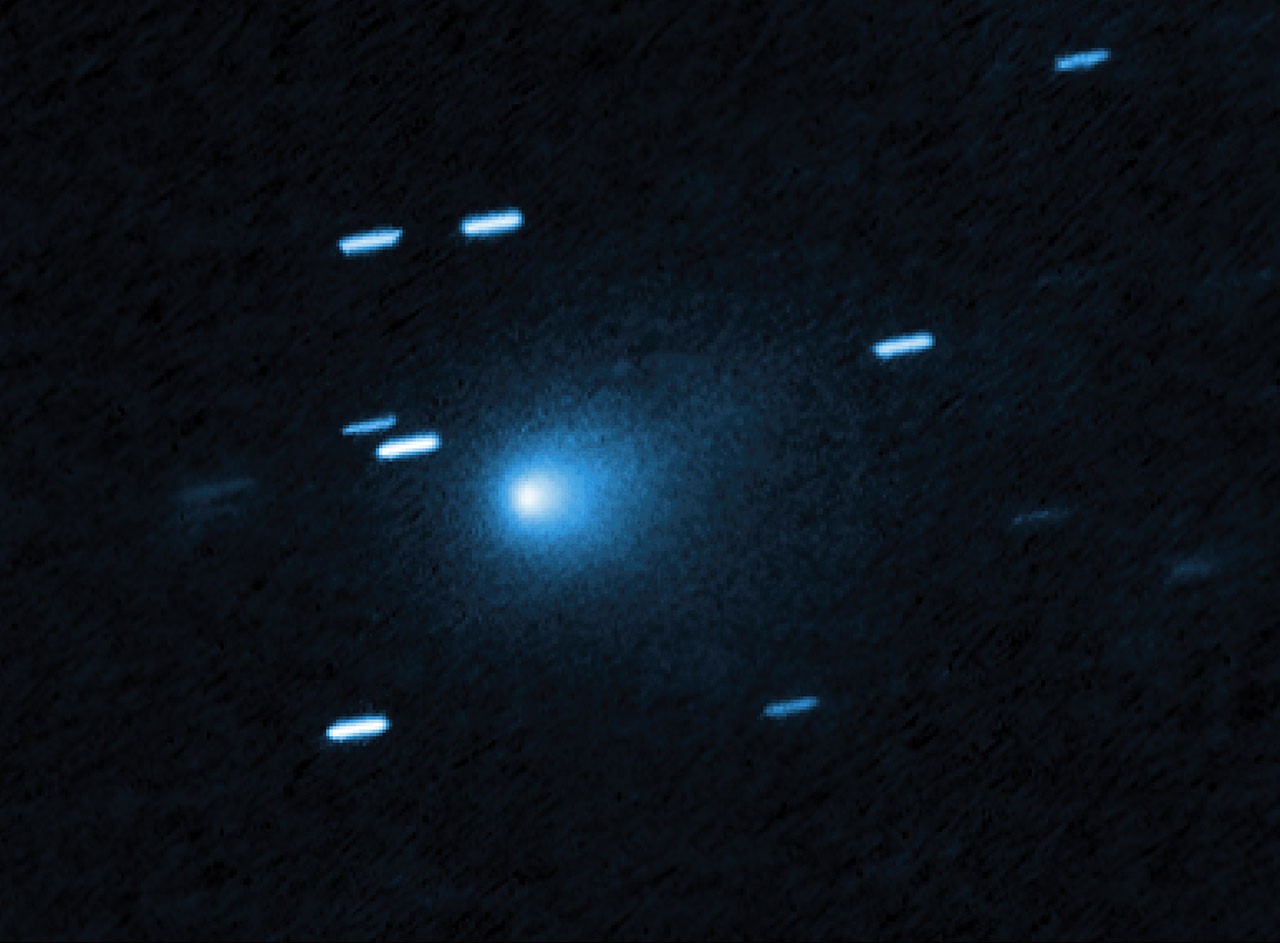
Hubble observed 3I/ATLAS on 21 July 2025, when the comet was about 277 million miles from Earth. In the processed image, a compact bright region sits inside a teardrop-shaped blue haze. Short streaks around it are background stars, stretched because Hubble tracked the moving comet during the exposure.
The blue is an assigned colour used to present the observation. It should not be read as the colour a nearby astronaut would necessarily see. More importantly, the bright centre is not a photograph of the solid nucleus. Hubble saw the surrounding dust cocoon and used its brightness profile to limit how large the hidden body could be.
The NASA image archive describes that geometry clearly. This is a useful case where a less spectacular interpretation is actually the more interesting one: the image records material being lifted from a body made in another planetary system.
Four months of warning changed the science
An interstellar object cannot be made to wait. 3I/ATLAS was never bound to the Sun, and no existing spacecraft was positioned to intercept it. The practical challenge was to use whatever instruments happened to be available before the comet faded on its outbound path.
The early discovery created time for a distributed campaign. Hubble followed its dust. Webb separated infrared signatures from gases in the coma. Spacecraft at Mars viewed it from a different location. Missions built to study the Sun, asteroids, Jupiter and the outer solar system turned their instruments toward it when geometry allowed.
NASA’s observation timeline eventually included more than a dozen missions. No single instrument produced a complete portrait. The value came from combining changing perspectives and wavelengths while the comet moved through different temperatures.
This was less like one perfect portrait and more like reconstructing a traveller from a sequence of brief encounters. Each observer saw the comet at a different distance, phase and level of activity.
The chemistry did not look quite local
By late 2025 and 2026, spectroscopy had taken the story beyond the orbit. Webb observations indicated an unusually carbon-dioxide-rich coma and detected methane directly in an interstellar object for the first time. Isotopic measurements of hydrogen and carbon pointed toward formation in a very cold environment with a chemical history different from that of familiar solar-system comets.
The results deserve care. An isotope ratio is not a birth certificate, and a coma is a changing mixture of nucleus gas, icy grains and sunlight-driven chemistry. The strongest interpretation placed the comet’s formation in material colder than about 30 kelvin and possibly much older than our solar system, but the age depends on models of Galactic chemical evolution.
ScienceBlog has treated those later results separately, including the case for water formed before the Sun and Webb’s methane and isotope measurements. The important connection to the discovery is straightforward. None of that chemistry could have been measured without a survey first noticing a faint moving point in time to organise the follow-up.
The third confirmation, not the third visitor
The “3” in 3I/ATLAS is a count of confirmed detections. It is not a claim that only three interstellar objects have ever passed through the solar system.
Planetary systems are expected to eject enormous quantities of small bodies while planets form and migrate. Most of those bodies drift through the Galaxy without coming close to another star. Some cross our neighbourhood, but they are dark, small and fast. We see them only when a favourable path brings them near enough to the Sun and a survey happens to be looking.
The first detection, ʻOumuamua, was small, inactive and already receding when astronomers recognised its interstellar orbit. The second, Borisov, looked much more obviously cometary. Observations described in an earlier ScienceBlog report found that Borisov was unusually rich in carbon monoxide, one early hint of how much foreign comets could widen the chemical sample.
3I/ATLAS is not simply a repeat. It arrived faster, was detected earlier in its approach and produced its own distinctive combination of dust, water, carbon dioxide, carbon monoxide and methane. With only three objects, it would be reckless to define a typical interstellar comet. The diversity is itself the finding.
Why there was no need for an alien-technology story
Anything arriving from another star invites the word “alien,” and in the geographical sense it is accurate. 3I/ATLAS is material foreign to the solar system. That does not make it a spacecraft.
The observations showed the familiar hallmarks of a natural comet: a dusty coma, volatile gases, increasing activity as sunlight warmed the nucleus, and small non-gravitational changes to its path consistent with uneven outgassing. Its hyperbolic orbit was unusual because of its origin, not because it performed controlled manoeuvres.
Rumours nevertheless spread widely enough that the International Astronomical Union mounted a public-information campaign about 3I/ATLAS in February 2026. Curiosity is healthy, but evidence should decide which explanations deserve weight. On the evidence available, this was an active interstellar comet.
There is no loss of wonder in that conclusion. A naturally ejected comet carries frozen evidence of another system’s planet-building era. It need not have been manufactured to be extraordinary.
A sample without a sample-return mission
We normally learn about other planetary systems from light. A telescope may measure a star wobbling under a planet’s gravity, record the dimming during a transit, or split an atmosphere into a spectrum. 3I/ATLAS brought matter from another system into the reach of instruments designed to study objects close to home.
No probe touched it, and no laboratory received a grain. “Sample” is therefore metaphorical here. Yet the gases and dust in its coma began inside the nucleus. Spectroscopy could compare their molecular and isotopic fingerprints with those of comets formed around our Sun.
That comparison is more valuable than a simple hunt for strangeness. Some similarities tell us which chemical processes may be common in cold protoplanetary disks. Differences reveal how temperature, metallicity, radiation and time change what gets locked into ice.
The quiet power of survey astronomy
There is a pleasing mismatch between the scale of the story and the appearance of the discovery data. A body wandered for an unknown span of time between stars, crossed into the realm of the giant planets, and announced itself as four small marks in survey images.
ATLAS did not know in advance where to look for an interstellar comet. That is precisely why wide surveys matter. They create a record of the sky that can catch rare events without having to predict them individually.
They also make later reconstruction possible. Once astronomers know an object exists, archived images can reveal where it was days or months earlier. A frame that looked uneventful when taken can become a scientifically valuable pre-discovery observation.
The same infrastructure can warn about an asteroid, measure a supernova, notice a comet and preserve evidence of something not yet recognised. Its strength is not a single spectacular instrument. It is patience made systematic.
What remains after 3I/ATLAS leaves
3I/ATLAS passed behind the Sun from Earth’s viewpoint around perihelion, reappeared on the outbound leg, and continued to fade. Solar gravity bent its path but could not capture it. The comet will not loop back in a few centuries. It is leaving.
Its data will stay. Astronomers can continue to refine the nucleus size, dust production, gas abundances and isotopic ratios. They can test whether measurements made at different times describe a changing coma or genuinely different reservoirs inside the object. They can also use the encounter to decide what future surveys should flag and how rapidly telescope time should be mobilised.
Three confirmed objects are too few for confident population statistics. They are enough to show that interstellar visitors are observable, varied and scientifically rich. New surveys with greater sensitivity and cadence should find more, perhaps early enough that a suitably prepared mission could someday do more than watch one pass.
For now, the discovery stands on a beautifully simple chain of work. A planetary-defence telescope photographed the sky. Software and people noticed that one point moved. Observatories measured it again. An orbit showed that it did not belong to the Sun. Then much of the solar system’s scientific machinery turned toward a small comet that would never come this way again.