

A red apple looks self-evidently red. A blue sky seems to occupy the whole space above us. A face appears complete the instant we look at it. Vision does not feel like a selective scientific instrument. It feels like reality arriving without mediation.
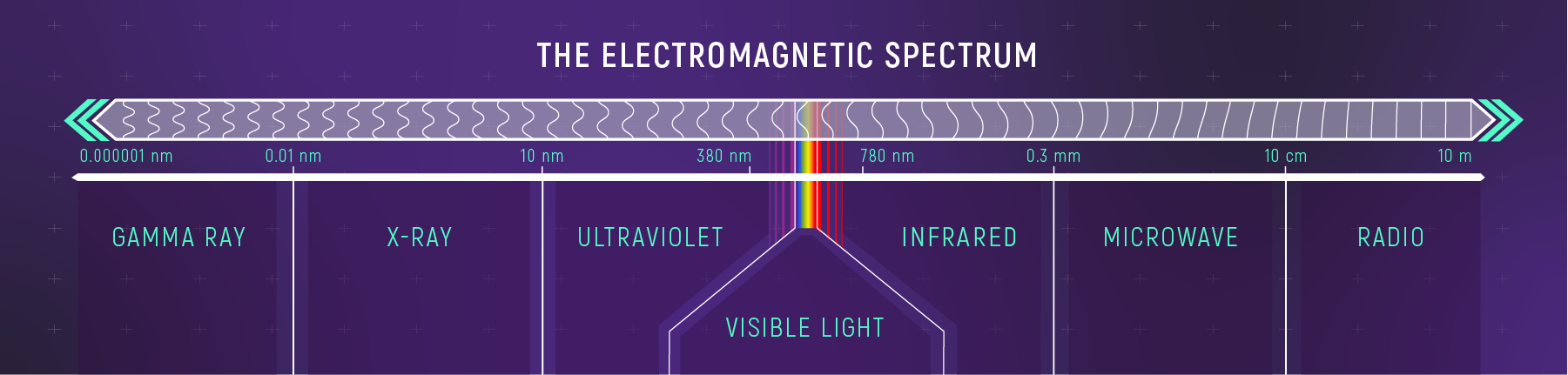
Yet every visible detail is a reconstruction made from a thin interval of electromagnetic radiation. The usual shorthand runs from about 380 nanometres at the violet end to about 700 nanometres at the red end. Everything our eyes call colour fits inside it.
That interval is narrow compared with the range detected by modern instruments, but its borders are not exact. The National Institute of Standards and Technology notes that visible limits depend on the radiant power reaching the retina and on the observer. It places commonly used lower limits between 360 and 400 nanometres and upper limits between 760 and 830 nanometres.
So 380 to 700 nanometres is a useful approximation, not a pair of biological cliffs. The deeper fact is that human sight samples one small window while an enormous electromagnetic world continues on both sides.
The edge of vision is a fading sensitivity, not a wall
At 699 nanometres, radiation does not possess one physical identity and then acquire another at 701. The labels visible and infrared describe how radiation relates to detectors, biological or artificial, as well as convenient regions used by scientists and engineers.
Near either edge, the amount of light matters. A sufficiently intense source at a marginal wavelength may produce a visual sensation where a weak one does not. Dark adaptation, age and differences among observers can shift the practical boundary too.
This is why reputable diagrams disagree without necessarily contradicting one another. Some put visible light at 400–700 nanometres. Others show 380–780. A formal definition may extend farther under unusual conditions. None says that ordinary vision gives equal sensitivity across that entire span.
Human sensitivity is strongest near the middle and declines toward both ends. The very word “visible” therefore bundles wavelength, intensity and physiology into one convenient term.
The distinction also clarifies ScienceBlog’s earlier look at ultraweak light from human bodies. Those bodies emitted photons at visible wavelengths, but far too few arrived together for an eye to perceive a glow. Visible-wavelength light is not automatically visible in practice.
Radio and gamma rays are both forms of light
The divisions of the electromagnetic spectrum can sound like a cabinet of unrelated things: radio, microwave, infrared, visible, ultraviolet, X-ray and gamma radiation. Physically, all are electromagnetic radiation. In quantum language, all consist of photons.
What changes is wavelength, frequency and the energy carried by each photon. Wavelength measures the distance between repeating points in a wave. Frequency counts how many oscillations pass a point each second. Because all electromagnetic radiation travels at the same speed in a vacuum, a longer wavelength means a lower frequency.
Photon energy rises with frequency. Move from radio toward gamma rays and wavelength becomes shorter, frequency becomes higher and individual photons become more energetic. NASA’s electromagnetic-spectrum guide emphasizes that the names describe different energy ranges of the same phenomenon.
The categories have fuzzy borders. Microwaves are often treated as part of radio. The distinction between a very energetic X-ray and a low-energy gamma ray may depend on how the photon was produced. The bands organize instruments and physical processes; they are not separate substances.
The scale is difficult to picture because it spans so many orders of magnitude. Visible wavelengths are measured in billionths of a metre. Radio wavelengths can extend from millimetres through metres and far beyond. Gamma-ray wavelengths can be smaller than an atom.
Why evolution settled on this particular window
The retina contains two broad families of photoreceptors. Rods are highly sensitive and dominate dim-light vision. Three types of cones have overlapping responses to different portions of the spectrum and support daytime colour vision. The brain compares their signals to construct colour; it does not carry a separate sensor for every shade.
Those photoreceptors work inside an environment that made some wavelengths more useful than others. The Sun delivers abundant energy around the visible range. Earth’s atmosphere allows much of that radiation to reach the surface. Water, where early visual systems evolved, also has a transmission window in broadly similar territory.
There are biological compromises. Long infrared wavelengths do not carry enough energy per photon to trigger ordinary visual pigments in the same way, while warm tissue produces thermal noise that would make an infrared retina difficult. At the other end, ultraviolet carries more energy and can damage biological molecules. Some animals do see into the near-ultraviolet, while some snakes sense infrared through heat-sensitive pit organs rather than eyes.
It would still be too neat to say evolution selected exactly 380–700 nanometres for one reason. Vision is inherited history shaped by available pigments, ancestral environments, optics, neural machinery and tradeoffs. The atmospheric and solar windows provide compelling context, not a single proof that every endpoint was inevitable.
Beyond red lies heat, dust and ancient light
Infrared begins just beyond visible red and continues toward microwaves. All familiar-temperature objects emit thermal infrared, including people, buildings and planets. A thermal camera detects part of that radiation and assigns visible colours to measured intensities. The colourful display is a translation, not the infrared itself becoming visible.
In astronomy, infrared can pass through dust that obscures visible light. It reveals cool clouds, forming stars, planetary atmospheres and galaxies whose light has been stretched to longer wavelengths by cosmic expansion. The James Webb Space Telescope was built around this advantage.
Move to still longer wavelengths and the spectrum enters microwave and radio territory. Human technology fills parts of those bands with radar, mobile signals, satellite links and broadcasting. Nature was there first. Cold interstellar gas, magnetic fields, pulsars, lightning and the afterglow of the early universe all produce radio or microwave signals.
A radio telescope is not listening to sound travelling through space. It collects electromagnetic waves. Any sound played through a speaker is another translation, made after the receiver turns the signal into data.
Beyond violet lies radiation energetic enough to alter matter
Ultraviolet begins beyond the violet edge. The Sun is a familiar source. UV photons can drive chemical reactions, contribute to vitamin D production and damage skin and DNA. We do not need to see ultraviolet for it to interact with us.
At shorter wavelengths and higher energies come X-rays. Because tissues absorb them by different amounts, X-ray detectors can reveal bones and internal structures. Cosmic X-rays expose matter heated to millions of degrees, stellar remnants and material falling into compact objects.
Gamma rays occupy the most energetic conventional region. Radioactive nuclear transitions, particle interactions, supernovae and gamma-ray bursts can produce them. Shorter wavelength means greater photon energy, but it does not mean the radiation travels faster. In a vacuum, radio waves and gamma rays both move at the speed of light.
Much ultraviolet and nearly all cosmic X-ray and gamma radiation is absorbed high in Earth’s atmosphere. That shielding is part of what makes the surface habitable. It also means astronomers must lift many detectors above the atmosphere to receive the signals.
Scientific images translate what eyes cannot receive
Earth’s atmosphere creates its own observing bias. NASA explains that visible light and portions of radio pass readily to the surface, while only some infrared and ultraviolet windows get through. X-ray and gamma-ray astronomy largely became possible when detectors could fly on rockets and satellites.
The detector must also match the photon. An antenna responds to radio waves. Semiconductor instruments record X-rays. Webb’s infrared detectors measure wavelengths the retina cannot. Scientists then turn those measurements into graphs, spectra, sounds or pictures that human senses can examine.
For Webb images, the translation is deliberate. NASA’s account of how full-colour composites are made explains that infrared exposures begin as numerical data rendered in shades of grey. Image processors commonly assign the shortest observed infrared wavelength to blue, intermediate wavelengths to green and the longest to red.
That does not make the finished picture fraudulent. It makes the mapping part of the caption. The spatial structures and brightness differences come from measurements, while the displayed colours let an eye compare information it could never receive directly.
As ScienceBlog previously reported when Webb and Hubble viewed the same galaxy cluster, infrared and visible observations can be combined into a broader portrait. Different wavelengths reveal different stars, dust and distances because matter emits, absorbs and scatters them differently.
There is something humbling in this. Human eyes are not poor instruments. Within their working range they provide exquisite spatial detail, rapid adaptation and a stable world assembled from ceaseless change. They simply were not built to inventory the universe.
Science extends vision by catching what biology leaves out, then translating it honestly back into the narrow band where seeing can begin.