

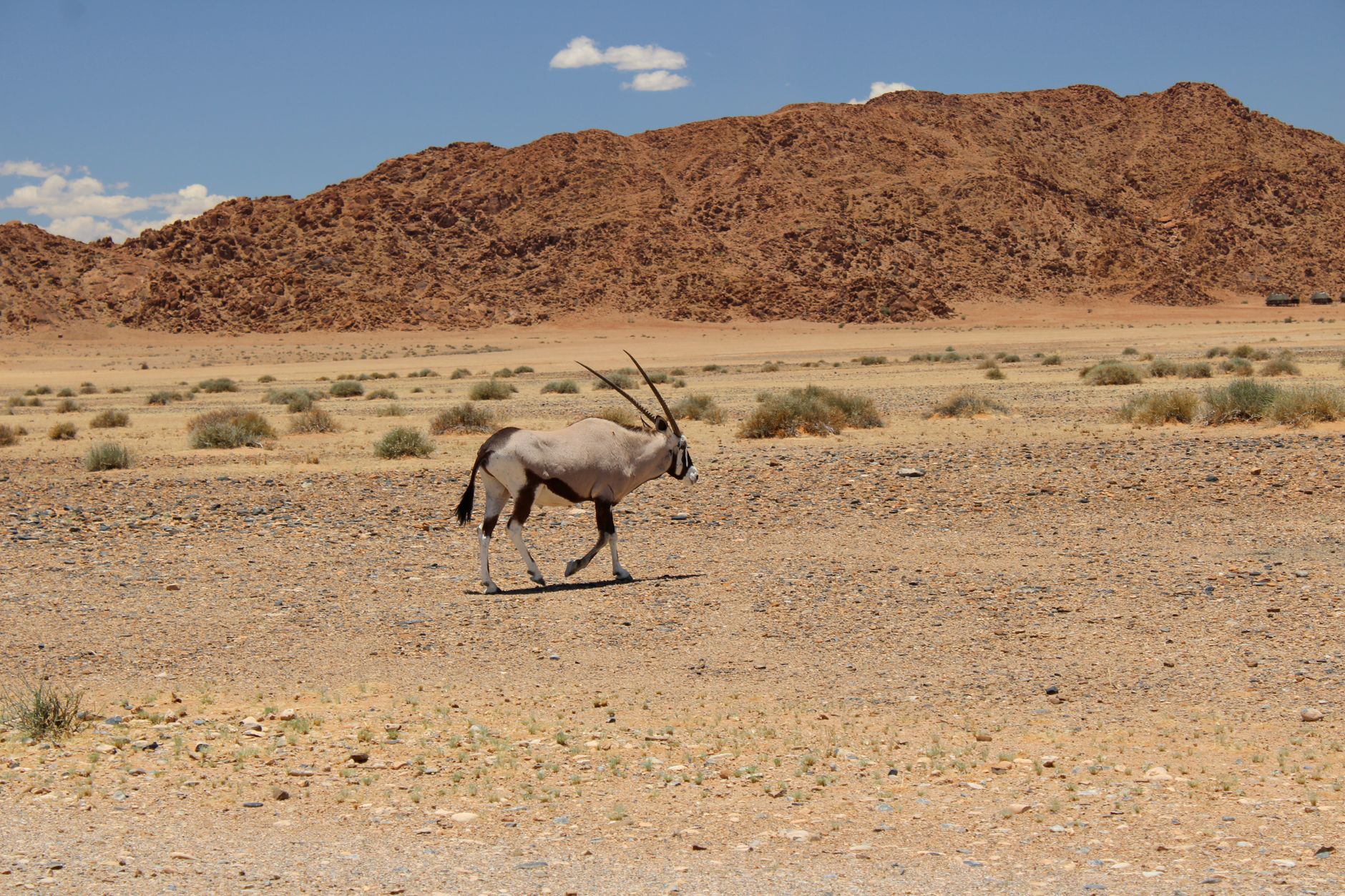
An oryx can leave a human standing in the opening seconds of a chase. But speed was not the contest researchers staged in the Namib Desert. Their 2025 field study of persistence hunting asked whether a human could keep returning in extreme heat until a much faster animal could no longer recover.
Across one successful pursuit, the contrast was stark. Air temperatures ranged from 36 to 41°C and the ground reached as high as 60°C. The instrumented hunter kept his core temperature at about the study’s safe ceiling, reported as no more than 39°C, while the oryx reached a hyperthermic 44°C.
It is a vivid demonstration of a possible human advantage, but not a reenactment of prehistory. The physiology came from one 58-year-old ultrarunner. The hunt took place on a private estate, the prey search began from a vehicle, and four of six pursuits stopped at the property boundary. What the team measured was feasibility under a particular set of conditions.
Six pursuits across three days
The hunters covered 49.5 kilometres on foot over 7.8 hours at the end of the hot dry season. Each pursuit began once an oryx had been found visually and followed on foot. Searching for animals was excluded from the measurements and conducted by vehicle.
Two pursuits succeeded. A healthy oryx was caught after two hours, with the hunters running for only 31 per cent of that time. An injured oryx was caught after one hour of walking, without running at all. In both cases the animals lay down and allowed close approach. The remaining four pursuits were abandoned when the prey left, or was about to leave, the 220-square-kilometre estate.
That success rate is informative, but “two out of six” is not an estimate for persistence hunting everywhere. Boundaries ended pursuits that might otherwise have continued, while one successful target was already disadvantaged. The healthy animal supplies the clearest test of the heat-based idea.
The setting was unusually favourable to the tactic. Sparse cover made tracking easier and gave the animals limited shade. Pursuits took place near peak daytime heat, when each fresh burst of flight added to an already difficult thermal load. In woodland, cooler weather or broken terrain, the balance between hunter and prey could shift sharply.
One human supplied the physiology
Four adult men took part, but all physiological measurements came from one of them. He was a European hunter and ultramarathon runner, aged 58, who arrived in the 1,100-metre-high Namib from sea level and cool late-autumn weather one day before the first pursuit. He had experience in desert ultrarunning and rifle hunting, but not persistence hunting.
Three local men accustomed to the heat accompanied him. None had previous persistence-hunting experience. The study is therefore best read as an instrumented case report nested inside six field pursuits, not a comparison of ordinary humans with oryx or a representative sample of experienced foragers.
The participant’s daily energy expenditure reached about 5,024 kilocalories and measured water turnover was 11.4 litres per day. The researchers estimated that water loss stayed below a critical dehydration threshold. Those numbers do not make the activity safe to imitate. They describe a monitored ultrarunner in a dry environment, supported by a research and hunting team.
The advantage was heat, not pace
Humans are unimpressive sprinters beside many quadrupeds. Our useful trait is that evaporative cooling can continue while we move. A high density of eccrine sweat glands, relatively little body hair and an upright shape expose moist skin to moving air. This system is costly in water, but it can prevent internally generated exercise heat from accumulating as quickly.
An oryx is hardly defenceless against desert heat. Research on free-ranging gemsbok thermoregulation shows how these animals alter activity and use microclimates in arid environments. Other oryx studies document substantial body-temperature variation. Persistence pursuit works by repeatedly denying the prey a long enough pause or refuge to restore heat balance.
The familiar explanation is that many mammals cool largely by panting, while the locomotor and breathing rhythms of galloping are coupled. A fleeing animal generates heat while its best cooling opportunity comes when it stops. A tracking human can arrive after each sprint and force another. The 44°C measurement is consistent with that mechanism, though a single animal cannot establish how all oryx respond.
The evolutionary argument began with anatomy
In a landmark 2004 Nature paper, Dennis Bramble and Daniel Lieberman catalogued traits that make sustained running unusually effective in the genus Homo. These included long legs, elastic tendons, expanded joint surfaces, a stabilising nuchal ligament and a large gluteus maximus, alongside human heat-loss capacity.
They argued that this suite originated roughly 2 million years ago and may have helped shape the human body. Persistence hunting was one proposed payoff, but so was reaching carcasses before competing scavengers. Fossils can reveal anatomy; they cannot record whether an individual ran an antelope to exhaustion.
The hunting interpretation has faced sustained criticism. A 2007 archaeological critique argued that early Homo lived partly in savanna woodland where visibility and tracking were harder, and that ethnographic persistence hunts were uncommon. It also questioned whether early humans possessed the tracking sophistication and hunting technology required to make the tactic routine.
Modern evidence has strengthened feasibility
More recent work has widened the ethnographic record. A 2024 analysis in Nature Human Behaviour assembled nearly 400 ethnographic and historical endurance-pursuit cases across 272 locations. Its authors estimated returns comparable with other premodern hunting methods in suitable contexts.
That study helped revive the case that endurance pursuit was available to ancient foragers, a development previously covered by ScienceBlog’s report on endurance running and human evolution. Yet availability is not frequency. Historical accounts differ in quality, and modern hunters may use technologies, terrain knowledge and cooperation that leave no direct trace in deep time.
Humans should not be declared the planet’s supreme endurance athlete either. An analysis using man-versus-horse races found no simple human takeover as conditions became hotter or distances longer. Horses carried riders, and races are not hunts, but the results warn against turning a context-dependent advantage into a universal ranking.
What the 44°C oryx actually shows
The Namib study closes one important gap. Earlier arguments depended on anatomy, modelling, stories and indirect measurements. Here, researchers measured energy use, water turnover and human core temperature during actual pursuits, then recorded an oryx at a temperature consistent with severe exercise-induced hyperthermia.
The energy calculation was favourable too. Depending on how labour was counted, the successful hunts returned an estimated 1,882 to 3,727 kilocalories per person-hour. That is a potential return from a large carcass, not energy eaten during the chase, and it depends on success, sharing and the work of processing and transporting meat. Even so, it answers one criticism: under the study conditions, the tactic was not automatically an energetic loss.
It also complicates the idea that early hunters needed to run continuously. The healthy-animal pursuit involved running less than one-third of the time, and the injured animal was taken by walking. The authors argue that this makes the tactic conceivable even for hominins without the full endurance-running equipment of modern humans.
Still, one instrumented ultrarunner cannot tell us how early Homo hunted, and one overheated oryx cannot tell us how often the method worked. The two-million-year date belongs to an anatomical hypothesis, not to this field experiment. The measured result is narrower: in punishing heat, a slow human maintained thermal control long enough for a much faster desert ungulate to lose it. That is a genuine endurance advantage, and a plausible glimpse rather than proof of its evolutionary origin.