

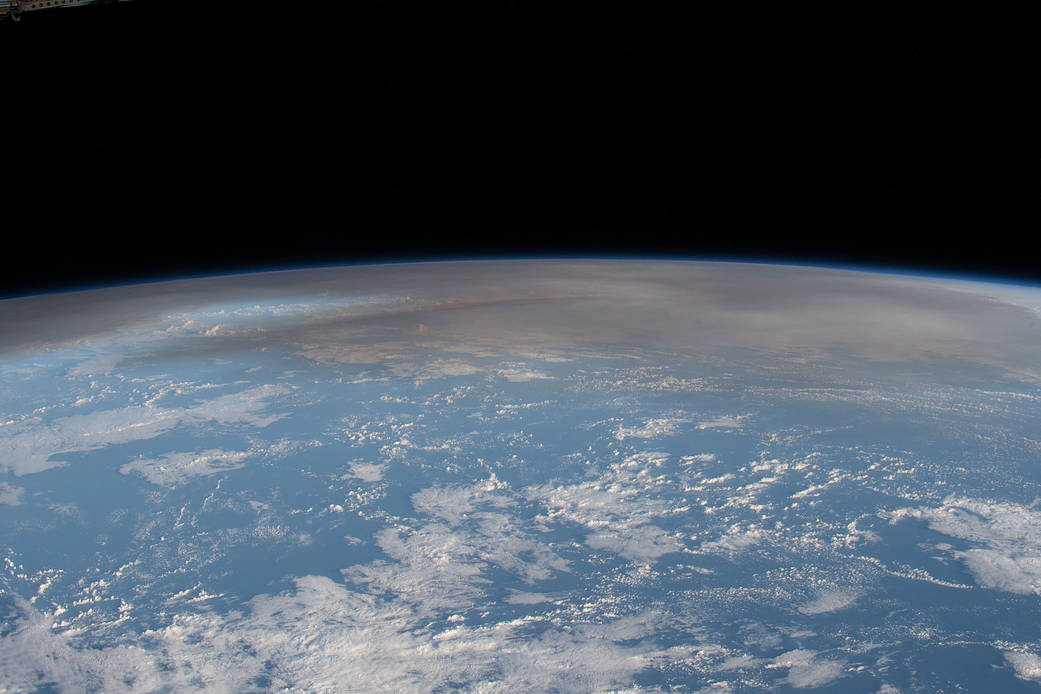
At about 4:10 a.m. UTC on January 15, 2022, a submarine volcano in the South Pacific generated signals that instruments would keep recording for days.
Hunga Tonga-Hunga Ha’apai pushed a pressure wave around the planet, drove a tsunami across ocean basins and lifted part of its eruption column into the mesosphere. A different satellite measurement found a mass of water vapor so large that it was estimated at roughly one-tenth of all the water normally held in the stratosphere.
Three records are often compressed into one description of the eruption. They came from separate instruments and describe different physical quantities. Keeping them separate makes Hunga more interesting, not less.
The underwater source produced an atmospheric blast without precedent in the modern geophysical record. The 57-kilometer figure was the plume’s brief maximum, not the height of the entire cloud. The 10% figure was an estimated addition to the stratospheric water burden, not a permanent increase in the atmosphere as a whole.
A submarine volcano produced an atmospheric record
Hunga’s broad caldera lay beneath the ocean, with only small islands marking parts of its rim. The climactic explosion erupted through seawater and air, so calling it an underwater explosion identifies the setting. The measurement that established its scale came mainly from the atmosphere.
A 2022 analysis in Science combined pressure sensors, infrasound stations, seismometers and satellite observations. The researchers described an atmospheric explosion of a size not previously documented in the modern geophysical record.
Its most conspicuous signal was a Lamb wave, a low-frequency pressure disturbance guided along Earth’s surface. The wave completed four global circuits, with three additional antipodal passages, during six days of observation.
Measured by Lamb-wave amplitude, Hunga was comparable with the 1883 Krakatoa explosion. ScienceBlog’s earlier look at Krakatoa’s planet-circling sound wave shows why that comparison carries weight.
It is not a claim that Hunga displaced more material than every earlier eruption, nor that it exceeded the largest nuclear detonation by every measure. Explosion energy, erupted volume, plume height and pressure-wave amplitude are related but not interchangeable rankings.
Three satellites turned parallax into altitude
Determining the top of a normal volcanic cloud often begins with temperature. A satellite measures infrared radiation, and researchers compare the cloud-top temperature with the atmosphere’s vertical temperature profile to infer height.
Hunga broke that shortcut. Its hottest and most forceful material surged through the troposphere and stratosphere into a region where temperature no longer changes with altitude in the expected direction. A temperature match could point to more than one possible height.
Simon Proud and colleagues instead used the same geometric effect that makes a raised thumb appear to shift when a person alternates between looking with the left and right eye. Japan’s Himawari-8, the United States’ GOES-17 and Korea’s GEO-KOMPSAT-2A viewed the cloud from different longitudes.
The weather satellites were taking images every 10 minutes. By measuring the plume’s apparent displacement against the underlying Earth from those different viewpoints, the team reconstructed its three-dimensional height through time.
The result published in Science placed the highest extent at 57 kilometers. That carried volcanic material through the stratosphere and into the lower mesosphere, the layer generally beginning near 50 kilometers.
Fifty-seven kilometers was a peak, not a ceiling
The number refers to the highest short-lived overshooting parts of the plume. The broad umbrella cloud spread at lower altitudes, and much of the ash, gas, water and ice never reached the mesosphere.
That helps explain why reports use values from about 55 to 58 kilometers. Instruments sampled different moments and components of an eruption column that was moving extraordinarily fast. A value of 57 kilometers is the peer-reviewed parallax result, while nearby figures are not necessarily conflicting measurements.
The previous satellite-era benchmarks were far lower. The same study cited a maximum of about 40 kilometers for Mount Pinatubo in 1991 and 31 kilometers for El Chichón in 1982.
There is an observational catch. Older satellites did not view eruptions as often or from as many useful angles. The authors noted that even Pinatubo’s true maximum may have been underestimated. Hunga holds the observed record, which is not identical to proving that no earlier eruption in human or geological history ever rose higher.
The volcano launched an ocean-sized pulse into dry air
Plume height was only one surprise. NASA’s Aura satellite carries the Microwave Limb Sounder, or MLS, an instrument that detects natural microwave emissions from gases at the edge, or limb, of the atmosphere.
Microwaves allowed MLS to measure water vapor through ash that could blind some infrared sensors. After the eruption, the readings were so far outside the instrument team’s experience that researchers checked the plume measurements individually.
Luis Millán and colleagues estimated that Hunga had injected 146 ± 5 teragrams of water vapor into the stratosphere. A teragram is one trillion grams, so the central estimate equals 146 million metric tons.
Their study in Geophysical Research Letters put that addition at approximately 10% of the stratosphere’s usual water burden. NASA translated the mass into a more visual comparison: enough for more than 58,000 Olympic-size swimming pools.
The denominator matters. This was not a 10% increase in all water in Earth’s atmosphere, most of which resides lower down in the troposphere. It was a roughly 10% pulse into the much drier stratosphere, based on the team’s 2022 estimate.
Nor did the stratosphere remain 10% wetter forever. The injected vapor spread, descended and participated in chemistry over subsequent years. The figure describes the scale of the initial perturbation.
This was not the usual volcanic climate story
Large eruptions are famous for cooling the planet. Sulfur dioxide can form tiny sulfate droplets that reflect sunlight, as happened after Pinatubo. Hunga did not follow that pattern cleanly.
NASA’s early satellite assessment estimated about 0.4 teragrams of sulfur dioxide in the upper atmosphere, far below Pinatubo’s roughly 20 teragrams. Hunga’s defining atmospheric cargo was water instead.
Water vapor absorbs heat, so the initial expectation was a small, temporary warming influence rather than a Pinatubo-like cooling. Extra stratospheric water could also alter ozone chemistry. These effects were scientifically detectable possibilities, not an explanation for the broader rise in global temperature and not a substitute for the much larger influence of human greenhouse-gas emissions.
The plume created chemistry that scientists were still unpacking years later. As ScienceBlog reported in 2026, researchers tracked formaldehyde that indicated chlorine chemistry may have destroyed methane in the water-rich volcanic cloud.
That finding does not make the eruption an atmospheric cleaning service. The same plume changed several gases at once, and the methane effect was a natural experiment produced under exceptional conditions. It shows how a single injection of seawater, ash and volcanic gases can open chemical pathways that ordinary climate models may rarely need to represent.
The ocean depth may have been unusually favorable
The caldera floor before the eruption was about 150 meters below sea level. NASA researchers argued that this placed Hunga in a narrow physical range: shallow enough for large quantities of seawater to reach hot erupting material, but not so deep that ocean pressure smothered the blast.
When seawater meets magma, rapid heating and expansion can fragment the magma and help drive explosive activity. Yet “water met lava” is too simple as a full explanation for an eruption of this scale.
A 2026 reconstruction of the eruption’s trigger proposed a gas-rich magma body, rapid decompression as caldera faults reactivated, and runaway phreatomagmatic interaction as seawater penetrated the system. That is a coupled failure rather than a single steam explosion.
The event also appears to have unfolded as a sequence of forceful pulses. Seismic researchers have described “magma hammer” signals that may reflect abrupt blockage and release in the conduit. How those subsurface pulses connected to the largest atmospheric blast remains an active reconstruction.
One hour became several natural experiments
Hunga arrived in an era when geostationary satellites watched the same region every few minutes, pressure sensors covered the globe, the Comprehensive Nuclear-Test-Ban Treaty Organization operated a worldwide infrasound network, and Aura could distinguish water in a cloud of ash.
No single instrument saw the entire eruption. Together, they followed energy from the ocean surface to the mesosphere and ionosphere, then around the circumference of Earth. Tide gauges also showed that the moving atmospheric disturbance helped force an unusually fast global tsunami.
That is the deeper meaning of “recorded by modern instruments.” Hunga may be compared with Krakatoa, but Krakatoa occurred before satellites, global digital sensors and microwave limb sounding. The modern record is shorter than the history of explosive volcanism.
The headline numbers remain sound when their definitions travel with them. The source volcano was underwater, while the record-setting explosion was measured through the atmosphere. The plume briefly peaked near 57 kilometers. A separate analysis estimated a 146-million-ton water injection, about 10% of the stratospheric burden at the time.
They are not three ways of saying Hunga was simply “big.” They show that it coupled ocean, rock and atmosphere with unusual efficiency, leaving a different signature on every instrument positioned to watch.