

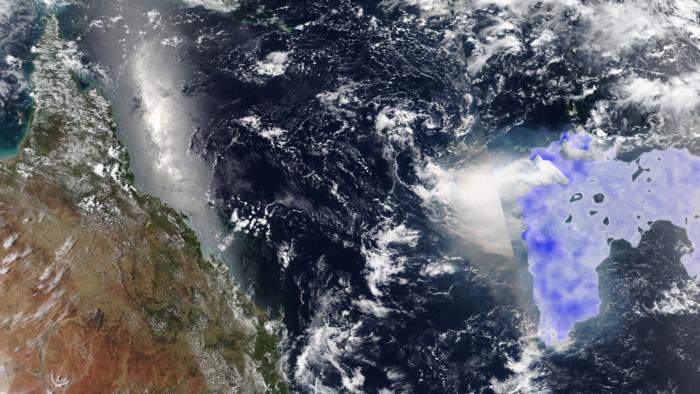
Formaldehyde is not supposed to be in the stratosphere. The molecule survives for a few hours at most before sunlight tears it apart, so finding a cloud of it drifting 30 kilometres above the South Pacific, stretching for thousands of kilometres and persisting for more than a week, was the kind of thing that makes atmospheric chemists stop and read the satellite data twice. The cloud appeared in January 2022, in the wake of the Hunga Tonga-Hunga Ha’apai eruption, one of the most violent volcanic blasts in recorded history. But what the satellite was picking up was not pollution from the eruption itself. It was the signature of something the volcano had done to the pollution it released: it had started destroying it.
The finding, published this week in Nature Communications, suggests that the eruption triggered a previously unknown atmospheric chemistry process in the stratosphere, one that actively broke down methane. The implications stretch well beyond volcanology.
Reading the Plume
Formaldehyde forms when methane is oxidised in the atmosphere. Because it breaks down so quickly, detecting it in large quantities is essentially a real-time signal that methane destruction is happening nearby. When Dr. Maarten van Herpen at Acacia Impact Innovation BV and his colleagues examined data from the European Space Agency’s TROPOMI instrument aboard the Sentinel-5P satellite, they found something nobody had seen before. “When we analysed the satellite images, we were surprised to see a cloud with a record-high concentration of formaldehyde,” van Herpen says. “We were able to track the cloud for 10 days, all the way to South America. Because formaldehyde only exists for a few hours, this showed that the cloud must have been destroying methane continuously for more than a week.”
That continuous destruction is the puzzle. The volcano itself emitted roughly 300 gigagrams of methane during the eruption, equivalent to the annual output of over two million dairy cows. Some of that methane, the new data suggests, was being scrubbed out of the plume at a rate of around 900 megagrams per day.
The proposed mechanism comes from an unexpected direction. Three years before the Tonga eruption, some of the same researchers had identified a curious process playing out over the North Atlantic. Saharan dust blowing westward mixes with sea spray and forms tiny particles called iron salt aerosols. When sunlight hits those particles, it releases chlorine atoms. Chlorine is ferociously reactive with methane, far more so than the hydroxyl radicals that do most of the work in normal atmospheric methane breakdown, and the Saharan dust was quietly accelerating methane destruction over the ocean without anyone having noticed.
The Hunga Tonga blast provided conditions that were, in a perverse sort of way, almost ideal for the same chemistry. The submarine eruption hurled not just ash and gas into the stratosphere but an extraordinary volume of seawater, injecting around 146 teragrams of water vapour into a region of the atmosphere that is normally bone-dry. The salty water and volcanic ash, combined with intense ultraviolet light at altitude, appears to have generated chlorine radicals that then went to work on the methane in the plume. Professor Matthew Johnson from the University of Copenhagen, one of the researchers behind both discoveries, notes that what makes the Tonga result striking is how far outside normal operating conditions the chemistry appears to work: the mechanism known from the ocean surface was apparently active in a stratospheric environment where pressure, temperature, and chemistry are all profoundly different.
Proving a Negative
Detecting that methane has been destroyed, rather than simply noting that it is absent, turns out to be harder than it sounds. This is one reason the formaldehyde signal matters so much. Dr Jos de Laat from the Royal Netherlands Meteorological Institute, senior author of the study, frames the problem plainly: “How do you prove that methane has been removed from the atmosphere? How do you know your method works? It’s very difficult. But here we address that problem by showing that methane breakdown can in fact be observed using satellites.”
Getting those satellite observations right was itself a substantial piece of work. TROPOMI was not designed to peer into stratospheric volcanic plumes. It normally measures formaldehyde in the troposphere, much closer to the ground, where the instrument’s sensitivity profiles are calibrated. The Belgian Institute for Space Aeronomy had to work out how to correct for the unusual altitude of the signal and disentangle the formaldehyde signature from interference caused by high concentrations of sulphur dioxide, which were also abundant in the plume. These were not minor adjustments. Without them, the researchers could not have been confident the formaldehyde enhancement was real rather than an artefact of the unusual conditions.
The numbers that emerged from those corrections are considerable. Peak formaldehyde concentrations in the plume reached 12 parts per billion at 30 kilometres altitude, a stratospheric record. Previous observations had never found more than a tenth of a part per billion of formaldehyde at that height under any conditions, including after major biomass burning events.
The Emergency Brake Analogy
Methane is, on a 20-year timescale, around 80 times as potent a greenhouse gas as carbon dioxide, though it breaks down in the atmosphere over roughly a decade. That relatively short lifetime is both bad news and, potentially, good news. It means the methane in the atmosphere right now was largely emitted in the last ten years; but it also means that cutting methane emissions would have a measurable effect on warming within a decade, much faster than equivalent cuts in CO2. Researchers sometimes call methane reduction an emergency brake on climate change. The trouble is that despite international pledges, atmospheric methane has been rising at its fastest rate in over 40 years, with record annual increases in 2020 and 2021. “It is known that volcanoes emit methane during eruptions, but until now it was not known that volcanic ash is also capable of partially cleaning up this pollution,” van Herpen says.
The discovery feeds into a small but growing field of research into whether methane removal could be deliberately engineered. Various proposals are circulating, most involving some variant of releasing iron-based particles or other chemical precursors into the atmosphere to catalyse chlorine production and accelerate methane breakdown. The Tonga eruption, in a sense, ran something like a large, uncontrolled pilot experiment. What the new paper adds is a methodology for measuring whether the experiment worked, something the field has lacked. A key concern for any proposed methane removal intervention is verification: you need to know whether the intervention actually did anything, and how much. The satellite-formaldehyde approach offers at least a preliminary answer to that problem, and one that works over the oceans, where methane monitoring via satellite is otherwise limited because seawater reflects too little light for conventional techniques.
The discovery also means the global methane budget needs revision. Atmospheric dust, whether from deserts or volcanic eruptions, appears to be removing methane at rates not previously captured in the models used to calculate how much methane is being emitted versus destroyed. The error may be modest, or it may not be. Quantifying it is now a priority. Johnson has suggested that industry might one day try to replicate the volcanic phenomenon deliberately, though not without first establishing that any such intervention is safe and effective. Whether or not that happens, the Tonga eruption has left behind something more enduring than the ash cloud: a plausible, satellite-verified pathway for watching methane disappear from the sky.
https://doi.org/10.1038/s41467-026-72191-4
Frequently Asked Questions
Could we deliberately recreate what the Tonga volcano did to remove methane from the atmosphere?
The idea is actively being studied. The Tonga eruption appears to have triggered chlorine-mediated methane destruction by combining iron-rich volcanic ash with seawater and intense sunlight, essentially running a version of the same process previously observed when Saharan dust mixes with sea spray over the North Atlantic. Several research groups are exploring whether iron-based particles could be released into the atmosphere to replicate this effect at scale. The new research matters here because it provides a satellite-based method to actually verify whether such an intervention removes methane, which has been a missing piece in evaluating whether these approaches could work.
Why is methane such a priority if carbon dioxide causes more total warming?
Methane is roughly 80 times more potent than CO2 over a 20-year period, but it breaks down in the atmosphere over about a decade rather than persisting for centuries. This means that reducing methane emissions now produces measurable cooling within years, not generations, making it one of the fastest levers available for slowing near-term warming. The catch is that atmospheric methane has been rising at its fastest rate in over 40 years, and natural sources are increasing as the planet warms, which is why some researchers are looking beyond emissions cuts to active removal.
How does formaldehyde prove that methane is being destroyed?
Formaldehyde is an intermediate step in methane’s breakdown: when a chlorine or hydroxyl radical attacks a methane molecule, formaldehyde forms briefly before breaking down further into carbon monoxide. Because formaldehyde survives only a few hours before sunlight destroys it, finding high concentrations of it somewhere in the atmosphere is essentially a real-time tracer for active methane destruction happening nearby. The Tonga plume contained record stratospheric concentrations, up to 12 parts per billion at 30 kilometres altitude, and the signal persisted for at least ten days, confirming that methane was being continuously oxidised rather than simply dispersed.
Is this the same eruption that caused a global pressure wave and disrupted communications?
Yes. The January 2022 Hunga Tonga-Hunga Ha’apai eruption was one of the most powerful volcanic events in recorded history, generating atmospheric pressure waves that circled the globe multiple times and producing a tsunami that affected coastlines across the Pacific. What made it chemically unusual was the amount of seawater it injected into the stratosphere: around 146 teragrams of water vapour, roughly ten percent of the total stratospheric water burden. That extraordinary water injection, combined with volcanic ash containing iron compounds, appears to have set up the conditions for the methane-destroying chemistry the new study documents.